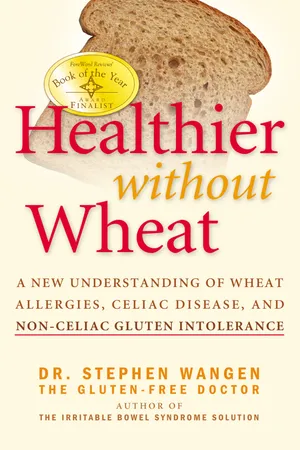
Healthier Without Wheat is the leading resource for understanding, diagnosing, and living with reactions to wheat and gluten. Critically acclaimed by Library Journal, and a 2010 Book of the Year Finalist for ForeWord Magazine, Healthier Without Wheat makes sense of a complex issue and explains why millions of people feel better when they avoid gluten. Dr. Wangen, a gluten intolerant physician, has an easy-to-understand writing style and uses patient stories with scientific facts to clearly explain how gluten intolerance causes numerous maladies and is often difficult to recognize. Most importantly, this book substantiates the much larger world of non-celiac gluten intolerance.
- 285 pages
- English
- ePUB (mobile friendly)
- Available on iOS & Android
eBook - ePub
Healthier Without Wheat
About this book
Information
Subtopic
Diseases & AllergiesPart I: Wheat and the Problems It Can Cause
CHAPTER 1: The Whole of Wheat
Our remedies oft in ourselves do lie.
—William Shakespeare (1564–1616), All’s Well That Ends Well
In a broad sense this is really a story about our assumptions regarding food. We love it. We hate it. We crave it. But do we really understand what we’re eating? Almost all of our thoughts about food focus on either satisfying our taste buds or evaluating what it will do to our waistlines. Most people don’t consider the most fundamental issue: Did nature ever intend for us to eat what we eat?
Challenging the Health Assumption
Whether or not we are really designed to eat wheat is an incredibly important question. Humans, like all living organisms, are the product of millions of years of evolution. We have been molded by nature to function in a very specific way and when we veer from this design, we suffer consequences. In this way we are not so unlike a car. If you put diesel into a gasoline engine, you wreck the engine. Or consider your favorite zoo animals. Zookeepers try to feed them the same kinds of foods they’ve been eating for millennia, because they know that the wrong food would make them sick.
However, we humans have a belief that somehow we can overcome or improve upon nature. We eat what we want to eat, or what we are told is good for us, without truly understanding how food and its components affect our bodies.
We make a lot of assumptions about our food. Perhaps the largest is that the major agricultural products in our country are healthy for humans. They may taste good and they may be full of nutrients, but just because something tastes good and contains nutrients doesn’t necessarily mean that it is nutritious, or nutritious for everyone.
This may sound almost too ridiculous to believe. But as we examine the history of food and the history of humans, you may be surprised to learn that most of what we eat today isn’t what humans have eaten throughout most of history. You may also be surprised to learn that what makes up our diet has more to do with economics than with health.
Wheat is part of nearly every meal in America. And most people eat it without a second thought. Yet millions potentially damage their health at nearly every meal without even realizing it. It may be difficult to believe, but it is happening right now and happens every day in numerous households throughout the country. Crazy nonsense, you say? Impossible! How can this be happening?
Food is defined as something that nourishes or sustains us. But what we think of as food, even healthy organic food, isn’t necessarily healthy for everyone. We make many assumptions about the health value of the foods that our culture places before us. These assumptions are often surprisingly illogical and are not always supported by sound scientific thought or good medicine. Yet due to a variety of forces, we don’t even think to ask the very simplest of questions: “Was I really meant to eat wheat?”
This is a very important question, and the primary question that this book aims to answer. However, in order to address this issue we must challenge conventional thinking. We must consider that something we see every day, something that numerous well-respected and highly educated authorities have told us is very good for us, may not, in fact, be good for a very large number of people.
In order to do this, we have to look at food very differently, and evaluate it for more than just its nutritional content. To help you understand what I mean, consider the well-known parable of the blind men and the elephant from the Buddhist canon:
It was six men of Indostan
To learning much inclined,
Who went to see the Elephant
(Though all of them were blind),
That each by observation,
Might satisfy his mind.
The First approached the Elephant,
And, happening to fall
Against his broad and sturdy side,
At once began to bawl:
“God bless me! But the Elephant,
Is very like a wall!”
The Second, feeling of the tusk,
Cried: “Ho! What have we here
So very round and smooth and sharp?
To me ’t is mighty clear;
This wonder of an Elephant,
Is very like a spear!”
The Third approached the animal,
And happening to take
The squirming trunk within his hands,
Thus boldly up and spake:
“I see,” quoth he, “the Elephant
Is very like a snake!"
The Fourth reached out his eager hand,
And felt about the knee.
“What most this wondrous beast is like
Is mighty plain,” quoth he;
“’T is clear enough the Elephant
Is very like a tree!"
The Fifth, who chanced to touch the ear,
Said; “E'en the blindest man
Can tell what this resembles most;
Deny the fact who can,
This marvel of an Elephant,
Is very like a fan!”
The Sixth no sooner had begun
About the beast to grope,
Than, seizing on the swinging tail
That fell within his scope,
“I see,” quoth he, “the Elephant
Is very like a rope!”
And so these men of Indostan
Disputed loud and long,
Each in his own opinion
Exceeding stiff and strong,
Though each was partly in the right,
And all were in the wrong!
So oft in theologic wars,
The disputants, I ween,
Rail on in utter ignorance
Of what each other mean,
And prate about an Elephant,
Not one of them has seen!
John Godfrey Saxe (1816–1887)
When we look at an issue from only one side, we do not get the whole picture. In our culture, we see wheat as a dietary staple. But for many people we might question whether or not wheat should even be called a food. In some circles a statement like this would be considered not only very strange, but almost unpatriotic. Apparently, this simple grass ...
Table of contents
- eBook Cover
- Title Page
- Disclaimers
- Dedication
- Acknowledgements
- INTRODUCTION
- Part I: Wheat and the Problems It Can Cause
- Part II: Celiac Disease
- Part III: Non-Celiac Gluten Intolerance and Wheat Allergies
- Part IV: Testing Summary for All Forms of Gluten Intolerance and Wheat Allergies
- Part V: Treating Gluten Intolerance
- APPENDICES
- GLOSSARY
- BIBLIOGRAPHY
- About the Author
- Footnotes
Trusted by 375,005 students
Access to over 1.5 million titles for a fair monthly price.
Study more efficiently using our study tools.
Frequently asked questions
Yes, you can cancel anytime from the Subscription tab in your account settings on the Perlego website. Your subscription will stay active until the end of your current billing period. Learn how to cancel your subscription
No, books cannot be downloaded as external files, such as PDFs, for use outside of Perlego. However, you can download books within the Perlego app for offline reading on mobile or tablet. Learn how to download books offline
Perlego offers two plans: Essential and Complete
- Essential is ideal for learners and professionals who enjoy exploring a wide range of subjects. Access the Essential Library with 800,000+ trusted titles and best-sellers across business, personal growth, and the humanities. Includes unlimited reading time and Standard Read Aloud voice.
- Complete: Perfect for advanced learners and researchers needing full, unrestricted access. Unlock 1.5M+ books across hundreds of subjects, including academic and specialized titles. The Complete Plan also includes advanced features like Premium Read Aloud and Research Assistant.
We are an online textbook subscription service, where you can get access to an entire online library for less than the price of a single book per month. With over 1.5 million books across 990+ topics, we’ve got you covered! Learn about our mission
Look out for the read-aloud symbol on your next book to see if you can listen to it. The read-aloud tool reads text aloud for you, highlighting the text as it is being read. You can pause it, speed it up and slow it down. Learn more about Read Aloud
Yes! You can use the Perlego app on both iOS and Android devices to read anytime, anywhere — even offline. Perfect for commutes or when you’re on the go.
Please note we cannot support devices running on iOS 13 and Android 7 or earlier. Learn more about using the app
Please note we cannot support devices running on iOS 13 and Android 7 or earlier. Learn more about using the app
Yes, you can access Healthier Without Wheat by Stephen MDiv Wangen in PDF and/or ePUB format, as well as other popular books in Medicine & Diseases & Allergies. We have over 1.5 million books available in our catalogue for you to explore.