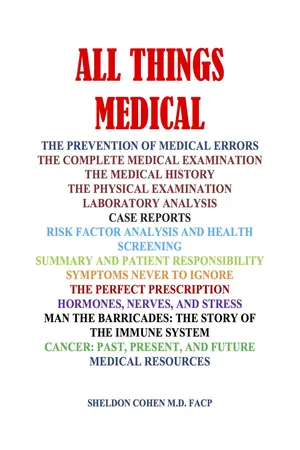
The author has taken his previously published medical ebooks and incorporated them into a single book: ALL THINGS MEDICAL, which includes the following topics:* The Prevention of Medical Errors
* The Complete Medical Examination including The Medical History, Physical Examination and Laboratory Data
* Case Reports
* Risk Factor Analysis and Health Screening
* Summary and Patient Responsibility
* Symptoms Never to Ignore
* The Perfect Prescription
* Hormones, Nerves, and Stress
* Man the Barricades: the Story of the Immune System
* Cancer: Past, Present, and Future
Medical ResourcesThis book is for patients and students of the health professions, with the hope that they will be better prepared to handle the rapid changes and challenges affecting health care as it transitions into the future.
- 324 pages
- English
- ePUB (mobile friendly)
- Available on iOS & Android
eBook - ePub
All Things Medical
About this book
Information
Subtopic
Clinical MedicinePART 1
THE PREVENTION OF MEDICAL ERRORS
“Es Irrt Der Mensch, So Lang Er Strebt”
(As long as human beings strive, they will make errors)
Johann Wolfgang von Goethe
(1749-1832)
Introduction
A medical error has occurred anytime a healthcare provider plans a medical action and it does not succeed as intended, or the wrong plan is used. These errors can include problems in medical practice, failure to diagnose, procedural problems, system failures, or product deficiencies.
Ninety-eight thousand people per year die from medical errors, a number that represents more deaths than occur from automobile accidents or breast cancer. This statistic, published by the Institute of Medicine in 1999, has prompted efforts by the Joint Commission on Accreditation of Healthcare Organizations to focus the accreditation process on operational systems critical to the safety and quality of patient care.
What is the Institute of Medicine? Who are its members? Are they a governmental organization? What is the funding source?
The federal government created the National Academy of Sciences to serve as an advisor on scientific matters. However, the Academy and its associated organization (e.g. the Institute of Medicine) is a private, non-governmental organization that does not receive direct federal appropriations for their work. The Institute of Medicine’s charter establishes it as an independent body. They use unpaid volunteer experts who author their reports, each of which undergoes a rigorous and formal peer review process that must be evidence-based where possible, or noted as an expert opinion where not possible. Many meetings of the Institute of Medicine are open to the public, or the committee may deliberate amongst themselves until they reach consensus. Any potential conflict of interest could disqualify a committee member.
One cannot dispute this committee’s findings—the best minds are at work. In addition, the Joint Commission considered it serious as well, for they have launched a nationwide effort to minimize medical errors in healthcare organizations.
Let us define what medical errors are. The Joint Commission has categorized a long list of hospital errors that have resulted in death or injury, the so-called sentinel events. This is necessary so that the Joint Commission can investigate and make sure that hospitals have put systems in place to prevent the error from reoccurring. These sentinel events are:
•Anesthesia related: death or injury may result from anesthesia.
•Delay in treatment: failure to diagnose in time, treatment delays resulting in disability or death and wrong diagnoses are all medical errors. An incomplete medical examination is often the reason.
•Elopement: serious injury or death could result when patients leaves facilities of their own accord before diagnosis.
•Infection-related: lapses in sterile technique may result in an infection.
•Maternal deaths: obstetrical deliveries may result in injury or death.
•Medical equipment: medical equipment failures may result in disability or death.
•Medication error: physician, pharmacist, or patient error may result in injury or death due to improper or wrong medication use.
•Operative/post-operative: complications may result from surgical or post surgical care.
•Patient abduction: infant abduction from newborn nurseries have occurred.
•Patient falls: the failure to identify the fall-risk patient, and/or the failure to safeguard the patient may have serious consequences.
•Perinatal deaths/injury:injuries or death may occur around the time of birth.
•Potassium Chloride: the accidental direct intravenous injection of potassium chloride can result in cardiac arrest.
•Restraint deaths: restraints are a last resort to protect patients from themselves and staff from patients. Restraint use is only for the shortest time necessary and includes frequent monitoring. Failure to monitor these patients may result in medical complications or death.
•Suicide: guidelines must be in place to identify and monitor the suicidal patient.
•Transfusion: an improper matching of a blood transfusion can cause injury or death.
•Ventilator: mechanical ventilation is often necessary to breathe for patients who are unable to breathe for themselves. Improper ventilator settings, machine failure and incomplete monitoring may result in death.
•Wrong site surgery: wrong-site surgery can result from failure to identify the precise surgical site.
•Wrong test performed: improper orders or failure of interpretation of orders will result in the wrong test.
Medical errors do not only happen within hospitals. They can occur in any healthcare facility including outpatient surgery centers, clinics, doctors’ offices, nursing homes, pharmacies and patient’s homes. In fact, home care fires are another sentinel event claiming victims over age sixty-five in most instances. Risk factors identified are:
1)Living alone
2)Absence of a working smoke detector
3)Flammable clothing
4)Home oxygen
5)Cognitive impairment
6)Smoking has been a factor in all cases reported
An incomplete medical history and physical examination will result in failure to diagnose. The same is true of an incomplete screening laboratory analysis and risk factor analysis. This is a crucial part of any physician-patient interaction from the diagnostic standpoint, and there is nothing more important for creating rapport and a lasting, trusted relationship between the physician and the patient.
When a medical error has occurred there has been a breakdown of one or more of the built-in safety measures put in place to prevent such mishaps. These safety measures are the responsibility of the entire healthcare team. Physicians must get involved by making certain that patients are educated and made to take responsibility for their care. Patients must understand that they are not a passive member of the team. They are the most important member. They must feel free to ask questions and satisfy themselves that the medical diagnostic and treatment option they choose is the best one taken for an optimal result.
There are basic steps any patient must take when confronted with a new diagnosis that has long-term future impact. These are:
•Learn all that is possible about the problem or problems.
•Speak with the physician;
•Get information from the internet or books;
•Look to support groups for assistance.
Only then will patients be in a position to decide upon a treatment plan. Physicians want their patients to do this. Careful evaluation of all the risks and benefits will produce a satisfied patient who will adhere to a well-planned proper course of action.
Medical errors are:
•Medication prescribing and use
•Medication use during care transitions
•Patient identification
•Performance of correct procedure at correct body site
•Communication during patient handovers
•Control of concentrated electrolyte solutions
•Catheter and tubing connections
•Infection control
•Diagnostic errors or failure to diagnose
Patients can and must assist in prevention. This book will provide clinical examples that illustrate the error discussed.
Medication prescribing and use
When a physician writes a prescription, it must be legible. If it is not, the pharmacist may have difficulty. If a patient cannot read the prescription, rewriting it is mandatory, or, at least, spelled out in writing. Sound-alike medications with similar spelling have been confused, so p...
Table of contents
- eBook Cover
- Title Page
- PART 1: THE PREVENTION OF MEDICAL ERRORS
- PART 2
- PART 3: CASE REPORTS
- PART 4: RISK FACTOR ANALYSIS AND HEALTH SCREENING
- PART 5: SUMMARY & PATIENT RESPONSIBILITY
- PART 6: SYMPTOMS NEVER TO IGNORE
- PART 7: THE PERFECT PRESCRIPTION
- PART 8: HORMONES, NERVES, AND STRESS
- PART 9: MAN THE BARRICADES: THE STORY OF THE IMMUNE SYSTEM
- PART 10: CANCER: PAST, PRESENT, AND FUTURE
- PART 11: MEDICAL RESOURCES
Trusted by 375,005 students
Access to over 1.5 million titles for a fair monthly price.
Study more efficiently using our study tools.
Frequently asked questions
Yes, you can cancel anytime from the Subscription tab in your account settings on the Perlego website. Your subscription will stay active until the end of your current billing period. Learn how to cancel your subscription
No, books cannot be downloaded as external files, such as PDFs, for use outside of Perlego. However, you can download books within the Perlego app for offline reading on mobile or tablet. Learn how to download books offline
Perlego offers two plans: Essential and Complete
- Essential is ideal for learners and professionals who enjoy exploring a wide range of subjects. Access the Essential Library with 800,000+ trusted titles and best-sellers across business, personal growth, and the humanities. Includes unlimited reading time and Standard Read Aloud voice.
- Complete: Perfect for advanced learners and researchers needing full, unrestricted access. Unlock 1.5M+ books across hundreds of subjects, including academic and specialized titles. The Complete Plan also includes advanced features like Premium Read Aloud and Research Assistant.
We are an online textbook subscription service, where you can get access to an entire online library for less than the price of a single book per month. With over 1.5 million books across 990+ topics, we’ve got you covered! Learn about our mission
Look out for the read-aloud symbol on your next book to see if you can listen to it. The read-aloud tool reads text aloud for you, highlighting the text as it is being read. You can pause it, speed it up and slow it down. Learn more about Read Aloud
Yes! You can use the Perlego app on both iOS and Android devices to read anytime, anywhere — even offline. Perfect for commutes or when you’re on the go.
Please note we cannot support devices running on iOS 13 and Android 7 or earlier. Learn more about using the app
Please note we cannot support devices running on iOS 13 and Android 7 or earlier. Learn more about using the app
Yes, you can access All Things Medical by Sheldon Cohen in PDF and/or ePUB format, as well as other popular books in Medicine & Clinical Medicine. We have over 1.5 million books available in our catalogue for you to explore.