In 114 pages 'Dealing with Dengue' covers every aspect of Dengue Fever. Here are the chapter titles:
1. What not to Do...
2. What is Dengue?
3. Diagnosing Dengue
5.Folk Remedies
6. Children & Dengue
7. Pregnancy & Dengue
8. Severe Dengue
9. Painkillers & Your Liver
10. Recovery & TCM
11. Doctors & Drugs
12. Immunity
13. Lab Tests
14. Somebody Stop Me!
15. Call Me Aedes
16. 99% Prevention
17. Insecticides & Repellents
18. Traps, Nets, Coils & More
19. Case Studies
20. Transmission
21. Vaccines, Bacteria & GMOs
22. Regular Mosquito Bites
23. Your Community
24. Blogs, Links, Downloads
25. Myths & Rumors
26. Videos
27. Dengue for MDsSee what I mean? It's everything you need to know about Dengue.
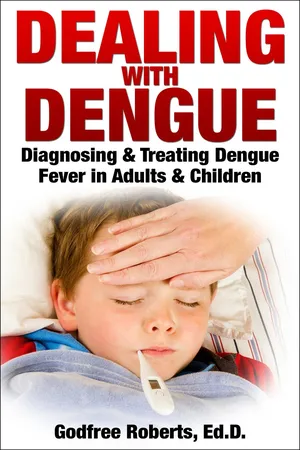
eBook - ePub
Dealing with Dengue: Diagnosing, Treating, and Recovering from Dengue Fever
- 114 pages
- English
- ePUB (mobile friendly)
- Available on iOS & Android
eBook - ePub
Dealing with Dengue: Diagnosing, Treating, and Recovering from Dengue Fever
About this book
Information
Subtopic
Diseases & Allergies1. WHAT NOT TO DO...
By Jodi Ettenberg
I have tried to avoid writing about myself other than in the abstract. I love sharing what I eat and learn, and the stories of food and people involve me in some way as it is a personal blog. But I don't want my blog to be a place where I whine or rant. I want it to be a place where people can learn through food.
So when I started losing clumps of hair in February last year I neither wrote about it nor shared updates on my Facebook page. A month later, when I stopped being able to bend my hands or knees without pain or look at bright light, I didn't mention that either. I kept up my usual schedule in Vietnam, exploring the Mekong and surrounding regions and walking around town for hours a day.
In May, after flying to England to visit my brother, I could barely walk down the street without feeling exhausted. Alarmingly, when my leg or arm was itchy and I scratched it I'd develop lines of bruises, coloring the spot where nails met skin. As the summer went on and my existing obligations and plans were ticked off the list -- conferences, meetups, interviews and more -- I found myself getting more tired and sick. My immune system was not cooperating with anything I did; every cold or virus seemed to latch onto me stubbornly and most of my days were obfuscated by a cloud of exhaustion.
Doctors were fairly unhelpful. One suggested that I was just stressed. As a former corporate lawyer I was pretty intimate with high stress situations, and I certainly was not stressed – except about the fact that my health was deteriorating. Which was, I think, pretty reasonable on the spectrum of Events to Stress About. In actuality, the pain and hair loss had started at a time when I was the least stressed in decades; I was in Vietnam, loving my exploration of the city and its soups. Another doctor thought I had lupus and, to be fair, many of the symptoms lined up, but blood tests gave no indication of lupus. So back to square one.
I confided in my close friends who stretched their arms wide to pull in connections from their broader networks in hope of helping me figure out what was wrong. I was introduced to, and corresponded with, a woman whose many symptoms led her to cut a number of significant foods from her diet and completely change the way she lives her life in an attempt to keep her pain under control. I met a gentleman at a conference who had similar health issues while trying to grow a startup, leading him to temporarily walk away from his company while he focused on getting better, a terribly tough decision to make. And I was given a book recommendation that calmed my brain down considerably, Full Catastrophe Living, written for those dealing with the stress and exhaustion of chronic pain and fortuitously updated days before it was suggested to me.
By October, when I was heading to India with my mother, I felt like I was hanging on by a thread. I sat in a pile of clothes packing, in tears. I was happy to be taking her to a country she wanted to see but feeling like I might just stop functioning somewhere between Jaipur and Agra and fall into a deep, long sleep.
We did have a terrific time in India, exploring the chaos and color of Rajasthan in a few too-short weeks. But I did still get sick again and again, and much of the trip is cloudy with pain, too. By the time I flew home to Canada, the airline stewardesses took one look at me as we boarded the plane and then cleared out the back row and insisted I sleep. I was tired and confused and tired of being tired and confused.
Then I figured it out.
I kept going back to February when it all began. Earlier in the month I was supposed to go to the Mekong, but I woke up feeling so sick and tired that I couldn't budge. I had a splitting headache and it felt like someone was pressing on my eyeballs; nothing relieved the pain. I thought I had a bad flu and I postponed my visit. My "flu" cleared up a few days later for the most part, though the headache took longer to go away. A few days later, when I was visiting Vung Tau with my friends, I developed a strange rash all over my stomach. It wasn't itchy -- it was just flat red dots that appeared in constellations all over my torso and around my belly button. I remember my friends all staring at my stomach one morning, confused as to what was causing it. We went with heat rash, and quickly forgot it. A few days later it was gone.
What could have caused the rash and my flu-like symptoms and then all the tiredness, joint issues and pain?
Dengue.
Interestingly, that's exactly whymy friends were in Vietnam -- they had gotten Dengue in Bangkok and were in recovery on their visa run. I Googled "Dengue rash stomach" and saw exactly what was on my stomach in Vung Tau. Then I looked into what happens when you don't take care of yourself when you have Dengue. (Those who have experience with it will know that the disease is not really treated per se; treatment involves hospital visits, hydration, rest and monitoring white blood cells and platelets, both of which are dangerously low when in the grasp of the Dengue virus).
I learned that, when you ignore it as I did, it wreaks havoc on your immune system, your joints, and on your general state of being. I went to a tropical diseases doctor and presented my case, and he confirmed that a Dengue infection is almost certainly what I'd contracted, especially given a February infection and my subsequent blood test results, which showed a lower-than-normal white blood cell and platelet count.
There's little to do at this point other than listen to what my body tells me, resting more, staying out late less, keeping the long haul flights to a minimum. (The time zone changes and effects on your body's adrenal system were, my doctor said, particularly problematic for long hauls.) And, you know, avoiding mosquitoes to the extent possible. Damn you, mosquitos!
So, after many months of saying nothing I'm writing to reiterate what not to do when you get Dengue. Or, put another way, when in Dengue-prone areas and having symptoms of the flu, if you see a rash on your person GET THEE TO A DOCTOR. I wish I had gone to check it out and could have then taken care of myself properly.– Jodi blogs charmingly at Legal Nomads.
2. WHAT IS DENGUE?
On an average, between 14.8 and 18.9 days are lost as the patient is incapacitated or a family member needs to stay at home to care for
Dengue-infected children or relatives. – Red Cross Report, 2014
Dengue is a Spanish word meaning 'well-dressed, or 'a dandy'. We use it to label the disease but no one is quite sure why. The most popular explanation is that when Spanish slaves in the West Indies contracted Dengue they were described as having the posture and gait of a dandy, and the disease was known for a while as "dandy fever".
Dengue, or Dengue fever, is caused by a virus carried by the female Aedes aegypti mosquito. She feeds on your blood in the early morning and late afternoon and breeds indoors in cool, dark corners.
Half of all Dengue-infected people have mild symptoms but, for the other half, it's a painful, debilitating, and potentially fatal disease.
A minority of people – usually previously infected – develop a complicated, hemorrhagic form of Dengue, known as Dengue Hemorrhagic Fever, or Dengue Shock Syndrome. Scientists now call it Severe Dengue. Severe Dengue is a leading cause of serious illness and death among children in some Asian and Latin American countries. World wide, 12,000 people die of it every year. Thailand, where I live, has extensive experience with Dengue and a good public health system so our mortality rate is less than 1%. But it requires immediate hospitalization, fluid replacement and sometimes blood transfusions.
The global incidence of Dengue has grown dramatically as our planet has warmed. Half of the world's population is now at risk, especially those of us living in urban and suburban areas in the tropics and subtropics. There is no vaccine yet to prevent Dengue, and no 'cure' for its symptoms. You have to manage dengue's symptoms and let it run its course. Recognizing the symptoms promptly and treating them correctly makes a life-saving difference.
3. DIAGNOSING DENGUE
People experience a ...
Table of contents
- CONTENTS
- FOREWORD
- 1. WHAT NOT TO DO...
- 2. WHAT IS DENGUE?
- 3. DIAGNOSING DENGUE
- 4. TREATMENT
- 5. FOLK REMEDIES
- 6. CHILDREN & DENGUE
- 7. PREGNANCY & DENGUE
- 8. SEVERE DENGUE
- 9. PAINKILLERS & YOUR LIVER
- 10. RECOVERY & TCM
- 11. DOCTORS & DRUGS
- 12. IMMUNITY
- 13. LAB TESTS
- 14. SOMEBODY STOP ME!
- 15. CALL ME AEDES
- 16. 99% PREVENTION
- 17. INSECTICIDES & REPELLENTS
- 18. TRAPS, NETS, COILS & MORE
- 19. CASE STUDIES
- 20. TRANSMISSION
- 21. VACCINES, BACTERIA & GMOS
- 22. REGULAR MOSQUITO BITES
- 23. YOUR COMMUNITY
- 24. BLOGS, LINKS, DOWNLOADS
- 25. MYTHS & RUMORS
- 26. VIDEOS
- 27. DENGUE FOR MDS
Trusted by 375,005 students
Access to over 1.5 million titles for a fair monthly price.
Study more efficiently using our study tools.
Frequently asked questions
Yes, you can cancel anytime from the Subscription tab in your account settings on the Perlego website. Your subscription will stay active until the end of your current billing period. Learn how to cancel your subscription
No, books cannot be downloaded as external files, such as PDFs, for use outside of Perlego. However, you can download books within the Perlego app for offline reading on mobile or tablet. Learn how to download books offline
Perlego offers two plans: Essential and Complete
- Essential is ideal for learners and professionals who enjoy exploring a wide range of subjects. Access the Essential Library with 800,000+ trusted titles and best-sellers across business, personal growth, and the humanities. Includes unlimited reading time and Standard Read Aloud voice.
- Complete: Perfect for advanced learners and researchers needing full, unrestricted access. Unlock 1.5M+ books across hundreds of subjects, including academic and specialized titles. The Complete Plan also includes advanced features like Premium Read Aloud and Research Assistant.
We are an online textbook subscription service, where you can get access to an entire online library for less than the price of a single book per month. With over 1.5 million books across 990+ topics, we’ve got you covered! Learn about our mission
Look out for the read-aloud symbol on your next book to see if you can listen to it. The read-aloud tool reads text aloud for you, highlighting the text as it is being read. You can pause it, speed it up and slow it down. Learn more about Read Aloud
Yes! You can use the Perlego app on both iOS and Android devices to read anytime, anywhere — even offline. Perfect for commutes or when you’re on the go.
Please note we cannot support devices running on iOS 13 and Android 7 or earlier. Learn more about using the app
Please note we cannot support devices running on iOS 13 and Android 7 or earlier. Learn more about using the app
Yes, you can access Dealing with Dengue: Diagnosing, Treating, and Recovering from Dengue Fever by Godfree Roberts Ed.D. in PDF and/or ePUB format, as well as other popular books in Medicine & Diseases & Allergies. We have over 1.5 million books available in our catalogue for you to explore.