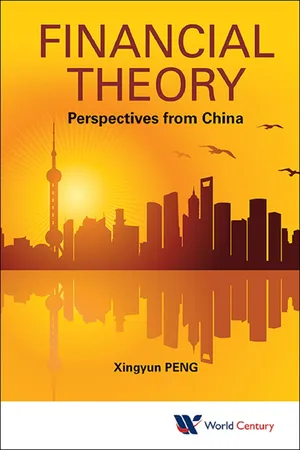
China is now the second largest economy in the world, with an increasingly efficient and open financial system. Many firms, agents and financial institutions have realized the potential in making money in China. Financial Theory: Perspectives from China serves as a timely textbook providing a unique introduction to economics theory, with a focus on money, banking and financial systems, through examples based mainly on China's financial practices. It contains up-to-date developments of theory and practices, as well as various interesting stories on China's financial system. Topics such as financial institutions, capital markets, debt securities markets, mutual fund markets, money markets, foreign exchange and financial derivative markets are discussed in depth. Financial theories are supplemented with illustrations from China's money supply mechanism and monetary policy system, China's financial regulatory and supervision system, as well as China's financial system and how it has liberalized and opened up to the rest of the world.Readers will find detailed examinations of financial theories, exemplified and reinforced by the inclusion of different financial cases and phenomena, each intriguing in their own right. This book provides readers with a deeper understanding of China's financial practices, providing vital knowledge for investing in China and engaging businesses there. Undergraduate students in economics and finance and those keen on becoming a player in China's financial markets will no doubt find this volume useful and necessary.Sample Chapter(s)China is now the second largest economy in the world, with an increasingly efficient and open financial system. Many firms, agents and financial institutions have realized the potential in making money in China. Financial Theory: Perspectives from China serves as a timely textbook providing a unique introduction to economics theory, with a focus on money, banking and financial systems, through examples based mainly on China's financial practices. It contains up-to-date developments of theory and practices, as well as various interesting stories on China's financial system. Topics such as financial institutions, capital markets, debt securities markets, mutual fund markets, money markets, foreign exchange and financial derivative markets are discussed in depth. Financial theories are supplemented with illustrations from China's money supply mechanism and monetary policy system, China's financial regulatory and supervision system, as well as China's financial system and how it has liberalized and opened up to the rest of the world.Readers will find detailed examinations of financial theories, exemplified and reinforced by the inclusion of different financial cases and phenomena, each intriguing in their own right. This book provides readers with a deeper understanding of China's financial practices, providing vital knowledge for investing in China and engaging businesses there. Undergraduate students in economics and finance and those keen on becoming a player in China's financial markets will no doubt find this volume useful and necessary.Sample Chapter(s)Undergraduate students in economics and finance as well as those interested in economics and investing in China.Key Features:Explains key theories in the economics of money and financial systems in depth, keeping readers up-to-date with current developments in the fieldFinancial theories exemplified and reinforced through interesting case studies with a China-centric focusDeepens the readers' understanding of China's financial practices, providing vital knowledge for investing in China and engaging businesses there
- 708 pages
- English
- ePUB (mobile friendly)
- Available on iOS & Android
eBook - ePub
About this book
Table of contents
- Cover Page
- Title Page
- Copyright Page
- Contents
- Foreword
- Acknowledgments
- Preface
- Part I. Introduction
- Part II. Financial Institutions and Markets
- Part III. Financial Controls
- Part IV. Financial Development and Stability
- Glossary
- Index
Trusted by 375,005 students
Access to over 1.5 million titles for a fair monthly price.
Study more efficiently using our study tools.