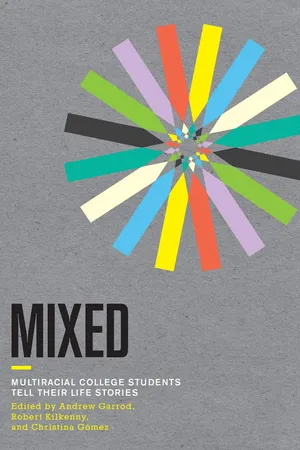
Mixed presents engaging and incisive first-person experiences of what it is like to be multiracial in what is supposedly a postracial world. Bringing together twelve essays by college students who identify themselves as multiracial, this book considers what this identity means in a reality that occasionally resembles the post-racial dream of some and at other times recalls a familiar world of racial and ethnic prejudice.Exploring a wide range of concerns and anxieties, aspirations and ambitions, these young writers, who all attended Dartmouth College, come from a variety of racial, ethnic, and socioeconomic backgrounds. Unlike individuals who define themselves as having one racial identity, these students have lived the complexity of their identity from a very young age. In Mixed, a book that will benefit educators, students, and their families, they eloquently and often passionately reveal how they experience their multiracial identity, how their parents' race or ethnicity shaped their childhoods, and how perceptions of their race have affected their relationships.
eBook - ePub
Mixed
Multiracial College Students Tell Their Life Stories
- 200 pages
- English
- ePUB (mobile friendly)
- Available on iOS & Android
eBook - ePub
Mixed
Multiracial College Students Tell Their Life Stories
About this book
Information
III
A DIFFERENT PERSPECTIVE
9
Taica Hsu Chow Mein Kampf
While attending my predominantly white elementary school, I did my best to fit in by acting white—speaking English without an accent, having white friends, and wearing “normal” clothing. Even though I looked different from most of my classmates, I never felt different, at least in terms of race. I always had friends, and my academic ability was never attributed to my race.
My third-grade teacher, Mrs. Dali, gave us a quiz every week to test our knowledge of the times tables. Wayne, a white classmate, and I consistently finished first and second, making no errors. For some reason I became known as the “Human Calculator,” and Wayne was simply my competition.
“Wayne, how did you do on the eights?”
“I think I got most of them right. How about you?”
“Yeah, me too. It was a little harder than the sixes or the sevens.”
“Yeah, but we always finish first.”
While I enjoyed the title, I never thought it was due to my being Chinese, or that I was expected to be better at math because I was Asian. My affinity for numbers followed me throughout elementary school, earning me blue ribbons in various math competitions and a plaque for first place in Superstars, a monthly worksheet of challenging math problems that was given to all students.
In fifth grade, my teacher recognized my passion for mathematics and nominated me for the gifted students program. I skipped almost six hours of regular class per week to spend time with similar students, studying topics such as the rainforest and chaos theory. My teacher expected us to embrace new forms of learning and assessed our performance through skits, plays, simulations, and Toastmasters, a program that enhances public-speaking skills. We were also expected to keep up with regular coursework. Consequently, I developed a special identity—that of one who deserved to skip regular classes to fraternize with the elite. That identity was shattered on the very first day of gifted class.
The students around me were capable of handling metaphor, representation, and, above all, creativity. I was not. Or perhaps I was just too shy, too insecure to share a novel response with the class. Whatever the reason, I left the teacher unimpressed, frustrated, and skeptical about my special placement in the class. Failure was a hard pill to swallow, and it left me vulnerable. In an all-white class of gifted and talented students, my race became a salient factor for the first time in my life. Why can everyone else see the fishing hole when I can’t? Why can everyone else deliver a public speech confidently when I can’t? I searched for an explanation for my obvious differences from the rest of “the club.” Naturally, I blamed my race. After all, Asians were supposed to be good at math but also timid, shy, and less outgoing than their white counterparts. Although I was not as hyperaware of these stereotypes in fifth grade as I am now, I do remember feeling different because of my physical appearance and linking that difference with my failures in the gifted class. I allowed my own internalized racism to stunt my growth as an individual: instead of working hard to improve my speaking ability and my facility with words, I figured I would never be as good as others when it came to verbalizing my thoughts and chose instead to focus on my strengths.
What perhaps sets my experience apart from that of monoracial individuals is the fact that I questioned why I didn’t have the best of both worlds. If I am half white and half Asian, why shouldn’t I be good at math and creative and outgoing? Since we cannot pick and choose the genes we get from our parents, I figured my Asian side dominated my white side. I used this hypothesis to explain my physical attributes as well, since most people thought I looked more Asian than white. I despised this notion, perhaps even more than I rejected my timidity. People can’t tell by looking at you that you’re an introvert, but race is there for everyone to see.
Middle school proved to be slightly better, at least in terms of racial diversity. I continued in the gifted program, which was now a completely separate team, so all of the students who were sorted to the top traveled together. While I am not a proponent of tracking in schools, I must say the environment was extremely conducive to learning. As many more races were represented in the classroom, I began to broaden my definition of what it meant to be “gifted.”
Although I do not remember meeting other Asians, I did meet the first person my age that I knew was also biracial, half African American and half white. We started dating in seventh grade, perhaps more because of peer pressure than physical attraction. As I look back, I remember being enamored of the attention and the social status that accompanies dating an attractive and popular girl. Hidden beneath the surface, however, was the lingering fear that this wasn’t for me.
McKayla identified more strongly with her African American side and sometimes complained about her “light skin.” Most of her closest friends were full African American, but for some reason she had a thing for a half-Asian boy who was shorter than her and obviously less developed. During our three-month relationship, I felt puny and, quite frankly, emasculated. McKayla was much taller, had large breasts, and typically attracted jocks who were much taller and more masculine than me. At one point she even told one of my best friends—Jamison, a muscular jock who hung out with me in private, but never during school—that I didn’t have much pubic hair. Ironically, it was with Jamison that I shared my first homosexual experience. It shouldn’t be surprising, then, that when I found out a year later that Jamison and McKayla were dating, I was more envious of McKayla than of Jamison.
Recently, through Facebook, I reconnected with McKayla and discovered that she too has had homosexual relationships. Although she identifies as bisexual, I find it intriguing that our union was not the match either of us really wanted. We laughed and joked that if middle-schoolers were more accepting of same-sex relationships, perhaps both of us would have come out earlier.
Jamison came over almost every weekend for sleepovers. One night, he initiated a conversation about a long pillow he found in my room.
“What do you use this for?”
“Sometimes I sleep with it at night,” I replied.
“I have an idea. Let’s put it between us and pretend we are each other’s girlfriend,” Jamison suggested.
I was excited and petrified at the same time. Does he want to have sex? What if my parents hear us? Does he want to be my boyfriend? I’d better lock the door.
Jamison and I dry-humped the pillow for thirty minutes, continuously moaning our girlfriends’ names. McKayla. Katie. McKayla. Katie. The interactions intensified with future sleepovers until there was no longer a need for the cotton barrier.
“Do you want to do the pillow thing?” Jamison asked.
“Sure,” I replied, already with a slight erection.
That night I performed oral sex on him and I remember thinking, “Does this mean I’m gay?”
And so I added one more item to the “being half Asian” list: slow sexual and physical development (but not homosexuality). It was becoming clear that my racial background was more a curse than a blessing. Jamison was white, and also taller, stronger, more attractive, and better equipped (so to speak) than me. He represented the standard of male beauty and behavior, even though he engaged in sexual activity with other males behind the scenes. Jamison also could easily cover his homosexual tendencies—or “curiosities,” as he liked to say—since he acted and talked like a typical male. I, by contrast, had a higher voice, a smaller body, and the stereotypical mannerisms that society attributes to gay men. These characteristics were beginning to manifest themselves more and more as the middle school years passed by, and more and more people began to notice. Therefore, my Asian side not only stunted my development but also prevented me from hiding my true sexuality for a longer period of time.
In retrospect, I believe that Jamison and I interpreted our activities behind closed doors in different ways. Although I eagerly anticipated his embrace, I felt that he used our escapades simply for sexual pleasure. After he got off, he was done. I always wanted more—affection, attention, time to cuddle. He wanted to sleep. I doubt that Jamison cried for hours like me after we missed the chance to say good-bye before I moved to California. I doubt that he desperately searched for my lingering scent when he returned home. I doubt that he waited by the phone every weekend in anticipation of the next sleepover. Jamison was my first love; I was his “experiment.”
Years later, during the summer of my sophomore year in high school, Jamison admitted that he frequently participated in threesomes with both girls and guys. Was he gay too? I pondered this for years. To this day, I have no idea where Jamison stands in terms of his sexuality. My best guess is that he plays the part of a heterosexual white male quite well and sleeps with men on the side. I must admit, I used to covet his chameleon-like identity—what Kenji Yoshino, a gay, half-Japanese Yale law professor, aptly calls “covering.” As always, I blamed my Asian genes for my inability to float through society unnoticed: that small, femme Asian boy must be gay. Why can’t I be Jamison? Why can’t I just sleep with other men? Thankfully, although I was tortured by such thoughts as a teen, today I wear the pink triangle with pride as an ambassador of the gay community.
My family decided to move to California when I was fourteen years old, the summer after I graduated from eighth grade. After shoving the last box into the back of my mom’s black Bronco, I sat in the passenger seat with tears in my eyes. My mom and I waved good-bye to my sister and my dad as I left my childhood in the dust. Jamison was supposed to visit me the night before, but he failed to show, which intensified my depression. I cried for hours in my closet, a prisoner of my own sexuality.
Our move to California was not optional. Five years earlier, my father had secretly started gambling large amounts of money at a nearby racetrack. After discovering a racing receipt in his back pocket, my mom hired a private detective to monitor his behavior. But it was too late. My father had already tapped into our family savings, lost it all, taken out a second mortgage, and, to top it off, refused to collect money from his lucrative construction jobs. With debt accruing and nearly no income, my mom and I were forced to move in with my great-grandmother, who lived three thousand miles away.
My mom had her own way of describing my father’s financial irresponsibility: “If I were standing outside in the freezing cold and one of your father’s friends was also outside, your father would give his jacket to his friend.” I once thought that the crude metaphor meant my father did not love my mom. I realized years later that what she meant was that my father has a lot of pride and, knowing that his family would always love him, needed to appear strong and generous to those on the outside—friends, employers, business partners—at the expense of his family. My mom attributed this to my father’s Chinese heritage, claiming that gambling was rampant in Asian communities. I, however, question whether this was the cause: my father could have been from any racial background and still have developed a gambling addiction. What I view as the most characteristically Asian of my father’s actions throughout this scandal was his complete lack of emotion, which is precisely what I blamed for my failure in the gifted class. He never expressed sorrow or remorse for his actions and appeared entirely unaffected by our forced move to California. I must have inherited my father’s indifferent attitude toward life’s obstacles, which would explain my decision to focus on my strengths (mathematics and logical reasoning) and to abandon my weaknesses (language arts and public speaking).
I knew my dad was wrong, but even to this day I have never heard the slightest admission of guilt, or even a simple “I’m sorry.” Thus, the tension between our family cultures intensified even further. My white mom wore her emotions on her sleeve and explained, with considerable remorse, the events that necessitated uprooting our life. My Chinese dad never said a word about the situation, at least to me. He said he would stay in Florida, take care of things, and meet us in California. Simple. It shouldn’t be surprising, then, that he was the only one with dry eyes when our family split.
Watching my parents deal with their emotions in such different ways made being white more attractive to me. I did not enjoy suppressing my emotions, particularly those related to my secret sexual identity. Yet I felt confined by my Chinese dad’s approach to emotion: keep it in, don’t talk about it, hide it. Why couldn’t I be more like my white mom and share my true feelings? If both my parents were white, would coming out have been easier, less taboo? I suppose gender roles added another layer of confusion to an already complex situation. Society characterizes men as emotionless and rational, women as irrationally emotional. Therefore, I question whether my dad adheres more strongly to the male or the Asian stereotype. Both identities certainly contribute to his inability to accept my identity as a gay, biracial male. Lest I shame my father even more, I relegated my emotions to the confines of the same closet that had, until high school, successfully concealed my sexuality.
Attending a new high school in a different state exacerbated the biracial duality that first reared its ugly head in the academic arena. As I traveled from class to class, I wove in and out of older students who...
Table of contents
- Preface
- Introduction
- I Who Am I?
- II In-Betweenness
- III A Different Perspective
- About the Editors
Trusted by 375,005 students
Access to over 1.5 million titles for a fair monthly price.
Study more efficiently using our study tools.
Frequently asked questions
Yes, you can cancel anytime from the Subscription tab in your account settings on the Perlego website. Your subscription will stay active until the end of your current billing period. Learn how to cancel your subscription
No, books cannot be downloaded as external files, such as PDFs, for use outside of Perlego. However, you can download books within the Perlego app for offline reading on mobile or tablet. Learn how to download books offline
We are an online textbook subscription service, where you can get access to an entire online library for less than the price of a single book per month. With over 1.5 million books across 990+ topics, we’ve got you covered! Learn about our mission
Look out for the read-aloud symbol on your next book to see if you can listen to it. The read-aloud tool reads text aloud for you, highlighting the text as it is being read. You can pause it, speed it up and slow it down. Learn more about Read Aloud
Yes! You can use the Perlego app on both iOS and Android devices to read anytime, anywhere — even offline. Perfect for commutes or when you’re on the go.
Please note we cannot support devices running on iOS 13 and Android 7 or earlier. Learn more about using the app
Please note we cannot support devices running on iOS 13 and Android 7 or earlier. Learn more about using the app
Yes, you can access Mixed by Andrew C. Garrod, Robert Kilkenny, Christina Gomez, Andrew C. Garrod,Robert Kilkenny,Christina Gomez in PDF and/or ePUB format, as well as other popular books in Social Sciences & Ethnic Studies. We have over 1.5 million books available in our catalogue for you to explore.