The popularity of the plant Stevia (Stevia rebaudiana) has risen due to increasing use and interest in its sweet constituents called steviol glycosides. In recent years, these have been approved all over the world as food additives in the category of sweetener, hence they have received more attention and their use in food formulations has increased significantly. New techniques in growing stevia have resulted in new varieties with interesting steviol glycoside profiles. Also, new techniques to analyse the content of sweeteners in different matrices and the detection of new steviol glycosides with very pleasant sensory profiles has followed. The aim of this book is to present novel uses and manufacturing developments as well as to gather together up-to-date information across the whole developing area of steviol glycosides research.
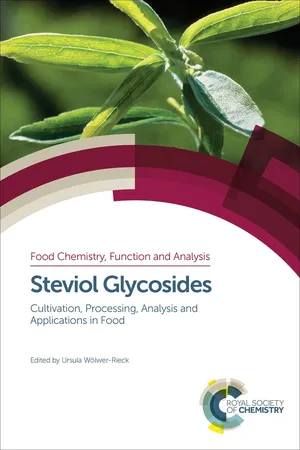
Steviol Glycosides
Cultivation, Processing, Analysis and Applications in Food
- 209 pages
- English
- ePUB (mobile friendly)
- Available on iOS & Android
About this book
Information
*E-mail: [email protected]
Worldwide demand for purified steviol glycosides (SVglys) from Stevia rebaudiana Bertoni leaves is steadily increasing. In the future, it is expected that the agricultural production capacity will be lower than the market demand. To improve the competitiveness of stevia production it is important to produce higher-performing crops in terms of yield and quality, resource use efficiency, greater resistance and resilience against drought stress, extreme weather conditions and a range of biotic stresses. Therefore, the development of new varieties/cultivars of S. rebaudiana with higher leaf and SVglys yields with greater resistance to abiotic and biotic stresses is the topmost priority and the primary aim for plant breeders. Since genotypic and phenotypic variation in the characters, in which we are interested, was reportedly quite high, researchers have attempted to enhance knowledge about this variability, and to develop breeding strategies, starting to study the feasibility and relevance of the characters being measured under different environmental and agro-climatic conditions. The chapter, aims to provide up-to-date scientific information regarding the breeding and selection programs carried out on stevia, describing both conventional plant breeding approaches and new biotechnological approaches, in order to provide new varieties/cultivars with improving quality traits.
1.1 Introduction
1.2 Objectives of Stevia Selection and Breeding
- high leaf yield per unit area
- high leaf-to-stem ratio
- rapid growth rate and regrowth capacity
- enhanced photosynthetic activity
- high SVgly content in the leaves
- high content of specific SVglys (e.g. rebaudioside A – Reb A)
- high adaptability to a wide range of pedoclimatic conditions
- resistance to environmental stresses, pest and diseases
- photoperiod insensitivity
- self-compatibility for viable seed production.
1.2.1 Dry Leaf Yield per Plant and Unit Area
1.2.2 Leaf-to-stem Ratio
1.2.3 Growth and Photosynthetic Activity
1.2.4 Wider Crop Adaptability, Yield Stability and Abiotic Stress Resistance
Table of contents
- Cover
- halftitle
- Title
- Copyright
- series_editors
- Preface
- Contents
- Chapter 1 Crop and Steviol Glycoside Improvement in Stevia by Breeding
- Chapter 2 Biosynthesis of Steviol Glycosides and Related Diterpenes in Leaves and Glandular Trichomes of Stevia rebaudiana Bertoni
- Chapter 3 Steviol Glycosides Production: Traditional Versus New Technologies
- Chapter 4 Analysis of Steviol Glycosides
- Chapter 5 Presentation and Analysis of Other Constituents in the Leaves: Polyphenolics in Stevia rebaudiana Leaves
- Chapter 6 Presentation and Analysis of Other Constituents in the Leaves: Analysis of Lipids and Volatile Terpenes in Stevia rebaudiana
- Chapter 7 Antioxidant Capacity of Stevia Leaves
- Chapter 8 Stevia rebaudiana Bertoni: Beyond Its Use as a Sweetener. Pharmacological and Toxicological Profile of Steviol Glycosides of Stevia rebaudiana Bertoni
- Chapter 9 Steviol Glycosides in Dentistry
- Chapter 10 Sensory Effects of Steviol Glycosides: Taste Perception and Beyond
- Subject Index
Trusted by 375,005 students
Access to over 1.5 million titles for a fair monthly price.
Study more efficiently using our study tools.
Frequently asked questions
- Essential is ideal for learners and professionals who enjoy exploring a wide range of subjects. Access the Essential Library with 800,000+ trusted titles and best-sellers across business, personal growth, and the humanities. Includes unlimited reading time and Standard Read Aloud voice.
- Complete: Perfect for advanced learners and researchers needing full, unrestricted access. Unlock 1.5M+ books across hundreds of subjects, including academic and specialized titles. The Complete Plan also includes advanced features like Premium Read Aloud and Research Assistant.
Please note we cannot support devices running on iOS 13 and Android 7 or earlier. Learn more about using the app