A Brookings Institution Press and American Enterprise Institute publication
There is widespread concern in the telecommunications industry that public policy may be impeding the continued development of the Internet into a high-speed communications network. In the absence of ubiquitous, high-speed ¡°broadband¡± Internet connections for residential and small-business customers, the demand for IT equipment and new Internet service applications may stagnate.
Broadband policy is controversial in large part because of the differences in the regulatory regimes faced by different types of carriers. Cable television companies face neither retail price regulation of their cable modem services nor any requirements to make their facilities available to competitors. Local telephone companies, on the other hand, face both retail price regulation for their DSL service and a requirement imposed by the 1996 Telecommunications Act that they ¡°unbundle¡± their network facilities and lease them to rivals. Finally, new entrants are largely unregulated, but many rely on facilities leased from the incumbent telephone companies at regulated rates to connect to their customers. This asymmetric regulation is the focus of this volume, in which telecommunications scholars address the public policy issues that have arisen over the deployment of new high-speed telecommunications services.
Robert W. Crandall is a senior fellow in the Economic Studies program at the Brookings Institution. His previous books include (with Martin Cave) Telecommunications Liberalization on Two Sides of the Atlantic (2001) and (with Leonard Waverman) Who Pays for Universal Service? (Brookings 2000). James H. Alleman is an associate professor in interdisciplinary telecommunications at the College of Engineering and Applied Science, University of Colorado, on leave at Columbia University.
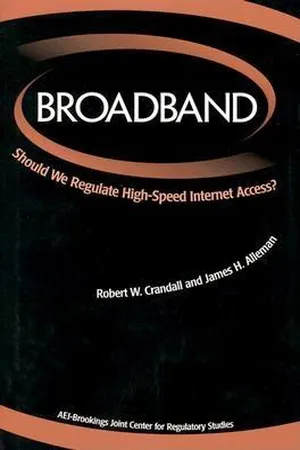
eBook - PDF
Broadband
Should We Regulate High-Speed Internet Access?
- 351 pages
- English
- PDF
- Available on iOS & Android
eBook - PDF
Broadband
Should We Regulate High-Speed Internet Access?
About this book
Information
Table of contents
- Front Cover
- Title Page
- Copyright Information
- Foreword
- Table of Contents
- Introduction
- Broadband Mysteries
- The Demand for Bandwidth: Evidence from the INDEX Project
- The Demand for Broadband: Access, Content, and the Value of Time
- Wired High-Speed Access
- From 2G to 3G: Wireless Competition for Internet-Related Services
- Internet-Related Services: The Results of Asymmetric Regulation
- Competition and Regulation in Broadband Communications
- Regulation and Vertical Integration in Broadband Access Supply
- Broadband Deployment: Is Policy in the Way?
- The Financial Effects of Broadband Regulation
- Subsidies, the Value of Broadband, and the Importance of Fixed Costs
- The Benefits of Broadband and the Effect of Regulation
- Contributors
- Index
- Back Cover
Trusted by 375,005 students
Access to over 1.5 million titles for a fair monthly price.
Study more efficiently using our study tools.
Frequently asked questions
Yes, you can cancel anytime from the Subscription tab in your account settings on the Perlego website. Your subscription will stay active until the end of your current billing period. Learn how to cancel your subscription
No, books cannot be downloaded as external files, such as PDFs, for use outside of Perlego. However, you can download books within the Perlego app for offline reading on mobile or tablet. Learn how to download books offline
Perlego offers two plans: Essential and Complete
- Essential is ideal for learners and professionals who enjoy exploring a wide range of subjects. Access the Essential Library with 800,000+ trusted titles and best-sellers across business, personal growth, and the humanities. Includes unlimited reading time and Standard Read Aloud voice.
- Complete: Perfect for advanced learners and researchers needing full, unrestricted access. Unlock 1.5M+ books across hundreds of subjects, including academic and specialized titles. The Complete Plan also includes advanced features like Premium Read Aloud and Research Assistant.
We are an online textbook subscription service, where you can get access to an entire online library for less than the price of a single book per month. With over 1.5 million books across 990+ topics, we’ve got you covered! Learn about our mission
Look out for the read-aloud symbol on your next book to see if you can listen to it. The read-aloud tool reads text aloud for you, highlighting the text as it is being read. You can pause it, speed it up and slow it down. Learn more about Read Aloud
Yes! You can use the Perlego app on both iOS and Android devices to read anytime, anywhere — even offline. Perfect for commutes or when you’re on the go.
Please note we cannot support devices running on iOS 13 and Android 7 or earlier. Learn more about using the app
Please note we cannot support devices running on iOS 13 and Android 7 or earlier. Learn more about using the app
Yes, you can access Broadband by Robert W. Crandall,James H. Alleman, Robert W. Crandall, James H. Alleman in PDF and/or ePUB format, as well as other popular books in Law & Media & Communications Industry. We have over 1.5 million books available in our catalogue for you to explore.