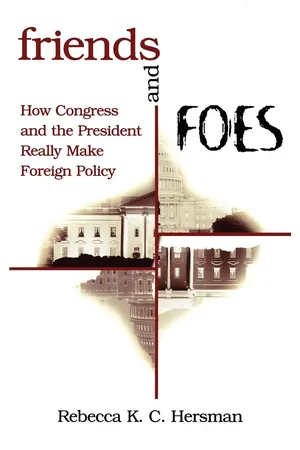
Foreign policy in the post–cold war era is profoundly complex, and so too are the institutions that share the responsibility to guide and manage America's relations with other countries. Policymakers struggle within porous and fragmented institutions, in which policy is driven more powerfully by clusters of like-minded individuals than by disciplined organizations. The nation's political parties face deep divisions over foreign policy and are unable to forge a coherent vision for the future. Congress is increasingly polarized along ideological lines, while traditional internationalist foreign policy spans a truncated political center. Few aspects of U.S. politics are more contentious or controversial than the respective roles of Congress and the executive branch in formulating foreign policy. In this complex environment, scholars, pundits, and policymakers look to the public and high-profile battles between Congress and the president as a bellwether of the future of U.S. foreign policy.In reality, foreign policy is often shaped, debated, and made out of public view. In Friends and Foes, Rebecca K. C. Hersman shifts the focus away from headline-grabbing events and disagreements to the day-to-day interactions that form the backbone of policymaking.Hersman illustrates the ebb and flow of foreign policy development through many examples and anecdotes. She also includes three in-depth case studies from the mid-1990s: the controversial transfer of three U.S. warships to Turkey; the dispute over relaxing sanctions against Pakistan because of concerns about that nation's nuclear proliferation record, and the 1995–97 battle over the Chemical Weapons Convention. The book also illuminates the role of the media in influencing the outcome of foreign policy decisionmaking. Countering the conventional wisdom that a president and a Congress of the same political party are best able to "get things done," Friends and Foes sheds new light on the institutional dynamics, conflicts, and issue loyalties that affect the development of U.S. foreign policy.
eBook - PDF
Friends and Foes
How Congress and the President Really Make Foreign Policy
- 154 pages
- English
- PDF
- Available on iOS & Android
eBook - PDF
About this book
Information
Table of contents
- Front Cover
- Title Page
- Copyright Information
- Foreword
- Table of Contents
- Introduction
- Individual Power and Issue Leaders
- Institutional Overlap and Issue Clusters
- Three Turkish Frigates
- Pakistan, Proliferation, and the Brown Amendment
- The Chemical Weapons Convention
- The Way Ahead
- Notes
- Index
- Back Cover
Trusted by 375,005 students
Access to over 1.5 million titles for a fair monthly price.
Study more efficiently using our study tools.
Frequently asked questions
Yes, you can cancel anytime from the Subscription tab in your account settings on the Perlego website. Your subscription will stay active until the end of your current billing period. Learn how to cancel your subscription
No, books cannot be downloaded as external files, such as PDFs, for use outside of Perlego. However, you can download books within the Perlego app for offline reading on mobile or tablet. Learn how to download books offline
Perlego offers two plans: Essential and Complete
- Essential is ideal for learners and professionals who enjoy exploring a wide range of subjects. Access the Essential Library with 800,000+ trusted titles and best-sellers across business, personal growth, and the humanities. Includes unlimited reading time and Standard Read Aloud voice.
- Complete: Perfect for advanced learners and researchers needing full, unrestricted access. Unlock 1.5M+ books across hundreds of subjects, including academic and specialized titles. The Complete Plan also includes advanced features like Premium Read Aloud and Research Assistant.
We are an online textbook subscription service, where you can get access to an entire online library for less than the price of a single book per month. With over 1.5 million books across 990+ topics, we’ve got you covered! Learn about our mission
Look out for the read-aloud symbol on your next book to see if you can listen to it. The read-aloud tool reads text aloud for you, highlighting the text as it is being read. You can pause it, speed it up and slow it down. Learn more about Read Aloud
Yes! You can use the Perlego app on both iOS and Android devices to read anytime, anywhere — even offline. Perfect for commutes or when you’re on the go.
Please note we cannot support devices running on iOS 13 and Android 7 or earlier. Learn more about using the app
Please note we cannot support devices running on iOS 13 and Android 7 or earlier. Learn more about using the app
Yes, you can access Friends and Foes by Rebecca K. C. Hersman in PDF and/or ePUB format, as well as other popular books in Politics & International Relations & American Government. We have over 1.5 million books available in our catalogue for you to explore.