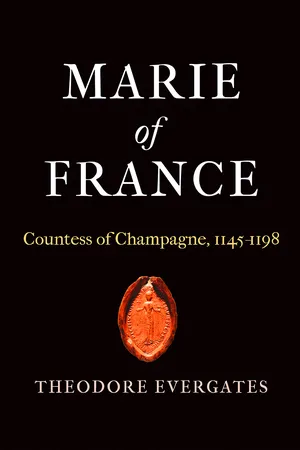
Countess Marie of Champagne is primarily known today as the daughter of Louis VII of France and Eleanor of Aquitaine and as a literary patron of Chrétien de Troyes. In this engaging biography, Theodore Evergates offers a more rounded view of Marie as a successful ruler of one of the wealthiest and most vibrant principalities in medieval France.
From the age of thirty-four until her death, Marie ruled almost continuously, initially for her husband, Henry the Liberal, during his journey to Jerusalem, then for her underage son, Henry II, and after his majority, during his absence on the Third Crusade and extended residence in the Levant. Presiding at the High Court of Champagne and attending to the many practical duties of governance, Marie acted with the advice of her court officers but without limitation by either the king or a regency council. If Henry the Liberal created the county of Champagne as a dynamic and prosperous state, it was Marie who expertly preserved and sustained it.
Evergates mines Marie's letters patent and the literary and religious texts associated with her to glean a fuller picture of her life and work. He situates Marie within the regional institutions and external events that influenced her life as well as within her extended families of royal half-siblings—including King Philip II of France and her Plantagenet brothers—and her many in-laws, including the queen mother Adele and Archbishop William of Reims. Those who knew Marie best describe her as determined, gracious, and pious, as well as an effective ruler in the face of several external threats.
- 192 pages
- English
- ePUB (mobile friendly)
- Available on iOS & Android
eBook - ePub
About this book
Information
Publisher
University of Pennsylvania PressYear
2018Print ISBN
9780812250770
9780812250770
eBook ISBN
9780812295672
Chapter 1

Marie of France, 1145−1164
On 11 June 1144 the newly reconstructed abbey church of St-Denis, just outside Paris, was dedicated with great fanfare. In his memoirs Abbot Suger names a few of the important lay and religious leaders of northern France he had invited to attended the ceremonies: five archbishops (Reims, Sens, Rouen, Bordeaux, Canterbury), thirteen bishops, and many prominent laymen, including the two most consequential personages of northern France, King Louis VII and his nemesis, Count Thibaut of Blois.1 On display were Suger’s abundant works in the church remodeled in the architectural style now known as Gothic: a luxurious great gold cross, stone carvings and life-size portal sculptures, stained glass panels, and magnificent bronze doors, not to mention the rebuilt monastic compound. Between 1137 and 1144 an army of craftsmen had labored on what was to be a monument to the abbot, whose image or name was inscribed on virtually every object.
A high point of the occasion was the presentation of gifts on the new altar of St-Denis. As Suger described it, the bishops laid their pontifical rings as offerings on the altar while the laymen presented precious stones—emeralds from King Louis VII, hyacinths and rubies from Count Thibaut, and pearls from the other optimates. The king and the count also presented personal gifts to the abbot. Louis re-gifted a rock-crystal vase, now known as the “Eleanor Vase,” that he had received from Eleanor of Aquitaine on their marriage in 1137. It was an heirloom from her grandfather William IX of Aquitaine, who had received it from Mitadolus, the last Muslim king of Saragossa. For Suger, it was such a prized possession that he had a base crafted for it with an inscription describing its provenance.2 Thibaut, too, re-gifted an exquisite vase, a rock-crystal ewer sent by King Roger II of Sicily on the occasion of his son’s marriage to Thibaut’s daughter. Suger especially appreciated that it came “in the same box in which the king of Sicily sent it.”3
The success of that festive occasion was made possible by a “surreptitious summit” of prelates and princes who met at St-Denis several weeks earlier, on 22 April.4 At issue was a simmering conflict that threatened to destabilize the realm, provoked most recently by the king’s heavy-handed intrusion into the episcopal election in Bourges and his wanton destruction of Count Thibaut’s castle-town of Vitry (spring–fall 1142).5 Of the many informal discussions, the most consequential was Queen Eleanor’s private meeting with Bernard of Clairvaux, the charismatic Cistercian abbot who was credited with performing miracles. According to the abbot’s traveling companion and secretary, Geoffroy of Auxerre, who made notes of their meeting, Queen Eleanor, then twenty years old, sought Bernard’s help because, she is quoted as saying, she had lived with the king for nine (sic) years and except for an early miscarriage had failed to bear a child and was despairing of her fertility. To which the abbot replied: “Diligently seek out a peaceful accord,” that is, convince Louis to make peace with Thibaut, “and I promise you a child through divine intervention.”6 That was one of Bernard’s many anecdotes and deeds that Geoffroy recorded, from either witnessing or hearing about them from Bernard. On being informed of Bernard’s promise, Geoffroy continued, Louis agreed to reconcile with Thibaut, and the queen finally conceived and delivered a child. From that time, Geoffroy added, peaceful conditions prevailed in the realm. By this reading, it was Bernard’s intervention in the matter of Eleanor’s pregnancy that ultimately reset relations between Louis and Thibaut, making possible Suger’s triumphant performance at St-Denis on 11 June. Eleanor’s daughter Marie, named after the intercession of the Virgin Mary, was born the next spring, perhaps in March or April 1145.7
The Second Crusade
About the time of Marie’s birth, news arrived in France of the destruction of Edessa and its Christian community by Turkish forces under Zengi (23 December 1144).8 Edessa was particularly vulnerable owing to its distance from the Mediterranean coast, and its destruction revealed the inherent weakness of the Frankish occupation of the Levant. The overseas Franks appealed for military support, but with the arrival of a new pope, the Cistercian Eugenius III (18 February 1145), the curia was slow in formulating a response to the first existential threat to the crusader states since their establishment four decades earlier. Meanwhile, probably during the summer or fall of 1145, Louis decided to undertake a pilgrimage to the Holy Land. His motives, however, were not transparent. He may have been moved by the accounts of Edessa’s fall, or he may have envisioned a penitential journey to expiate his recent misdeeds, especially the destruction of Vitry with its considerable loss of innocent life.9 At his Christmas council in Bourges, where he announced his plan to go to Jerusalem, Bishop Geoffroy of Langres, an intimate of Bernard of Clairvaux, gave an impassioned sermon on the atrocities suffered by the Christians of Edessa. Yet the king’s barons were not inclined to join what seemed to be a personal quest to expunge his unseemly deeds. They did not yet know that on 1 December 1145 Pope Eugenius had called for a new crusade in the spirit of the First Crusade declared fifty years earlier at Clermont (1095).
The prospect of a Second Crusade took hold in the early months of 1146. The pope reissued his bull Quantam praedecessores (1 March 1146), calling on the king of France and the great lords to continue the work of their ancestors in defending Christendom in the East. At Vézelay on Easter (31 March) the king and barons of France took the cross after a reading of the papal bull and agreed to leave on crusade from St-Denis the next year. It was at that point, in the summer or fall of 1146, while crusaders were preparing for their journey, that Count Geoffroy of Anjou sought to betroth his thirteen-year-old son Henry to the infant Marie, at that time the king’s only child. Bernard of Clairvaux strenuously opposed it. In a letter to the king, Bernard reported that he had learned from reliable sources that Queen Eleanor and the count of Anjou were related in the third degree and therefore the marriage of their children was barred by the canonical impediment of consanguinity.10 Nothing came of that marriage proposal, but the prospect of Marie’s marriage would resurface during the crusade.
The crusade army formed at St-Denis on 11 June 1147, precisely three years after the dedication of the abbey church. Although the pope made no mention of women in his call for armed combatants to fight the infidel, Queen Eleanor and a number of highborn wives joined their husbands on the crusade. Marie was just two years old when her parents left, and four and a half years old when they returned in the fall of 1149.11 Two related events in the intervening years would determine the course of her life. The first was the bond formed on the crusade between Louis, then in his late twenties, and Count Thibaut’s son Henry, who was in his early twenties. It was an improbable relationship. Henry was born and spent his earliest years in Vitry, which the king’s forces had destroyed only five years earlier. But the peace arranged between the king and the count at St-Denis tempered royal-comital relations, allowing Louis and Henry to develop a close rapport during the overland march from Paris to Constantinople. Their bond was strengthened by Henry’s loyalty to the king during the difficult weeks in Asia Minor where Louis lost control of his army, which suffered devastating loses in the ascent of Mount Cadmus in early January 1148. By the time the French forces reached Acre, Louis had decided to betroth Marie to his steadfast companion from Champagne. That seems to be the import of William of Tyre’s description of Henry at the Council of Palmarea (24 June 1148), where the French barons decided to attack Damascus. Among the participants, according to William, was “Lord Henry, eldest son of lord Thibaut, count of Troyes, and son-in-law (gener) of the king, a young man of fine character.”12 In light of later events, it seems that three-year-old Marie was only promised in marriage, not yet formally betrothed to Henry. Even so, Henry was regarded as the king’s future son-in-law—and potential successor in the event that Louis failed to produce a son. When Henry returned to France in the summer of 1148 ahead of the royal couple, he carried with him a letter of appreciation from Louis addressed to Count Thibaut. Louis spoke of his close friendship (amor) with Henry, who had displayed “devotion at all times” and whose “loyal service” had earned the king’s gratitude and affection.13 Louis did not mention a betrothal, but he left no doubt that he had formed a special relationship with Henry.
The second consequential event in Marie’s early life was the collapse of her parents’ marriage. According to John of Salisbury, who was in Rome at the time and must have heard reports from the East, Eleanor’s intimate talks with her uncle Raymond of Toulouse, prince of Antioch, had generated malicious rumors in the army, prompting an angry Louis to leave Antioch suddenly, with Eleanor in tow. That followed Eleanor’s announcement that their marriage was not valid, since she and Louis were related within the prohibited canonical degrees of kinship, and therefore she would seek a divorce.14 But Louis and Eleanor remained in the East another year and a half while they toured the holy sites. On returning in the fall of 1149, they stopped in Sicily, where they were entertained by King Roger II, and passed through Rome, where they met Pope Eugenius, who had seen them off at St-Denis two years earlier. Eugenius prohibited any talk of divorce, and in order to foster a marital reconciliation, according to John of Salisbury, he tucked them in bed.15 Marie’s sister, Alice, arrived in 1150, probably in the summer months, another product of a Cistercian intervention in Eleanor’s marriage, if we accept John of Salisbury’s tale.
We know nothing about Marie and Alice before 21 March 1152, when the Council of Beaugency under Archbishop Hugh of Sens heard a number of prelates and relatives of the king and queen swear that the couple was too closely related for a canonical marriage. And so Queen Eleanor was granted the divorce she had sought three years earlier while on the crusade. Leaving her two daughters in Paris, seven-year-old Marie and two-year-old Alice, Eleanor joined and then married (18 May) young Henry of Anjou, with whom she was rumored to have had a liaison.16 The girls may have come under the care of the queen mother, Adelaide, until she entered the convent of St-Pierre of Montmartre in 1153.17 Within a year Louis had a new queen, Constance of Castile, and the girls were sent away.18 Exporting the children of a first marriage in order to make space for a new family was an entirely conventional practice. If Marie, between her fifth and seventh year, had developed any intimacy with Eleanor, there is no evidence of it, and it seems unlikely that she ever saw her mother again.19
Marie may still have been in Paris when she was formally betrothed to Count Henry of Champagne. The count’s notary quoted Henry, who in making a grant to the priory of Coincy said that he did it “in the year [1153] in which I betrothed (affiduciavi) the daughter of the king.”20 Nothing further is known about the place and circumstances of that betrothal or whether eight-year-old Marie gave her provisional “future consent” on that occasion to marry Henry. Just where she spent the next eleven years is not entirely clear. It may have been at the Benedictine convent of Avenay, just north of Count Henry’s castle-towns along the Marne and not far from the king’s friend Samson, archbishop of Reims (see Map 2).21 More likely she was placed in the household of the recently widowed Viscountess Elizabeth of Mareuil-sur-Aÿ, a fortified town located only three kilometers from Avenay, where she could enjoy the company and educational opportunities of an old aristocratic convent while living with the viscountess.22 Guarding the road between Reims and Troyes, Mareuil was staffed by a garrison of seven knights supported by thirty-four knights who rendered annual castleguard, ranging from one to six months, under the command of the count’s viscount.23 The nuns of Avenay had a parish church just outside Mareuil’s walls, and so they were closely connected with the town by the time Marie arrived either in the convent or in the household of the viscountess.24 When Henry and Marie formally met in 1159, ostensibly for fourteen-year-old Marie to confirm her betrothal, she was accompanied only by her tutor (magistra) Alice of Mareuil, not by the abbess or any nun from Avenay, suggesting that Marie and her tutor did not live in the abbey.25 Whether she lived in Mareuil or in Avenay, Marie apparently received a traditional Latin-based education in the decade she spent in Champagne, between her eighth and nineteenth years. She also must have acquired the regional vernacular an...
Table of contents
- Cover
- Half title
- Title
- Copyright
- Contents
- Preface
- Chapter 1. Marie of France, 1145−1164
- Chapter 2. Countess of Troyes, 1165−1181
- Chapter 3. Regent Countess, 1181−1187
- Chapter 4. Retirement, 1187−1190
- Chapter 5. A Condominium Lordship, 1190−1198
- Chapter 6. Images of Countess Marie
- Appendix 1. Countess Marie’s Court Officers
- Appendix 2. Andreas Capellanus as Witness to Countess Marie’s Acts
- Appendix 3. The Regional Bishops
- Genealogy of Countess Marie and Her Relatives
- Chronology
- List of Abbreviations
- Notes
- Bibliography
- Index
Trusted by 375,005 students
Access to over 1.5 million titles for a fair monthly price.
Study more efficiently using our study tools.
Frequently asked questions
Yes, you can cancel anytime from the Subscription tab in your account settings on the Perlego website. Your subscription will stay active until the end of your current billing period. Learn how to cancel your subscription
No, books cannot be downloaded as external files, such as PDFs, for use outside of Perlego. However, you can download books within the Perlego app for offline reading on mobile or tablet. Learn how to download books offline
Perlego offers two plans: Essential and Complete
- Essential is ideal for learners and professionals who enjoy exploring a wide range of subjects. Access the Essential Library with 800,000+ trusted titles and best-sellers across business, personal growth, and the humanities. Includes unlimited reading time and Standard Read Aloud voice.
- Complete: Perfect for advanced learners and researchers needing full, unrestricted access. Unlock 1.5M+ books across hundreds of subjects, including academic and specialized titles. The Complete Plan also includes advanced features like Premium Read Aloud and Research Assistant.
We are an online textbook subscription service, where you can get access to an entire online library for less than the price of a single book per month. With over 1.5 million books across 990+ topics, we’ve got you covered! Learn about our mission
Look out for the read-aloud symbol on your next book to see if you can listen to it. The read-aloud tool reads text aloud for you, highlighting the text as it is being read. You can pause it, speed it up and slow it down. Learn more about Read Aloud
Yes! You can use the Perlego app on both iOS and Android devices to read anytime, anywhere — even offline. Perfect for commutes or when you’re on the go.
Please note we cannot support devices running on iOS 13 and Android 7 or earlier. Learn more about using the app
Please note we cannot support devices running on iOS 13 and Android 7 or earlier. Learn more about using the app
Yes, you can access Marie of France by Theodore Evergates in PDF and/or ePUB format, as well as other popular books in History & European Medieval History. We have over 1.5 million books available in our catalogue for you to explore.