In The Psychology of Inequality, Michael Locke McLendon looks to Jean-Jacques Rousseau's thought for insight into the personal and social pathologies that plague commercial and democratic societies. He emphasizes the way Rousseau appropriated and modified the notion of self-love, or amour-propre, found in Augustine and various early modern thinkers. McLendon traces the concept in Rousseau's work and reveals it to be a form of selfish vanity that mimics aspects of Homeric honor culture and, in the modern world, shapes the outlook of the wealthy and powerful as well as the underlying assumptions of meritocratic ideals.
According to McLendon, Rousseau's elucidation of amour-propre describes a desire for glory and preeminence that can be dangerously antisocial, as those who believe themselves superior derive pleasure from dominating and even harming those they consider beneath them. Drawing on Rousseau's insights, McLendon asserts that certain forms of inequality, especially those associated with classical aristocracy and modern-day meritocracy, can corrupt the mindsets and personalities of people in socially disruptive ways.
The Psychology of Inequality shows how amour-propre can be transformed into the demand for praise, whether or not one displays praiseworthy qualities, and demonstrates the ways in which this pathology continues to play a leading role in the psychology and politics of modern liberal democracies.
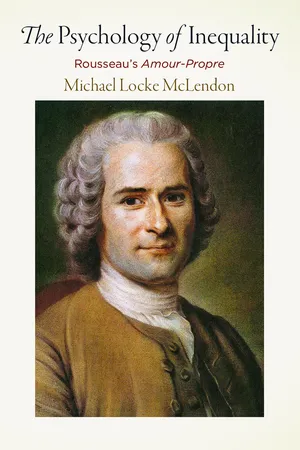
- 220 pages
- English
- PDF
- Available on iOS & Android
eBook - PDF
About this book
Information
Publisher
University of Pennsylvania PressYear
2018Print ISBN
9780812250763
9780812250763
eBook ISBN
9780812295733
Table of contents
- Cover
- Contents
- Introduction
- Chapter 1. Being Aristos and the Politics of Aristocracy
- Chapter 2. Amor Sui and Amour-Propre in Augustine and Neo-Augustinianism: Surrogate Virtue or Gateway to Libido Dominandi?
- Chapter 3. Amour-Propre in Rousseau: Subverting the Aristocratic Personality
- Chapter 4. Tocqueville’s Liberal Reply
- Conclusion
- Notes
- Bibliography
- Index
- Acknowledgments
Trusted by 375,005 students
Access to over 1.5 million titles for a fair monthly price.
Study more efficiently using our study tools.
Frequently asked questions
Yes, you can cancel anytime from the Subscription tab in your account settings on the Perlego website. Your subscription will stay active until the end of your current billing period. Learn how to cancel your subscription
No, books cannot be downloaded as external files, such as PDFs, for use outside of Perlego. However, you can download books within the Perlego app for offline reading on mobile or tablet. Learn how to download books offline
Perlego offers two plans: Essential and Complete
- Essential is ideal for learners and professionals who enjoy exploring a wide range of subjects. Access the Essential Library with 800,000+ trusted titles and best-sellers across business, personal growth, and the humanities. Includes unlimited reading time and Standard Read Aloud voice.
- Complete: Perfect for advanced learners and researchers needing full, unrestricted access. Unlock 1.5M+ books across hundreds of subjects, including academic and specialized titles. The Complete Plan also includes advanced features like Premium Read Aloud and Research Assistant.
We are an online textbook subscription service, where you can get access to an entire online library for less than the price of a single book per month. With over 1.5 million books across 990+ topics, we’ve got you covered! Learn about our mission
Look out for the read-aloud symbol on your next book to see if you can listen to it. The read-aloud tool reads text aloud for you, highlighting the text as it is being read. You can pause it, speed it up and slow it down. Learn more about Read Aloud
Yes! You can use the Perlego app on both iOS and Android devices to read anytime, anywhere — even offline. Perfect for commutes or when you’re on the go.
Please note we cannot support devices running on iOS 13 and Android 7 or earlier. Learn more about using the app
Please note we cannot support devices running on iOS 13 and Android 7 or earlier. Learn more about using the app
Yes, you can access The Psychology of Inequality by Michael Locke McLendon in PDF and/or ePUB format, as well as other popular books in Politics & International Relations & Political Philosophy. We have over 1.5 million books available in our catalogue for you to explore.