![]()
Chapter 1
Basic Concepts of Thermodynamics
1.1.Introduction
Thermodynamics is
a part of physics that studies the relationship between the properties of substances and the quantities we refer to as “work” and “heat” when the substances in question undergo a change of state [
1, p. 3]. The term “thermodynamics” (initially spelled “thermo-dynamics” comes from two old Greek (Gr.) words
[
thermos], meaning “hot” and
[
dunamikos], meaning “powerful, strong” [
2] which suggests the fact that the object of study is the thermal energy, which can be transferred from one substance to another and converted to other forms, hence its “power” (see also [
3]). Considering the corpuscular structure of matter, the
thermal energy can be defined as the part of the overall energy
a of a system that comes from the movement of atoms and molecules in matter. It is a form of kinetic energy associated to the random translational movement of those particles. The thermal energy of a system can be increased or decreased. If one adds to this thermal energy (kinetic energy) the potential energy associated with the binding forces that hold the particles together, one obtains the
internal energy. However, in order to study thermal phenomena, it is not necessary to make reference to the corpuscular
structure of matter. This is what the so-called
phenomenological thermodynamics (also named classical thermodynamics) does. It emerged as a science in the seventeenth century, and most of its fundamental laws were formulated before 1870, way before the modern atomic theory. The classical thermodynamics represents a generalization of extensive empirical evidence, and its conclusions are supported by the
statistical thermodynamics (or statistical mechanics), emerged in the late nineteenth century, which explains thermal macroscopic phenomena through statistics and mechanics (classical and quantum) at the microscopic level.
Engineering thermodynamics, studying the conversion, transfer and use of thermal energy in engineering applications, is essentially phenomenological thermodynamics.
1.2.Quantities measuring units and dimensions
Because engineering thermodynamics is mainly an experimental science, measurements play an important role. The process of measuring involves a comparison of a certain quantity to a measuring unit of the same type. The result of a measurement is a real number (the ratio of the magnitude of the quantity to the magnitude of the unit) times the measuring unit. Quantitative data in the real world being analog (continuous), not digital (discrete), the result of any measurement is not an exact value, only an approximation. Consequently, the result of any measurement will be affected by errors. Two important terms are defined in connection to the errors of measurement: precision and accuracy.
Precision refers to the smallest portion of a unit to which a measurement is taken. For example, 12.3 m is precise to a 1/10 of a meter. The number of significant digits here is 3 (1, 2 and 3). The digits (or figures) in the result of a measurement are called “significant” because they have a certain significance with respect to precision and accuracy [4, p. 30]. Nonzero digits are always significant. The case of zeros is more complex. For instance, zeros in front of other digits are not significant (0.045 has two significant digits), but trailing zeros to the right of a decimal are significant (6.70 has three significant digits). Trailing zeros in integer numbers are ambiguous when assessing the level of significance; therefore, to avoid uncertainty, use the scientific notation to place significant zeros behind a decimal point. The number of decimal digits shows implicitly the precision of measurement.
Accuracy refers to the number of digits in a measurement that are known to be accurate, or true, or significant. For example, 0.0123 m is accurate to three figures. The number of significant digits here is 3, which reflects also the accuracy of the measurement.
When performing calculations using measured values, keep in mind that no result of a calculation can be more accurate than the least accurate of the quantities entered. As a rule of thumb, perform calculations with a precision of at least (n + 1) significant digits and round only the final result to the required number of significant digits, n.
There are several systems of weights and measure currently in use, but the system that is nearly globally adopted is the International System of Units (abbreviated SI, from the French “le système international d’unités”), developed in 1960 from the meter–kilogram–second (mks) system [5].
SI (often referred to as “metric”), largely used in physics and engineering, is centered on seven base units, defined in an absolute way, corresponding to seven base quantities: meter [m] for length; kilogram [kg] for mass; second [s] for time; ampere [A] for electric current; kelvin [K] for thermodynamic temperature; mole [mol] for amount of substance; candela [cd] for luminous intensity.
From these seven base units several other units are derived. Each derived unit is defined purely in terms of a relationship with other units; for example, the unit of velocity is 1 m/s (i.e., the measuring unit for length over the measuring unit for time).
Units accepted for use with the International System are: minute [min], hour [h], day [d], degree of arc [°], minute of arc [′], second of arc [″], liter [l or L], tonne [t].
A prefix may be added to units to produce a multiple of the original unit. All multiples are integer powers of ten. The greatest advantage of the SI consists of its coherence, in the sense that when only base and derived units are used, conversion factors between units are never required.
Still in use in North America, especially in the United States, is the United States Customary System (also called American system or, sometimes, “English units”) developed from the British imperial system. Since in the US Customary System the multiples of original units are not powers of ten, most engineering calculations require the use of conversion factors, even within the system.
However, a physical law must be independent of the units used to measure the physical variables. Based on this postulate, the dimensional analysis has been developed. It is a tool to check relations between physical quantities by using the concept of dimension [6, pp. 17–24]. By definition, each type of base quantity has its own dimension. For instance length L, mass M, time τ, and temperature T are base dimensions. The dimension of a derived quantity can be described using a combination of basic physical dimensions according to a physical equation; for example, mass flow rate has the dimension “M/τ”, and may be measured in kilograms per second, pounds per minute, or other units. An immediate consequence is that any meaningful physical equation must have the same dimensions on both sides of the equals sign. This property is called dimensional homogeneity of a physical equation and checking it is the basic way of performing dimensional analysis. Another important use of the dimensional analysis is to determine the dimension of a variable in an equation. The dimension for the resultant quantity can be derived by simply substituting each quantity in the equation with its base dimension, omitting any numerical coefficients, and doing the algebra. For example, from the physical equation for kinetic energy mV2/2, its derived dimension is
or, using SI dimensional symbols (measuring units),
Thus the principles of dimensional analysis led to the conclusion that meaningful physical laws must be expressed by homogeneous equations in their various units of measurement. This was ultimately formalized in the Buckingham Pi theorem [7, p. 297], providing a method for computing dimensionless parameters, like the similitude criteria used in the study of convective heat transfer.
1.3.Thermodynamic systems
For a correct analysis of thermodynamic processes, some basic concepts need to be defined first.
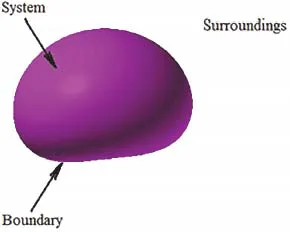
The term “system” was used already in Sec. 1.1 when talking about the overall energy. A thermodynamic system can be seen as the portion of the universe, with a finite volume, that makes the object of some investigation (see Fig. 1.1). The rest of the universe outside the system is known as the surroundings (or the environment). The system and the surroundings are separated by an imaginary layer called boundary.b The boundary enveloping the system, like a surface in geometry, has no thickness and does not belong to the system nor to the surroundings; depending on the situation, the boundary may or may not be permeable to mass or energy exchange.
Fig. 1.1
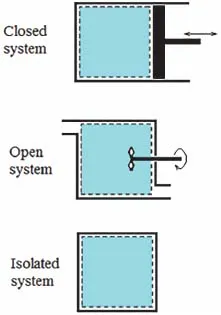
Fig. 1.2
Energy transfer is studied in three types of systems: closed systems, open systems and isolated systems (see Fig. 1.2; the system boundary is represented with dashed line).
A closed system exchanges only energy with the surroundings. Its boundary can expand or contract but remains impermeable to mass flux,c i.e., no mass can flow into or out of the system. For this reason, such a system is also referred to as “control mass”. If the boundary does not allow any heat exchange, it is called “adiabatic”; if it does not allow any work exchange it is called “rigid”. Example of closed system: an engine cylinder with valves closed.
An open system exchanges both mass and energy with the surroundings. Its boundary is permeable to mass and energy flux and has a fixed position, enclosing a constant volume. For this reason, such a system is also termed “control volume”. When the flux of mass and energy transfer is constant with time, the conditions are described as “steady” (e.g., steady flow). Certainly, if an open system has its boundary impermeable to heat exchange, it is called “adiabati...