![]()
1 Introduction
AGING POPULATION TREND
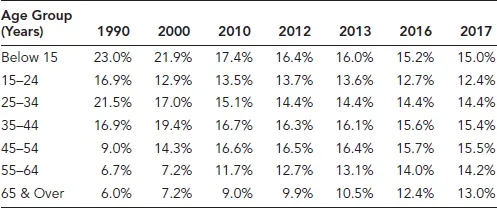
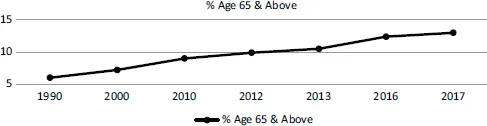
According to the Department of Statistics, Singapore, the percentage of Singapore residents above 65 years of age was 13% in 2017. The percentage had risen over the years, from 6% in 1990 to 10.5% in 2013, and to 13% in 2017.
The ratio of residents (as shown in Table 1 and Chart 1 from the Department of Statistics, Singapore) aged 20–64 to residents aged 65 and above continued to fall from 6.7 in 2012 to 5.1 in 2017. Thus, there will be fewer younger persons to support each older person in years to come.
Table 1. Age Distribution of Singapore Resident Population.
Chart 1. Percentage of Residents Aged 65 and Above Over the Years.
ACTIVITIES OF DAILY LIVING (ADLS)
ADLs are the things that we routinely do, without needing assistance. The activities include washing or bathing, dressing, feeding, toileting, transferring and mobility. An older person may have reduced ability to perform ADLs, owing to functional decline in aging or to a chronic health problem. A decrease in ADLs is most drastically felt after a major illness such as a stroke or even after a serious infection for an older person. The purpose of assessing the person’s ability to perform ADLs is to provide objective data for observing improvement or decline in the health status and for planning the care of the person.
The Basic ADLs are:
(1)Washing or bathing
The ability to wash in the bath or shower (including getting into and out of the bath or shower) or to wash by other means.
(2)Dressing
The ability to put on, take off, secure and unfasten all garments (upper and lower) and, as appropriate, any braces, artificial limbs or other surgical or medical appliances.
(3)Feeding
The ability to feed oneself food after it has been prepared and made available.
(4)Toileting
The ability to use the lavatory or manage bowel and bladder function through the use of protective undergarments or surgical appliances if appropriate.
(5)Mobility
The ability to move indoors from room to room on level surfaces.
(6)Transferring
The ability to move from a bed to a chair or wheelchair, and vice versa.
The ability to perform ADLs is a common gauge of disabilities for insurance claims. A person will be eligible for claims if he or she is unable to perform at least three of the ADLs.
In 2012, there were 27,900 Singapore residents above the age of 60 with at least one ADL limitation needing assistance. However, there were only 10,692 beds in intermediate and long-term care facilities.
By 2030, it is projected that there will be 57,300 Singapore residents above the age of 60 with at least one ADL limitation needing assistance. Of these residents, it has been projected that 48,000 (83%) will reside at home. This coupled with the decrease in the ratio of younger persons supporting older persons means that the burden of caring for the old in Singapore is increasing.
To provide good care for the dependent older persons at home, we will need to train the caregivers. The caregivers will be empowered and have the knowledge to provide a good quality of care to the dependent older persons. There is also a lesser chance of the caregivers getting caregiver stress if they know what to expect and what to do. The dependent older person will also face fewer problems with good care from the caregiver. In addition, is better for the dependent older person to stay in an environment that he or she is familiar with.
A trained caregiver will be able to help the older person with the ADLs and to monitor the health of the older person. The caregiver should be able to identify if the older person is unwell and start simple treatment if needed or to sound the alarm for more help. In this case, the trained caregiver will be able to decrease the morbidity and mortality of the older person.
With better-trained caregivers, dependent older persons can get more professional care at home and prevent reversible conditions, for example constipation leading to complications such as urosepsis requiring hospitalisation for more invasive treatment.
![]()
2 Training Modules for the Caregiver of a Dependent Older Person
MODULE 1: BASIC CARE OF A DEPENDENT OLDER PERSON
Part 1: Washing/Bathing
Performance Skill #1: Proper Hand Washing Techniques
Step1:Wet your hands and apply soap. Rub the palms together.
Step2:Rub the back of both hands.
Step3:Interlace the fingers and rub the hands together.
Step4:Interlock the fingers and rub the back of the fingers of both hands together.
Step5:Rub the thumb in a rotating manner, then the area between the index finger and the thumb, for both hands.
Step6:Rub the fingertips on the palm for both hands.
Step7:Rub both wrists in a rotating manner. Rinse and dry the hands thoroughly.
Performance Skill #2: Partial Bed Bath/Full Shower or Tub Bath
Partial Bed Bath
Step1:Inform the older person about the bath and ensure privacy.
Step2:Make sure that the temperature of the bathing water is lukewarm and comfortable.
Step3:Wipe the face (eye area first) and progress down to the arm, chest and back, pelvis and gluteal area, and finally the lower limbs. Clean the washcloth after wiping each different body part or use a new bathing wipe. Use dry shampoo for the hair if needed.
Step4:Dry the person and apply moisturiser over the body and barrier cream to the diaper areas.
Step5:Change the linen if necessary.
Full Shower or Tub Bath
Step1:Transfer the older person safely via a commode to the shower room.
Step2:Ensure that the temperature of the bathing water is lukewarm and comfortable.
Step3:Wash the face first with mild soap, followed by the rest of the body. Use soft white paraffin as soap if needed.
Step4:Dry the person and apply moisturiser over the body and barrier cream to the diaper areas.
Step5:Change the linen if necessary.
Performance Skill #3: Performing Shaving and Nail Care
Performing Shaving
Step1:Clean the area, before shaving, with lukewarm water.
Step2:Apply shaving cream if available.
Step3:Shave the beard on the face (cheeks/upper lips/chin) in the direction of hair growth.
Step4:Shave the beard on the neck against the direction of hair growth.
Step5.Clean and dry the shaven areas. Apply aftershave lotion if available.
Nail Care
Step1:Clean the foot and nails (outside and inside) with lukewarm water, and mild soap if needed.
Step2:If the nails are thick, soak the foot in lukewarm water for 10–15 min before attempting to trim the nails.
Step3:Trim the nails straight across with toenail clippers; do not cut inwards at the corn...