![]()
PART I
Topological Polymer Chemistry - Concepts and Practices -
![]()
CHAPTER 1
SYSTEMATIC CLASSIFICATION OF NONLINEAR POLYMER TOPOLOGIES
Yasuyuki Tezuka
Department of Organic and Polymeric Materials, Tokyo Institute of Technology, Meguro-ku, Tokyo, Japan
E-mail: [email protected] A systematic classification of nonlinear polymer topologies including branched and cyclic forms is presented by reference to the graph presentation of constitutional isomers in a series of alkanes (CnH2n+2), monocycloalkanes (CnH2n) and polycycloalkanes (CnH2n-2, CnH2n-4, etc). A systematic notation of nonlinear polymer topologies is also presented based on their principal geometrical parameters of terminus and junction numbers.
1. Introduction
A systematic classification of polymer constructions will provide not only fundamental insights on geometric relationships between different macromolecular structures, but also their rational synthetic pathways. A rational classification might also give a systematic nomenclature, as in the cases of dendrimers, knots, catenanes and rotaxanes.1–3 However, there have been few attempts on the systematic classification of nonlinear, and in particular cyclic and multicyclic polymer architectures composed of sufficiently long and thus flexible segment components.4,5
Herein, a systematic classification process for a series of nonlinear, thus cyclic and branched polymer architectures is proposed by reference to the graph presentation of constitutional isomers in alkanes (CnH2n+2) and in a series of mono- and polycycloalkanes (CnH2n, CnH2n-2, etc).6,7 The molecular graph of linear, branched, cyclic and multicyclic alkane molecules is taken as a source according to the procedure by Walba,8 in order to produce a unique topological construction. Thus in this transformation, the total number of termini (chain ends) and of junctions (branch points) are maintained as invariant (constant) geometric parameters. The total number of branches at each junction and the connectivity of each junction are preserved as invariant parameters as well. On the other hand, such Euclidian geometric properties as the distance between two adjacent junctions and that between the junction and terminus are taken as variant parameters, to conform with the flexible nature of the randomly-coiled and constrained polymer segments. Furthermore, topological constructions having five or more branches at one junction can be produced despite the corresponding isomers having the relevant molecular formula are not realized.
In this Chapter, a classification procedure of simple to complex branched and cyclic polymer topologies is presented to group them into different main-classes and sub-classes based on geometrical considerations. A systematic notation method for nonlinear polymer topologies is also presented based on the above classification and on principal geometrical parameters of terminus and junction numbers.
2. Classification of Branched Polymer Topologies
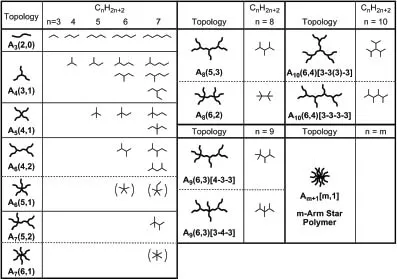
Alkane molecules of generic molecular formula CnH2n+2 with n = 3–7 and selected topological constructions by reference to their corresponding higher alkane molecules of CnH2n+2 with n > 7, together with their relevant topological constructions produced by the procedure described in the preceding section are shown in Table 1. A point from methane (CH4) and a line construction from ethane (C2H6) are not included since the former is not significant with respect to polymer topology and the latter produces an equivalent topological construction from propane (C3H8).
As seen in Table 1, two butane isomers of n- and iso-forms produce a linear and a three-armed star construction, respectively. Likewise, from pentane isomers a new four-armed star construction is produced upon neo-pentane in addition to the two others already produced from butane isomers. From five hexane isomers, two new constructions of an H- shaped and of a five-armed star architecture are produced. And further, heptane isomers produce the two new constructions of a super H-shaped and a six-armed star architecture. Thus by this process, a series of branched polymer topologies is relevantly ranked as shown in Table 1.
Table 1. Topological constructions produced by reference to alkane isomers (CnH2n+2: n = 3–7) and selected isomers (CnH2n+2: n = 8–10 and m).
A systematic notation for a series of branched topologies is also introduced as listed in Table 1. All these constructions are classified as A main-class, since they are produced from alkane isomers. A linear construction is produced from propane (C3H8) and this particular topology is ubiquitous in those from all higher alkanes. This sub-class construction is thus termed A3, or alternatively A3(2,0) by indicating the total number of termini and of junctions, respectively, in parentheses. Likewise, sub-classes A4 (or A4(3,1)) and A5 (or A5(4,1)) are uniquely defined as shown in Table 1. On the other hand, sub-classes A6, A7 and An with higher n values consist of multiple constructions, and each component can be defined by specifying the total number of termini and junctions, respectively, in parentheses as shown in Table 1. As a typical example, an m-armed star polymer topology is classified Am+1(m,1), as listed in Table 1.
Selected constructions from octane and higher alkane isomers are collected also in Table 1. Thus in sub-class A8, the two new constructions are distinctively defined again by specifying their total numbers of termini and junctions, respectively, in parentheses, i.e., A8(5,3) and A8(6,2). In sub-class A9, on the other hand, two of the newly produced constructions of A9(6,3) cannot be distinguished by simply showing the total numbers of termini and junctions. The connectivity of junctions for these two constructions is each distinctive, and can be specified by applying the nomenclature rule for substituted alkanes. That is, first a backbone chain having the most junctions is identified, and the number of branches at each junction is given in brackets in descending order from the most substituted junction. Thus, the above two A9(6,3)'s are designated as A9(6,3)[4-3-3] and A9(6,3)[3-4-3], respectively. Another pair of constructions in sub-class A10(6,4) in Table 1, namely one having a dendrimer-like star polymer structure and another having a comb-like branched structure, are defined by specifying their junction connectivity, as A10(6,4)[3-3(3)-3] for the former and A10(6,4)[3-3-3-3] for the latter, respectively.
From a topological viewpoint, it is important to note that a series of branched constructions in Tables 1 is distinct from dendrimers (dendritic polymers possessing well-defined branched structures) and comb-shaped polymers, although they are also referred as model branched macromolecules having well-defined structures. Thus, the topological constructions produced above are based on the assumption that the distance between two adjacent junctions and between the junction and the terminus are variable geometric parameters. This conforms to the flexible nature of sufficiently long polymer chains capable of assuming a random coil conformation. In dendrimers, on the other hand, the distance between two adjacent junctions and between the junction and the terminus are regarded to be invariant. Consequently, they tend to constitute a stiff, shape-persistent molecule possessing a gradient of structural density.9 For comb-shaped polymers, likewise, the distance between two junctions along the backbone are regarded as invariant, whereas the branch chain is either flexible (polymacromonomers)10 or stiff (dendron-jacketed polymers).11
3. Classification of Cyclic Polymer Topologies
3.1. Monocyclic polymer topologies
Monocycloalkane molecules of CnH2n with up to n = 7 and their relevant topological constructions are listed in Table 2. They are produced according to the procedure applied for the A main-class, branched topologies. Thus, a simple cyclic topology is produced upon the molecular graph of cyclopropane (C3H6). Likewise, two constructions, namely one having a ring with a branch architecture and another having a simple ring structure, respectively, are produced from the two isomers of C4H8, that is methylcyclopropane and cyclobutane. And the latter simple ring topology is already produced upon cyclopropane. Moreover, the two new constructions are produced from C5H10 isomers, in addition to those observed either from C3H6 or C4H8 isomers. These two constructions are distinguished from each other by their junction and branch structures, i.e., one has two outward branches at one common junction in the ring unit while the other has two outward branches located at two separate junctions in the ring unit. Four new topological constructions are subsequently produced by reference to C6H12 isomers; the one having five branches at one junction is hypothetical and is therefore shown in parentheses in Table 2. Thus by this process, a series of a ring with branches constructions has been ranked by reference to the constitutional isomerism in monocycloalkanes.
A systematic notation for a series of a ring with branches constructions has been accordingly introduced as given in Table 2. First, these are classified into a I main-class topology, since they are produced from monocycloalkanes. Then, a simple ring construction produced from cyclopropane is designated as sub-class I3, or alternatively I3(0,0) by showing the total number of termini and junctions in parentheses. This topology is ubiquitous among all higher sub-classes in the I main-class. A new construction from ...