![]()
Part One
Changes in Social Stratification
![]()
1
Social Stratification and Its Transformation in Brazil
C. Scalon
Inequality and Stratification
According to Grusky (2008: 13), “The task of identifying the essential dynamics underlying social change has long been fundamental to Sociology, but nowhere is this interest better developed or more fundamental than within the field of inequality analysis.”
Thus social transformation cannot be discussed without also taking into consideration transformations in the distribution of wealth and how individuals are allocated within the social structure. This is all the more important given that inequality is the most expressive trait of Brazilian society, appearing as a multi-dimensional, transversal, and durable phenomenon. Inequality is largely the result of the way in which social stratification is configured within a given society. It depends on circumstances and on choices made throughout the history of each society. This is why analyzing class structure is so relevant to understanding Brazil.
All contemporary societies are unequal and the inequality is manifested in many different ways: power, wealth, income, and prestige, among others. Its origins are as varied as its manifestations. What makes Brazil distinct is that such historical inequality persists even though the country has been going through an accelerated process of modernization. This trend becomes clearer when looking at the extremely elevated rates of income inequality. Even as the Gini coefficient has steadily decreased over the last decade, the degree of inequality in income is still quite high, even when considering how unequal the Latin American continent is as a whole.
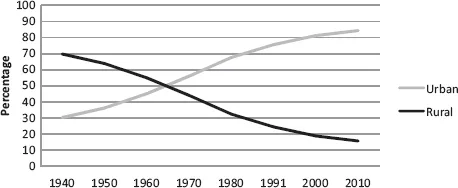
Fig. 1.1. Brazilian population in rural and urban areas by decade.
Source: Population censuses, Brazilian Institute of Geography and Statistics (IBGE).
It is therefore crucial that we take a better look at the structural changes that have taken place in emerging countries during the last few decades. In Brazil, the greatest transformation in the country’s social structure in the last decades is still, to this day, the transference of labor force from the countryside to the city. Until 1960, the population was still mostly rural, with 54.92% living in the countryside. Since then there has been significant growth within the urban population (see Fig. 1.1).
According to the 2010 census, Brazil has a population of 190,732,694 inhabitants, 84.35% of whom (160,879,708) live in urban areas. These rates vary from region to region, for instance, the urbanization rate in the Southeast is 92.92%, while in the Northeast the rate is 73.13%. Note that the latter is the poorest region of the country, having the largest rural population, approximately 27%.
On a purely demographic level, this transformation is meaningful since it incorporates transformations in the occupational and economic structures, as well as access to goods and services. Naturally, this transformation also has an impact on the composition of the labor force because every year legions of workers become employed in urban sectors.
Brazil’s economy grew at an average rate of 7% per year between 1950 and 1980, a development rate made possible because of the transference of labor force from country to city, and also because of importing technology. These factors were also facilitated by the accelerating growth of the GDP and rising productivity.
The country started industrializing at the end of the 19th century, but industrial growth started accelerating only after 1950. Until then, Brazil’s economy was based on traditional labor relationships. With modernization, an increasingly unequal income distribution has run parallel to this development.
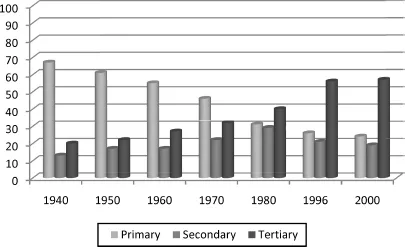
In 1940 and 1950, over 60% of the EAP (Economically Active Population1) was employed in the primary sector, but in 1980, this percentage dropped to 31%, further dropping to 26% in 1996. This reduction is still in progress since demographic statistics from the year 2000 census show that out of an EAP2 comprising 87.2 million people or 48.5% of the country’s total population, only 24.2% still worked in the primary sector. Here, special attention should be given to the progressive mechanization of agricultural work in the country.
The secondary sector employed 19.3% of the EAP in the year 2000. This small proportion may be explained by mechanization and robotization in industrial activity. In any case, this phenomenon may be explained by the de-industrializing process that took place in Brazil during the 1980s and 1990s. Already in the 1980s, workers in the secondary sector only comprised 29% of the EAP.
The tertiary sector currently employs the greatest number of Brazilian workers, corresponding in 2000 to 56.5% of the EAP. Activities that in 1960 incorporated merely 33.3% rose to 40% in 1980. However, we need to keep in mind that this kind of work is not dominated by modern businesses but, on the contrary, personal care and services that generally employ unqualified labor.
The tertiary sector enjoyed the greatest growth rate in the country. In 1940, it employed only 20% of the EAP; in 1980 this proportion had doubled and by 1996 it had already come to incorporate 56% of the 68 million people making up the economically active population in the country. The tertiarization of Brazil’s economy, which reached a peak during the 1980s economic crisis, relocated labor force from the secondary and primary sectors to the tertiary sector, and grew at a rate of 16% between 1980 and 1996.
Figure 1.2 shows the evolution of the distribution of the three sectors between 1940 and 2000.
Fig. 1.2. Economic sectors by year.
Source: Population censuses and 1996 demographic counting, IBGE.
In 2009, of the 162.8 million people who were 10 years or older, 101.1 million were economically active. Out of these, 92.7 million were employed and 8.4 million were looking for work during the week the survey was carried out (PNAD, 2009). In other words, the unemployment rate was 8.3%.
Urbanization and industrialization led to the appearance of new urban social groups with ties to the modernized sector of the national economy. At the same time, however, the urban industrial sector remained concentrated in the Southeast (Rio de Janeiro and São Paulo) and these new classes lived alongside traditional structures located in less developed regions.
This is the typical scenario throughout Latin America. As Shanin (1976: 53) has affirmed: “In Latin America capitalist production is combined in a variety of ways with other modes of production, thus constituting a degree of complexity difficult to comprehend.” In addition, urban development in Brazil has increased at a much greater rate than industrial development. Consequently, the economy is incapable of absorbing all of the available labor force, thus resulting in unemployment and underemployment.
In 2009, merely 50% of the salary-earning workforce had registered jobs, 44.7% were either independent or working without signed documents, and 4.4% worked merely for their own subsistence (PNAD, 2009).
Different from poverty, which is more visible and easier to target for specific eradication policies, inequality is not always perceived and framed as a problem. As an all-encompassing and diffuse problem, inequality may be found wherever we look: income, education, employment, physically occupying geographic space, and even citizenship are stratified and unequally distributed.
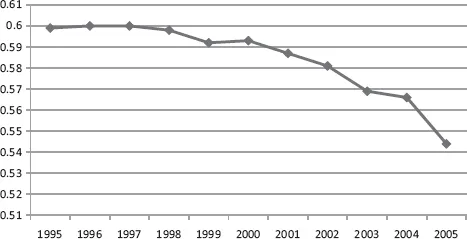
Fig. 1.3. Evolution of the Gini Index for Brazil (1995–2005).
Source: Paes de Barros et al. (2007).
Despite a decrease in income inequality (see Fig. 1.3), with a 0.05 drop in the Gini index within a decade, Brazil still possesses one of the worst income concentration rates in the world. In 2009, the Gini still hovered at 0.54.
In Brazil, it is clear that poverty is the result of an unequal income distribution. Poor people work and may thus be considered to be “deserving poor”. Yet due to a lack of capital — both educational capital and property — they actually earn much less than what would be necessary to lead a dignified life.
There has been some debate over the methodologies used to measure the poverty line. These discussions end up revealing divergences over the concept of poverty itself. For example, one may speak in terms of absolute and relative poverty. According to Nobel Prize winner Amartya Sen, deprivation cannot be understood in absolute terms since it is present at diverse levels. As such, the concept of poverty cannot be reduced to the notion of unstable income; poverty must be understood in a more complex and encompassing way as a lack of basic capabilities that lead to vulnerability, exclusion, exposure to fear and violence lack of power, participation, and voice. In sum, this amounts to being excluded from basic rights and wellbeing. Hence, the problem of inequality should not be limited to income, since this factor is related to other forms of inequality, such as race, gender, class, and citizenship, among innumerous other dimensions of social reality. Sociology would be reductionist to limit itself to focusing on income as the major type of inequality; this kind of perspective is better adapted to economics than other social sciences. This is why they are more concerned with relationships, practices, and other dimensions of life within a society, and not merely the economic sphere.
For Sen (2001: 171): “Even the prerequisite of ‘objectivity’ in a description does not require social invariability, as is sometimes supposed. What is considered as a terrible privation may vary naturally from one society to another, yet from the social analyst’s perspective these variations all serve as material to be used in an objective study.” Since Sen defends the proposition that poverty should be analyzed by considering deficiencies in basic functional capabilities and not in terms of functions that have already been carried out, he affirms that “As far as income is concerned, the relevant concept of poverty should be inadequacy (to generate minimally acceptable capabilities). A ‘poverty line’ that completely ignores individual characteristics cannot do justice to our genuine concerns over what is most basic to poverty; insufficient capabilities due to inadequate economical means. It is always a better idea to group individuals together into particular categories (related to class, sex, occupational group, employment status, etc.). If we chose to express poverty in terms of income, then the required income will have to be linked to the causal requirements of minimum capabilities” (Sen, 2001: 175). This would explain why the relationship between income and capability is not the same for all social groups, but on the contrary, varies according to age, place of residence, race, and sex, among other social factors.
Here, it is worth emphasizing that Sen’s theory has been elaborated around the concept of an individual’s capability to function according to the given values of this individual. This is the basis for liberty and equality.
Even so, in order to implement and evaluate public policies used to combat poverty, it is still necessary to establish an objective base by using some sort of measurement of absolute poverty. This is because measuring relative poverty would have to incorporate an extensive debate about which particular consumer items should or should not be considered basic. Rocha (2005: 46) maintains that “establishing a poverty line based on observed consumer patterns consists in selecting a theoretical basis, such as the nutritional necessities established by the Food and Agricultural Organization (FAO). ...