Algorithmics Of Matching Under Preferences
eBook - ePub

Algorithmics Of Matching Under Preferences

  1. 524 pages
  2. English
  3. ePUB (mobile friendly)
  4. Available on iOS & Android
eBook - ePub

Algorithmics Of Matching Under Preferences

About this book

Matching problems with preferences are all around us: they arise when agents seek to be allocated to one another on the basis of ranked preferences over potential outcomes. Efficient algorithms are needed for producing matchings that optimise the satisfaction of the agents according to their preference lists.

In recent years there has been a sharp increase in the study of algorithmic aspects of matching problems with preferences, partly reflecting the growing number of applications of these problems worldwide. The importance of the research area was recognised in 2012 through the award of the Nobel Prize in Economic Sciences to Alvin Roth and Lloyd Shapley.

This book describes the most important results in this area, providing a timely update to The Stable Marriage Problem: Structure and Algorithms (D Gusfield and R W Irving, MIT Press, 1989) in connection with stable matching problems, whilst also broadening the scope to include matching problems with preferences under a range of alternative optimality criteria.

Contents:

  • Preliminary Definitions, Results and Motivation
  • Stable Matching Problems:
    • The Stable Marriage Problem: An Update
    • SM and HR with Indifference
    • The Stable Roommates Problem
    • Further Stable Matching Problems
  • Other Optimal Matching Problems:
    • Pareto Optimal Matchings
    • Popular Matchings
    • Profile-Based Optimal Matchings


Readership: Students and Professionals interested in algorithms, especially in the study of algorithmic aspects of matching problems with preferences.

Frequently asked questions

Yes, you can cancel anytime from the Subscription tab in your account settings on the Perlego website. Your subscription will stay active until the end of your current billing period. Learn how to cancel your subscription.
No, books cannot be downloaded as external files, such as PDFs, for use outside of Perlego. However, you can download books within the Perlego app for offline reading on mobile or tablet. Learn more here.
Perlego offers two plans: Essential and Complete
  • Essential is ideal for learners and professionals who enjoy exploring a wide range of subjects. Access the Essential Library with 800,000+ trusted titles and best-sellers across business, personal growth, and the humanities. Includes unlimited reading time and Standard Read Aloud voice.
  • Complete: Perfect for advanced learners and researchers needing full, unrestricted access. Unlock 1.4M+ books across hundreds of subjects, including academic and specialized titles. The Complete Plan also includes advanced features like Premium Read Aloud and Research Assistant.
Both plans are available with monthly, semester, or annual billing cycles.
We are an online textbook subscription service, where you can get access to an entire online library for less than the price of a single book per month. With over 1 million books across 1000+ topics, we’ve got you covered! Learn more here.
Look out for the read-aloud symbol on your next book to see if you can listen to it. The read-aloud tool reads text aloud for you, highlighting the text as it is being read. You can pause it, speed it up and slow it down. Learn more here.
Yes! You can use the Perlego app on both iOS or Android devices to read anytime, anywhere — even offline. Perfect for commutes or when you’re on the go.
Please note we cannot support devices running on iOS 13 and Android 7 or earlier. Learn more about using the app.
Yes, you can access Algorithmics Of Matching Under Preferences by David F Manlove in PDF and/or ePUB format, as well as other popular books in Biological Sciences & Science General. We have over one million books available in our catalogue for you to explore.

Information

Chapter 1

Preliminary definitions, results and motivation

1.1 Introduction

1.1.1 Remit of this book

1.1.1.1 Matching under preferences
This book is about computational problems that involve matching agents to one another, subject to various criteria. Here, the term agent is used loosely to mean any participant in a matching process, and could include commodities in addition to human subjects. In many cases the agents form two disjoint sets, and we seek to assign the agents in one set to those in the other. Examples include assigning junior doctors to hospitals, pupils to schools, kidney patients to donors, and so on.
We primarily focus on the case that a subset of the agents have ordinal preferences over a subset of the others. That is, there is a notion of first choice, second choice, third choice, etc. For example a school-leaver who is applying for admission to university might rank in order of preference a small subset (say 5) of all available universities. Likewise, the universities might form a ranking of their applicants according to academic merit, and possibly other criteria. We will not always insist that the preference lists be strictly ordered: for example a school-leaver might have two universities that are jointly ranked as first choice in her preference list.
Typically there are other constraints in addition to the preference lists: for example, it is reasonable to assume that a school-leaver should not be assigned to more than one university, and likewise a university might have a capacity, indicating the maximum number of students that it could admit in a particular academic session.
1.1.1.2 Free-for-all markets
Applications of matching problems involving ordinal preferences (henceforth the term ordinal preferences will be shortened to preferences) can be very large in practice. For example in 2011, 140,953 students applied for admission to higher education in Hungary [90]. Economists have identified several problems that arise in free-for-all markets, in which the agents are able to negotiate with one another directly in order to arrange assignments [518, 467].
These problems include unravelling in which agents form assignments with one another earlier and earlier in advance of the deadline by which all assignments must be fixed. For example, hospitals wishing to recruit the best applicants might compete with one another by advancing the date when they make their offers. To avoid this issue, agents might be prevented from entering into premature assignments before a certain date.
This can then lead to the problem of congestion, in which agents do not have sufficient time to negotiate with one another over potential assignments prior to the deadline. For example a hospital h offering 20 places to applicants might have to make substantially more than 20 offers, to allow for applicants who will turn down h’s offer.
In an effort to avoid congestion, a new problem might emerge, namely exploding offers. In such a case, agents are given only a short time period to decide whether they are able to form a given assignment, otherwise the potential for making that assignment is removed. For example hospital h might force an applicant r to make a decision swiftly by setting r a deadline, beyond which the offer expires. Unravelling, congestion and exploding offers lead to a situation in which agents might be forced into forming an assignment with one another before they have knowledge of the whole range of potential assignments that may potentially be available to them.
Prior to 1952, the assignment of junior doctors to hospitals in the USA was carried out by a free-for-all market. A detailed description of the problems that this led to (which included unravelling, congestion and exploding offers as described above), with reference to this particular application, has been given in several references in the literature [261, 514, 518, 467].
1.1.1.3 Centralised matching schemes
Centralised matching schemes (referred to as (centralised) clearinghouses by economists) can avoid some of the problems that are inherent in free-for-all markets. These work along the following lines: the input data involving the agents and their preferences over one another are collected by a given deadline by a trusted central authority. This third party then compu...
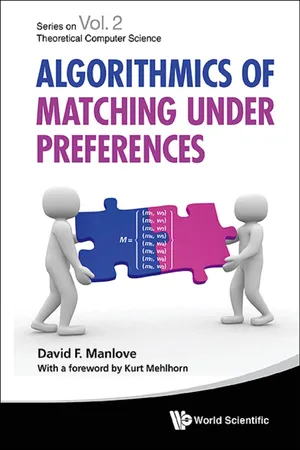
Table of contents

  1. Cover
  2. ALGORITHMICS OF MATCHING UNDER PREFERENCES
  3. Volumes
  4. Title
  5. Copyrights
  6. Dedication
  7. Preface
  8. Foreword
  9. Acknowledgments
  10. Contents
  11. List of Figures
  12. List of Tables
  13. List of Algorithms
  14. Chapter 1
  15. Part 1
  16. Part 2
  17. Biblography
  18. Glossary
  19. Index