![]()
Chapter
1
Overview of Food Safety
Management in China
1.1 Changes in the Focus of Food Safety in China
The concept of food safety has experienced a change from a quantity-oriented definition to a quality-oriented definition. In the World Food Conference held in 1974, the UN Food and Agriculture Organization (FAO) defined food safety as: under any circumstances, all people have access to adequate food necessary for healthy survival. By the 1980s, as the focus of food safety study had been changed from the security of aggregate food supply to the structure of food supply and consumer demand, more and more attention had been focused on food quality safety. In 2003, the World Health Organization (WHO) defined food safety as a public health problem and that poisonous and harmful substances in food affect human health.
Currently, most scholars tend to divide food safety into two levels: the security of food quantity (Food Security) and the safety of food quality (Food Safety). Food Security is mainly related to the security of aggregate food supply and the structure of food supply, while Food Safety is mainly associated with the quality of food and health security.
In China, due to the limited amount of arable land and the huge population pressure, food security has been given greater concern for a long period of time, and the grain supply, which is the basis of food supply, has always been the focus of policies and related research. Over the past decade, with the steady growth in grain output, especially the yield increase for seven consecutive years from 2003 and the steady aggregate yield of more than 500 million tons for five consecutive years after 2007, China’s grain supply and demand falls into a situation of tight balance, obvious structural contradiction, and appropriate imports, and the concern of aggregate food supply has been slowly transferred to the structure and quality of food supply. In 2002, the Central Rural Work Conference made it clear that the task of agriculture and food industry development should be upgraded from food supply security to food quality safety. With the rapid economic development and increase in per capita income since the reform and opening up, the consumption level and consumption structure of urban and rural residents in China took on the following characteristics: first, despite the existence of urban-rural differences, the overall consumption level has increased continuously; second, the consumption structure has been diversified, instead of a grain-based one, which mainly finds expression in the steady decrease in the consumption of staple foods and in the steady increase in non-staple foodstuff consumption; third, with the enhancement of people’s concern about their own health, the rural and urban residents are showing increasing solicitude for food safety. People pay much closer attention to the quality of food and have put forward higher requirements for the quality and sanitation status of food processing. To sum up, we believe that, currently, the food safety issues in China have entered a stage that highlights both food security and food safety, while the food safety concern is more prominent. Therefore, this chapter will focus on the analysis of China’s food safety issues.
1.2 China’s Food Safety: Understanding Based on the Perspective of Non-Traditional Security
After the 1990s, the concept of “non-traditional security” has been given more and more attention. The so-called non-traditional security is naturally opposite of the traditional security (political security and military security). However, it is very difficult to precisely define this term because, on the one hand, it covers all the threats and dangers for the survival and development of human society as a whole in a wide range of fields, like the economy, ecology, culture, and information, with the exception of politics and the military world (Yu et al., 2006), and on the other hand, the characteristics and focus of non-traditional security issues of different countries vary enormously. But, it is generally believed that non-traditional security is a generalized definition of security and it is the expansion of traditional security theory, generally including economic security, environmental security, ecological security, cultural security, and information security. In essence, we believe that the core of non-traditional security is human security which touches upon the various factors directly posing a threat to the security of human beings in the real world. According to the elaboration of the United Nations Development Programme1, human security includes two aspects: the security from the threat of long-term factors such as starvation and food-borne illness as well as the protection from unexpected damage in daily lives. Yu et al. (2006) listed seven major elements necessary for human security: economic security, food security, health security, environmental security, personal security, community security, and political security. Food security is obviously related to the safety of human beings and interacts with economic security and health security. Therefore, it is essential to re-examine food safety issues from the perspective of non-traditional security.
Firstly, food safety falls into the category of non-traditional security. We previously mentioned that the focus of China’s food safety issues has gradually expanded from quantity security to quality security. But whether it is quantity security or quality security, it is closely linked with the core of non-traditional security — human security. Viewed from the perspective of quantity security, grain security is not only one of the core issues of food safety, but also a very important element among the seven major elements for human security. In addition, the grain security issues are intertwined with issues of economic security, community security and political security. Viewed from the perspective of quality security, grain security is directly related to health security, environmental security, and personal security. Seen from the impact of food safety issues, it is more obvious: (1) viewed from the microscopic perspective, that food safety issues directly affect the nutritional status and physical health of residents. (2) Viewed from the industry perspective, the generation of food safety issues has a direct relationship with the current mode of economic growth. Such an extensive mode of growth, on the one hand, resulted in a waste of resources and damage to the environment and thus a threat to the country’s ecological security and environmental security; on the other hand, because of the reaction within the environment — mainly a variety of pollution, the quality of food was adversely affected, resulting in a low level of food quality. In addition, the occurrence of food safety incidents also allowed consumers to decrease their trust in food companies, which not only raised the management costs of the government, but also hindered the development of new food markets, like organic food, which is based on a credit mechanism. (3) Viewed from the perspective of the national level, food safety issues have a direct impact on the national economic security, social stability, and public confidence in the government. (4) Viewed from its international impact, the development of economic globalization connects all countries more closely in the same world market, and thus a country’s food safety problems can be easily extended to other countries through trade mechanisms, resulting in global food safety crisis and even political disputes. European mad cow disease is a typical example. In short, due to the potential of causes, the proliferation of transference, the comprehensiveness of governance, and the universality and severity of influence, food safety issues have obvious characteristics of non-traditional security. Thus, we believe that China’s food safety issues can be classified in the category of non-traditional security.
Secondly, research on food safety issues needs to draw lessons from the concept of non-traditional security. Between non-traditional security and traditional security, there is a big difference in their security concept, security sources, security subject, security focus, and security maintenance. Specifically, non-traditional security refers to a security concept of excellent state coexistence, and it includes not only national security, but also human security and social security. With respect to the security subject, it includes, apart from the state behavioral agent, a wider range of non-state behavioral agents, and thus the security maintenance involves the participation of all people. Viewed from the reasons for the occurrence of food safety issues, especially food quality safety issues, in addition to the imperfections of the national governance system, the inadequate technical support of food safety governance as well as producers’ subjective and intentional violation of laws in the food production process should not be ignored; thus, the sources of food safety issues have much uncertainty, which is similar to non-traditional security. The governance system for food safety issues should be a system involved in the participation of multi-subjects, but the current governance system for food safety issues is more of a government-led regulatory system. In this system, the various behavioral subjects in the food supply chain are only the objects of governance and receivers of policies and they passively participate in the governance process of food safety issues; therefore, the system cannot effectively play a role. According to the concept of non-traditional security, the governance system of food safety issues should be a regulatory system, in which the government plays a leading role, in which the subjects of the supply chain, the main third-party agencies, and the media participate, in which information can be exchanged, and in which smooth communication between different levels can be achieved. Either viewed from relevant foreign experience or from the effect of current supervision of food safety issues, the latter is an ideal food safety supervision approach. In addition, enlightenment of the theory of non-traditional security for the supervision of food safety issues also lies in the premise and content of security maintenance.
The theoretical study of food safety issues typically begins with the analysis of food attributes. In fact, the so-called food safety consists of the food quality safety attributes, which can be subdivided into security attributes, including food problems that may cause damage to human health, food nutrition, as well as food quality, etc. However, regardless of what kind of quality safety attributes are studied, the related information is asymmetric to different extents. Therefore, we usually believe that the root of food safety issues is the problem of asymmetric information, and thus the governance mechanism of food safety issues should focus on how to eliminate the problem of asymmetric information. To solve this problem, scholars have performed a lot of research and argumentation from the perspective of economics and public management, and economic analysis consisting of three different approaches, namely, information economics, welfare economics, and property rights theory.
1.3 China’s Food Safety Supervision: Progress and Achievements
In China, numerous food safety incidents happened in the past few years but, on the other hand, in this period China’s food safety supervision work has also made great progress. In 2010 and 2011, both the Special Operation against Quality Safety Problems of Agricultural Products led by the Ministry of Agriculture and the Special Operation Combating Illegal Food Additives carried out by the State Administration of Food and Drug Safety have both achieved positive results. China’s capability of safeguarding food safety has been significantly enhanced, and the level of food quality safety has been continuously improved. Take agricultural products for example, the statistics released by the Ministry of Agriculture show the following: In 2010, in the routine monitoring of the quality safety of vegetables, animal products, and aquatic products, the pass rates were 96.8%, 99.6% and 96.7%, respectively, maintaining a steady increase since 2009 and being over 96% for two consecutive years; in the second quarter of 2011, in the routine monitoring of the quality safety of vegetables, animal products, and aquatic products, the pass rates were 97.9%, 99.7%, and 96.6%, respectively. This shows that China’s agricultural products quality safety is overall in good condition. In addition, with respect to the food safety supervision system, China has made considerable progress in the formulation of laws and regulations, in the construction of a standards system, in quality safety monitoring and early warning of agricultural products, and in the construction of “Three Products, One Indication (pollution-free agricultural products, green agricultural products, organic agricultural products, and agro-product geographical indication)”.
1.3.1 Construction of Food Safety Law System
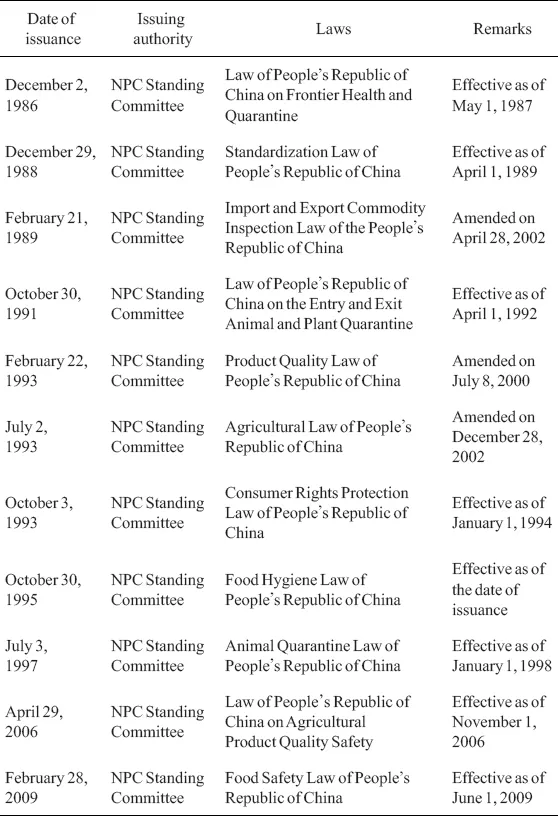
China’s food safety law system has been gradually developed since the foundation of P.R. China, and up to now it is a combination of a number of laws, like the Food Safety Law, Product Quality Law, Agricultural Law, Law on Agricultural Products Quality Safety, Standardization Law, Import and Export Commodity Inspection Law, and Consumer Rights Protection Law, and a series of complementary rules and regulations on food safety released by the State Council and ministries as well as provincial and municipal governments. Table 1.1 lists a number of laws on food safety promulgated since the foundation of P.R. China, and there are also numerous rules, regulations, and ordinances on food safety released by the State Council, ministries, and local governments at all levels. In particular, during the “Fifteenth Five-year Plan” period, China has promulgated over 70 laws and regulations relating to food safety. The issuance of the Food Safety Law and Enforcement Regulations of Food Safety Law in 2009 marks a new stage of China’s food safety law system construction.
Table 1.1 Food safety laws released since the foundation of P.R. China
1.3.2 Constant Improvement of the Food Safety Standard System
While China’s food safety law system has been constantly improving, the construction of China’s food safety standard system has been gradually strengthened.
Food safety standards cover a large number of items, including the agricultural production environment, quality of irrigation water, guidelines for the rational use of agricultural inputs, procedures of animal and plant quarantine, appropriate agricultural practices, limits of pesticides, veterinary drugs, pollutants and harmful microorganisms in food, food additives and related application standards, hygiene standards of food packaging materials, standards of special dietary food, labeling standards of food label, management and control standards of the safety food production process, and standards of food testing. These standards are involved with grain, oilseeds, fruits and vegetables and related products, milk and dairy products, meat and eggs and poultry products, aquatic products, potable spirit, condiments, infant foods, and other edible agricultural products and processed foods, covering all stages from food production, processing, and distribution to the final consumption. At present, China has released more than 1,800 national standards concerning food safety and more than 2,900 industry standards, including 634 mandatory national standards.
1.3.3 Capacity Enhancement of Food Safety Monitoring and Early Warning
Agricultural products are the basis of the food industry and are also important sources of food safety risks. During the “Eleventh Five-Year” period, China implemented the Construction Plan of National Agricultural Product Quality Safety Inspection System (2006-2010) and on the whole established a quality safety monitoring network, which covers the major cities across the country, the main agricultural production areas, and the main varieties of agricultural products. The Twelfth Five-Year Plan for the Development of Agricultural Product Quality safety developed by the Ministry of Agriculture shows that: during the “Eleventh Five-Year” period, the government invested RMB 5.9 billion Yuan for the platform construction of agricultural products – newly constructed, renovated and expanded 49 ministerial-level quality inspection centers, 30 provincial-level comprehensive quality inspection centers, 936 county-level agricultural products quality inspection stations; the range of routine monitoring on consumption safety has covered 138 large and medium-sized cities across the country, 101 kinds of agricultural products, and 86 safety test parameters.
1.3.4 Steady Advancement of the Project of High Quality Safety Brand Building: Three Products, One Indication
“Three Products, One Indication” project is involved with pollution-free agricultural products, green agricultural products, organic agricultural products, and agro-product geographical indication. As the focus of a national high quality safety brand building project and as the characteristic content of the construction of agricultural modernization, the total scale of “Three Products, One Indication” project is steadily increasing. By the end of 2010, up to 56, 532 pollution-free agricultural products, 16,748 green agricultural products, and 5,598 organic agricultural products were certified and 535 agro-product geographical indications were newly registered. The amount of production area certified with “Three Products, One Indication” accounts for more than 30% of the total amount of agricultural production areas; the amount of certified products account for over 30% of the total amount of edible agricultural products. In the first five months of 2011, the “Three Products, One Indication” project maintains the momentum of rapid development: 9,645 agricultural products of 4,894 production units are certified with pollution-free agricultural products certification, with an annual output of 33.8176 million tons; 601 companies and 1,299 products are newly conferred with the right to use the mark of green agricultural products; 365 enterprises and 1,846 agricultural products have g...