![]()
PART I
UNIVERSAL ECONOMY
![]()
Chapter 1
Economics and Economic Systems
Economic Behavior
Most people seek to better themselves through a process of rationally guided self-discovery, enlightenment, consumer choice, and investment.1 They learn by means of trial and error how best to script their lives, what activities to undertake, and how to efficiently work, produce, market, consume, finance, and invest. If choices are rational, that is, if people conserve scarce resources, sell on favorable terms, and cost effectively purchase preferred goods, then their behavior is economic. Economic behavior may be imperfect. People may fail to cost minimize, profit maximize, optimally consume, and fully realize their human potential (wellbeing and fulfillment),2 yet still improve their utility. Actions are economic if people merely undertake a rational utility search, but all people do not economize to the same degree. Thorough profit and utility seekers will come close to realizing their potential; those who are less thorough because they prejudge prospects without adequate justification (satisficers) and therefore incompletely search utility possibilities will do less well.3
Economic behavior conceived in this way need not be moral. A devil that delights in torturing can maximize his utility by cost effectively harming others. While such behavior is repugnant, it is still economic as long as the devil torments sinners as effectively as he can.4
Economic behavior may be self-deceptive. A recovering alcoholic, who takes just one drink, may feel that she is making a sound decision at the moment of choice, but her judgment may be wishful thinking.
Behavior however cannot be economic when rationality is seriously impaired. Decisions made in the heat of passion (love or hate), under the influence of intoxicants or in a psychotic state cannot be expected to be utility improving, judged by the decision maker’s own sober assessment.5 Choices must be rationally calibrated given the information at hand (bounded rationality) by individuals in “normal” states of mind to qualify as economic.
Economic Systems6
Economic men and women, sinners and saints alike should advantageously exchange services, taking into account search and behavioral adjustment costs. Theory teaches that this can be accomplished best through open, unfettered competition which makes individual consumers economically sovereign in accordance with their competitively acquired income and wealth. However, individuals, groups and cultures may reject open unfettered competition choosing instead to impose their will on others in the market place and through various forms of governance (including the mafia). If they succeed in exerting power and become predominant forces in the market and/or the state they can dethrone consumers making themselves the economy’s principal “sovereigns” (isms).7 Bad sovereigns who usurp the people’s (consumers’ power) rule solely in their own interests; their virtuous counterparts (Plato’s philosopher kings),8 govern for the people, or deserving elements of society.
Sovereigns of diverse persuasions can employ existing political and economic institutions, or modify them. If the system is a true democracy, then the sovereign is the people, and consumers rule.9 If it is not, others are in control. Every system has its own sovereign(s) [dominant policymaker(s) /terms-setter(s)] who strives to preserve power and orchestrate the nation’s utility seeking, behind an idealistic facade.
Economic systems can be divided broadly into two categories: coercive and voluntary. Coercive systems thwart self-discovery, enlightenment, free utility seeking and the empowerment of individuals, minorities, majorities and rivals. The coercers may be individuals (authoritarians), groups (classes, castes, parties, etc.), religions (theocracies), and even cultures (Confucianism, communalism, etc.)
Voluntary systems foster self-discovery, enlightenment, free utility seeking and the harmonious empowerment of individuals, minorities, majorities and rivals. This paradigm is epitomized by democracies committed to free enterprise and the protection of minority rights, but all democracies are not the same.10 Social democracies like the EuropeanUnion infringe individual property rights in order to transfer wealth to social groups its sovereigns consider deserving.11
American democratic sovereigns are elected on the principle of restricted majority rule, where all minority rights are constitutionally protected. EU democracy also upholds the concept of electoral majority rule, but with exceedingly weak property rights protections enabling officials to transfer more of the nation’s purchasing power from individual consumers to the state than in America.
Economic systems are heterogeneous, and the criteria for appraising them are correspondingly diverse. Systems analysis requires an open mind, and careful scrutiny of outcomes from internal and external perspectives to appreciate various economies’ strengths and weaknesses.
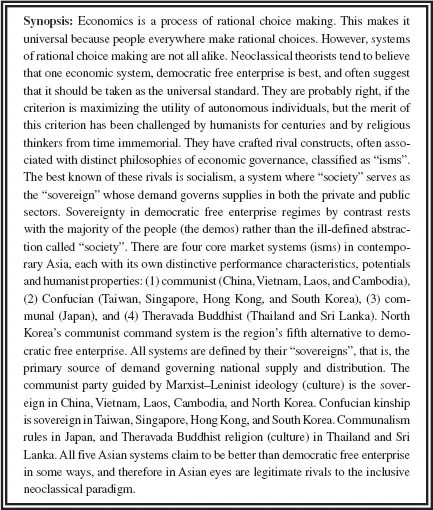
This liberal approach is particularly important in Asia where all systems have some coercive aspects. North Korea’s communist regime is the most despotic. Communist China, Laos, Vietnam and Cambodia are more permissive in the household and civic spheres, but remain politically repressive, while Japan, South Korea, Taiwan, and Thailand are maturing democracies with elements of market competition, and civil liberties. The restrictive dimension of Japan’s, South Korea’s, Taiwan’s, and Thailand’s systems judged from the standpoint of the American democratic free enterprise model mostly reflect consensus cultural values (isms) and are voluntary from this perspective. They are approved by the vast majority even though they violate individualist neoclassical textbook principles of economic efficiency and national welfare maximizing. The restrictive dimensions of China’s, Laos’s, Vietnam’s and Cambodia’s regimes by contrast are involuntary because they are imposed by their communist parties.
Modernization
The wealth of nations is not determined solely by systems. Endowments, the vicissitudes of time, war, taste, market size and scope generate windfall gains and losses that influence relative international prosperity.Wealth, income and power are continuously being reconfigured. The United States was a primitive wilderness in 1776, but a century later it had become affluent despite the civil war. For a time it seemed that America’s standing in the global order might be surpassed by Soviet Russia, Nazi Germany and Japan. Perhaps someday it will be eclipsed by China and India, but the important point to appreciate is that nations which surge ahead create opportunities for those left behind, a phenomenon described in the literature as the advantage of relative economic backwardness. Laggards not only find themselves in a position to copy, and borrow advanced technologies, but businessmen in leading countries are lured by the prospect of huge profits to bring superior techniques to less developed nations. Low factor costs created by the low value-added characteristic of developing economies draw outsourcers and other direct foreign investors, transferring superior technologies to the poor at no or little recipient cost. The process may modify their cultures, but this is not necessary. Nations can modernize; adopting advanced technologies that narrow the gap between rich and poor countries without discarding their systems. During much of the catch up, inferior economic systems may shine, exhibiting impressive rates of sustained GDP growth despite embedded inefficiencies. However, the miracle seldom lasts. Japan once seemed to possess a superlative economic system, but when the advantages of relative economic backwardness vanished, the underlying shortcomings became apparent.12
Inclusive Systems
Economic systems provide citizens with private and public goods.13 It is important therefore to avoid making a false dichotomy between government administration and economics. The term “inclusive” emphasizes this unity. Democratic free enterprise system provides a familiar example. In true democracies public goods are supplied by elected officials in accordance with the individual preferences of the majority,14 and private goods are supplied by competitive markets. The two mechanisms do not have to be homogeneous. Free enterprise in the private sector can be paired with authoritarian state provision of public goods.
Democratic Competitive Ideal
Neoclassical economic theory teaches that every individual can actualize his or her full human potential within limits imposed by bounded rationality,15 under the rule of law, through market competition in the private sector and democratic governance in the public domain. The competitive and democratic assumptions exclude the possibility of monopolistic distortions and insider governance although this condition can be softened by invoking the concept of workable competition.16 All individuals in the perfectly competitive paradigm are assumed to have equal political, civil and business opportunity. They advance their wellbeing by utility seeking in the private sector, and availing themselves of democratic government services whenever the state is a least cost provider. The primary functions of democratic government are providing public services, administering the law, and regulating the economy as the majority desires, subject to various constitutional protections.
The characteristics of this best can be illustrated in the factor, production, distribution and income transfer spaces with standard geometry, assuming that utility seekers offer their labor to the point where the value of leisure and additional work at the margin are equal, and employers hire workers until the value of their marginal products equal the competitive wage. Employers profit maximize, given competitively determined product prices, and employees utility maximize, earning incomes and enjoying leisure given equilibrium wages. As a consequence, consumers are sovereign; that is, the supplies produced competitively maximize their utility.
Most consumer goods are bought in retail outlets, where once again profit maximizing and utility maximizing govern product distribution to final buyers. If people are uncharitable, this constitutes the social welfare maximum otherwise, the analysis proceeds to the goods transfer space, where each individual decides how much of his or her income should be bestowed upon others.
Each phase of the competitive maximization process in the private sector is governed by a logic known as Pareto optimality,17 where transactions continue until it is impossible to voluntarily improve one person’s utility without diminishing the utility of another. The composite maximization is often described as Pareto ideal, or a Pareto general equilibrium, and applies to all business and civic activities. Public programs operate according to similar principles, but differ in important details because balloting provides officials with less information about people’s preferences than direct face-to-face discussion and negotiation.
Pareto Efficiency
These concepts can be expressed graphically with the aid of analytic geometry. The exercise provides a useful benchmark for pinpointing, assessing and evaluating the inefficiencies of Asia’s diverse systems. There are four spaces that require close consideration: factor, production, distribution and welfare.
Factor supply and allocation in the private sector are connected with production in the Edgeworth-Bowley box displayed in Fig. 1.1. The coordinate axes forming the sides of the box indicate voluntary equilibrium supplies of capital (k) and labor (l). The sides end where the derived utility in consumption of each factor is just equal to the foregone value of leisure. Their dimensions can change with the credit supply and workers attitudes toward leisure. Tightened credit and increased leisure reduce GDP, but this will be optimal if it maximizes utility even though it might superficially seem like a depression.
The box’s in...