![]()
1
INTRODUCTION
Hooman Peimani
Global warming is surely the most formidable challenge of the 21st century as its consequences have affected and will continue to affect the survival of our planet. Although there are still some scientists, representing a minority view, who deny this as a global phenomenon, major climatic changes reflected, for example, in frequent droughts, forest fires, floods and rising sea levels in different parts of the world, including the Asia-Pacific region, serve as evidence to the contrary. Among those who acknowledge it as a global reality, some attribute it to natural and periodic changes, which have been in place for millions of years creating consecutive long or short phases of global warming and global cooling. Hence, the ongoing global warming is simply yet another episode of warming based on the natural pattern of climatic change being a characteristic of our planet caused mainly by terrestrial and celestial factors. Unnatural factors caused by the activities of the human race are not the causes of this phenomenon although they may have some local implications, as the view holds. Yet, global warming has now been accepted by the majority of scientists concerned with climatic changes and just about all governments as a real and expanding phenomenon with short-and long-term dire consequences should it continue. Accordingly, the human-made emission of greenhouse gases (GHG) is the main cause of this phenomenon. Within this context, the main problem is CO2, which is generated primarily by the heavy global consumption of fossil fuels (oil, gas, and coal), a phenomenon that has been in place over the last two centuries. It has had various manifestations in different parts of the world, including destruction of forests caused by frequent fires, rapid depletion of water resources, desertification and rapid/permanent melting ice. The latter has been manifested in the rapid melting of glaciers in different parts of the world (e.g., those of the Himalaya) and the melting of the Arctic ice.
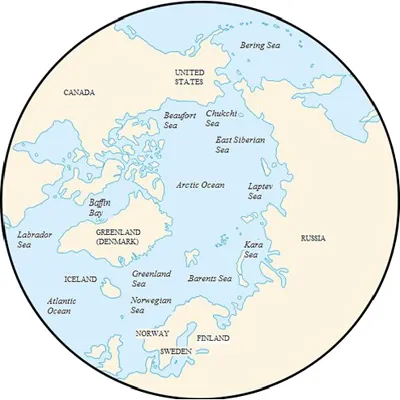
Fig. 1.1. Arctic Region. Source: Author's creation based on Arctic blank map by Radostaw Botev. http:// en.wikipedia.org/wiki/File:Arctic blank map.png
1.1. CONTEXT FOR THE ARCTIC'S DEBATE: CHALLENGES
Hence, global warming underlies the Arctic debate, which is the focus of this book, and has various implications ranging from environmental to energy security. While melting of some land-based large concentrations of ice (glaciers) may have, at least initially, local implications, the melting of huge floating Arctic ice is a major development with global implications. In other words, this phenomenon, if it continues, will pose formidable challenges, given its disastrous short-and long-term environmental consequences, and will seriously question the survival of this planet and its living creatures in worst-case scenarios. Apart from worsening global warming, which will substantially diminish the world's largest cooling source, the melting of the Arctic ice will eventually trigger a process affecting all glaciers to varying extents, especially the one in Greenland, which is the world's largest. This process will prompt sea levels to rise over time at a rate faster than what we are witnessing today. The International Panel on Climate Change (IPCC) projections are alarming enough for the benchmark year of 2100. Thus far, the rise is projected to be 14.61 inches (37.11 centimetres) and 19.13 inches (48.59 centimetres) for A1B1 and A1FI2 scenarios.3 The IPCC estimated that the Arctic could be free of summer sea ice somewhere between 2050 and 2080,4 and 10% (possibly as much as 50%) of the Arctic tundra could be replaced by forests by 2100.5 Apocalyptical results could be expected in the case of a total melting of the Arctic ice, which, in turn, would melt the Greenland ice and raise the sea level by 7 meters.6
1.2. OPPORTUNITIES: EXPLORATION OF RESOURCES AND NAVIGATION
The gradual melting of the Arctic is surely serious because of all its negative environmental implications, not only for the Arctic region, but also for the rest of the world. The resulting damage to the environment will eventually and inevitably affect other sectors, including the economic, political, and social ones. Yet, in the short-and possibly medium-term, the gradual melting of the ice could provide certain opportunities, such as energy extraction and mining, as the Arctic region is rich in fossil fuels, particularly oil and gas, as well as minerals. Directly related to this, the possibility of ice-free sea routes, for at least a few months of the year, through the Arctic could stimulate intercontinental trade. In short, this unfortunate environmental event could have certain benefits for a limited period of time, as will be briefly discussed in the following sections.
1.2.1. Energy
Based on the currently available data, the Arctic is the last known region of the world with vast untapped reserves of oil and gas as well as large coal deposits. Of course, there are various estimates of the size of the resources under the ice and in the deep sea, which can be confirmed only when major exploration projects begin. Moreover, it is still uncertain, though there are estimates, as to just how much of these resources are commercially retrievable given the high cost of deep sea oil/gas extraction in such a climatically-hostile environment. Nevertheless, based on mean estimates, the entire region — consisting of those areas within the Arctic state's territorial boundaries — and the rest of the region, including the disputed areas, has at least 90 billion barrels of undiscovered oil.7 The mean estimates for undiscovered natural gas and natural gas liquids are 47.2891 trillion cubic meters and 44 billion barrels, respectively.8
1.2.2. Minerals
The Arctic contains large quantities of various minerals, including precious metals and stones. They include nickel, copper, tin, uranium, phosphate, lead, zinc, gold, apatite, alumina, iron ore, mica, titanium, phlogopite, vermiculite, niobium, tantalite, quartz, fluorite, barite, calcite, amethyst, amazonite, and diamonds.9 Their estimated value of US$1.5–2 trillion clearly indicates the reason for their importance to the regional states.10 In this regard, the following examples are noteworthy as they reflect the regional and global significance of the Arctic minerals. In the American Arctic part, Alaska has major reserves of minerals, plus large reserves of zinc and lead. The Red Dog mine, for instance, is a zinc/lead mine located within the boundaries of the Red Dog Mine census-designated place. The world's largest producer of zinc in its heyday, and also the largest mineral producer in the state of Alaska in 2009, accounting for 53.3% of its annual production, it now has the world's largest zinc reserves. At the end of 2009, the most recent year for which data is available, the mine had reserves of 67.66 million tons of zinc of 16.6–20% grade and 67.66 million tons of lead of 4.4–5.4% grade.11
Canada's Arctic section is also rich in minerals. For example, its iron deposits are significant for their size and production capabilities, as evident in the case of an undertaking by the Baffinland Iron Mines Corporation. Currently, this corporation is developing a large open pit iron mine in the Mary River area of Baffin Island, Nunavut, Canada, which consists of nine high-grade iron ore deposits.12 Scheduled to make its first commercial ore shipments in September 2014, the mine is expected to produce 18 million tons of iron ore per year for 20 years.13
The European Arctic section is rich in minerals similar to the North American section. Iron ore is also in abundance here. As a Greater Arctic country, Sweden contains the region's largest iron-bearing area in Swedish Lapland, of which the total discovered reserves (mainly magnetite and hematite) are estimated to be 2,413 million metric tons.14 Norway also has large deposits of iron ore, including about 1,000 million tons in its Northern part (Sør-Varanger) and a large reserve of iron ore has also recently been surveyed at Kolari in northwest Finland.15
1.2.3. Northern sea route and North-West passage
The melting of the Arctic ice, if it continues, will result in part of the Arctic becoming ice-free for a few months each year in the future. If this happens, it will be possible to navigate between the Atlantic and Pacific Oceans via the Arctic and thus through the Northern Sea Route via the Russian Arctic and the Northwest Passage via the Canadian Arctic, which will be significantly shorter than the currently-used Southern Sea Route through the Suez Canal and the Strait of Malacca.Today, the travelling distance for a ship from Murmansk in Russia to Yokohama in Japan via the Suez Canal is 20,554 kilometres, but it would be only 9,232 kilometres through the Arctic (Northern Sea Route).16 Likewise, the distance between South Korea and the Netherlands is about 20,320 kilometres via the Southern Sea Route, while it would be only approximately 14,720 kilometres via the Northern Sea Route.17
Such a possibility could, and likely would, facilitate, indeed, encourage trade between Europe, North America and the Northeastern part of Asia (Asia-Pacific region) by reducing the cost of intercontinental exports/imports. Heavy sea traffic through the Arctic for a few months of the year would certainly contribute to large-scale air and water pollution, further contributing to the region's warming with obvious negative environmental impacts on the Arctic and subsequently the rest of the world. Apart from its environmental dimension, such traffic could potentially and significantly affect sea traffic through the Southern Sea Route as Asian, European, and North American countries with access to the Arctic sea routes would likely have a strong incentive to conduct part of their inter-continental trade through them during its few months of availability.
Today, no one can predict the real extent of cargo and possibly oil and liquefied natural gas (LNG) tanker traffic, through these routes to determine the impact on the Southern Route. To start with, large-scale commercial use of the Northern Sea Route, which is comparatively more developed than the North-West Passage and thus more likely to be used at a relatively significant scale in the foreseeable future, requires the route remaining ice-free for a few months a year or at least a situation close to being ice-free requiring limited use of icebreakers to keep the route navigable. This would enable unhindered navigation of large cargo ships and/or sea tankers. Contingent on the continuation of global warming, such scenarios are predicted to happen sometime in the future, but the approximate date is disputed by various scholars. Thus, estimates for an ice-free Northern Sea Route in summer, prolonging the sailing season from the current 20–30 days to about 120 days range from as early as 2013 to as late as 2080, but most estimates fall between 2040 and 2060.18 According to research carried out by Cambridge University, as presented by Professor Peter Wadhams in 2011, the sea route could well be available even sooner than 2013 as the whole North Pole could be “ice-free in just a few year's time, all gone by the summer of 2015.”19 The total disappearance of the Arctic Ocean by 2015 is of course a nightmare scenario given the calamitous consequences for which no country is prepared.
One should hope that the required global efforts, hinging on a substantial decrease of GHG emissions, will take place soon enough to end or at least slow down global warming to avoid its catastrophic effects, including a significant and steady melting of the Arctic ice. Nevertheless, if the melting of the Arctic ice continues, the availability of the Northern Sea Route for a few months a year will certainly decrease cargo/tanker traffic via the Southern Sea Route for those countries with access to the Northern Sea Route, with obvious negative economic implications for the countries along the Southern Sea Route. There should also be a decrease in the geostrategic importance of this route and, by default, its respective countries. However, the mentioned negative consequences should be limited given that the bulk of intercontinental trade will have to be conducted through the Southern Sea Route in any case, given that the use of the Arctic routes, including the Northern Sea Route, would not be a geographically feasible option for such trade involving Southern European, Southern American, West and South Asian and many Asia-Pacific countries. In particular, the large and growing intraregional trade, such as that from the Asia-Pacific region, will still have to be done through the Southern Sea Route regardless of the availability of the Arctic sea routes.
1.2.4. Immediate and aspiring beneficiaries
Assuming that the current environmentally disastrous trend continues, the melting of the Arctic ice will open doors for certain economic activities of not just regional, but also global significance, including oil and gas extraction, mining and intercontinental navigation. Without a doubt, the main immediate beneficiaries of such activities are the five littoral states, namely: Canada, Denmark/Greenland, Norway, Russia and the United States. By virtue of sharing parts of the region, they have direct access to it as well as opportunities to expand into the unchartered and/or disputed parts of the Arctic. Moreover, the bulk of the region's known mineral and energy (oil and gas) resources fall within their territories and exclusive economic zones (EEZ). These resources are unevenly distributed and leave certain countries, such as Russia, in a much better situation than others. Indeed Russia has the largest share of the region's energy resources. Parts of the region (mainly its sea sections) are disputed, pitting concerned littoral countries against each other, e.g., parts of the Barents Sea over which both Norway and Russia claim ownership. Undoubtedly, the five littoral states are very much interested in the prospect of carrying out part of their intercontinental trade through the Arctic sea routes, if they become a reality. By significantly decreasing the shipping costs of their trade, these routes are certainly too tempting to be ignored, especially because all of them have been hard hit by the last decade's financial/economic crises, continuing to this date . The importance of the routes is also linked to a negative economic trend, which started most notably in the 1990s as a result of the littoral state's loss of their economic strength to the emerging economies of Asia and Latin America. For Russia, the Soviet Union's fall and subsequent loss of its economic strength and also its secured markets of the Soviet block and its non-communist allies are yet to be compensated. Hence, lower export costs for Russian pro...