![]()
CHAPTER 2
IL–1: IDEALIZED SITUATION
Since the existing logic systems are mostly designed for axiomatic systems, establishing NAL on AIKR is not a trivial job. We will see in the following that none of the major components of classical logic can be accepted into NAL in its current form. To simplify the design and analysis of NAL, we start from an idealized situation, where AIKR can be temporarily ignored.
In this chapter, we introduce an
Inheritance Logic, or IL [Wang (1994b)]. IL is an
idealized version of NAL, in the sense that it is similar to NAL in grammar, semantics, and inference rules, though it assumes
sufficient knowledge and resources. Therefore, IL is not a “non–axiomatic” logic, but a step in building such a logic. Just like NAL, IL is also built with layers. For each layer
the corresponding
is defined first, then the effect of insufficient knowledge and resources is introduced, to turn
into
This chapter defines IL–1, the simplest inheritance logic.
1In the history of logic, there are two major traditions: a “term logic” tradition exemplified by Aristotle (1882) and Sommers (1982), and a “predicate logic” tradition exemplified by Frege (1999) and Whitehead and Russell (1910). Though at the present time the latter is the dominating paradigm, NAL and IL belong to the former. The reasons of this important decision will be gradually explained in the following chapters.
2.1. Categorical Language
The simplest sentence in a predicate logic has a
“predicate–arguments” format, such as
P(a1,..., an), where
P is the
predicate symbol, while each
ai is an
argument of the predicate. On the contrary, the simplest sentence in a term logic has a
“subject–copula–predicate” format, which is often called a “categorical sentence”, and a language consisting of such sentences is called a “categorical language”. Since term logic uses this type of language, it is sometimes called “categorical logic” [Smith (2012)].
Narsese is a categorical language, and IL uses a version of it. The smallest component of the language is a “term”, which, in its simpest form, is an identifier used in the logic.2
Definition 2.1. The basic form of a term is a word, that is, a string of characters from a finite alphabet.
There is no additional requirement on the alphabet. In this book, the alphabet includes English letters, digits 0 to 9, and a few special signs, such as hyphen (‘–’). In the examples, we often use common English nouns for terms, such as bird and animal, just to make the examples easy to understand. There is no problem to do the same in a different natural language, such as Chinese. On the other hand, it is also fine to use terms that are meaningless to human beings, such as drib and aminal.
Definition 2.2. The basic form of a
statement is an
inheritance statement, where
S is the
subject term, P is the
predicate term, and
is the
inheritance copula, defined as being a
reflexive and transitive relation from one term to another term.
Graphically, an inheritance statement can be represented as two vertices connected by a directed edge. Its direction is purely conventional, though usually it is taken to be from the subject to the predicate.
The intuitive meaning of
is
“S is a special case of
P” or
“P is a general case of
S”. For example, “Bird is a type of animal” can be represented in Narsese as
Now we begin to see the difference between IL, as a term logic, and a predicate logic, like FOPL (First–Order Predicate Logic). The same example is typically represented in FOPL as a proposition
where predicates
Bird and
Animal both take variable x as argument, and
is the implication operator defined in propositional logic.
3 Though the IL statement and the FOPL proposition have similar meanings, they are based on different ontological presumptions. FOPL presumes objects (represented by
arguments) with properties and relations (represented by
predicates), while IL presumes categories (represented by
terms) within a generalization hierarchy (established by
inheritance). One consequence of this difference is that in FOPL “predicates” and “arguments” are disjoint sets, while in IL (and NAL) “subject term” and “predicate term” are defined
relatively, with respect to a certain statement, in the sense that the subject term of a statement (like the
“bird” in
“bird →
animal”) can be the predicate term of another statement (like “
dove →
bird”), which is also the case in other term logics, such as Aristotle’s Syllogistic. Therefore, the “predicate symbol” in FOPL and the “predicate term” in IL are not the same, though they are intuitively related to each other.
We can also compare IL with set theory, where the above example can be represented as
“Bird Animal” with
Bird and
Animal being sets. Since the
subset relation is both reflexive and transitive,
Table 2.1. The grammar rules of IL–1.
it is just like the inheritance relation. Here the difference is that inheritance is defined between two terms, which are not sets in general. For example, “Water is a type of liquid” that can be similarly represented in IL as “water → liquid”, though the two terms cannot be naturally considered as sets. More differences between term and set will be introduced later.
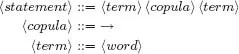
The representation language used in IL–1 contains inheritance statements as sentences, as defined by the grammar rules in Table 2.1. All grammar rules in this book are represented using a variant of the Backus Naur Form (BNF) specified in Appendix A.
2.2. Experience–Grounded Semantics
The semantic theory of IL–1 defines the truth–value of a statement, as well as the meaning of a term.
Definition 2.3. The truth–value of a statement in IL is either true or false.
Therefore, IL is a binary logic, like most of the existing logic systems.
From the relevant definitions, some theorems can be proved, as conclusions about IL.4 The proofs of the theorems in this book are collected in Appendix D. The following theorems directly come from the reflexivity and transitivity of the inheritance copula.
Theorem 2.1. For any term X, statement is true. Following the tradition of logic, such a statement is called a tautology.
Theorem 2.2. For any term X, Y, and Z, if both “X →Y ” and “Y → Z” are true, so is “X → Z”.
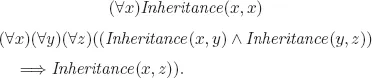
Treating an IL statement as a proposition, the above theorems can be expressed in FOPL as
The inheritance relation is neither symmetric nor anti–symmetric. That is, for different X and Y, given “X → Y” alone, the truth–value o...