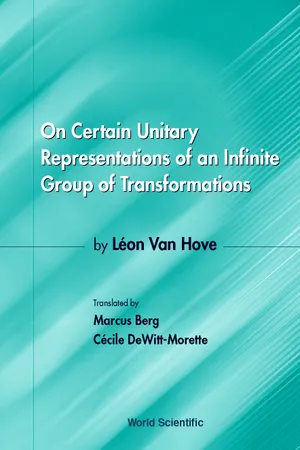
On April 20, 1951, Léon Van Hove presented his thesis "Sur certaines représentations unitaires d'un groupe infini de transformations' to the Université libre de Bruxelles (Free University of Brussels), two days before the University of Grenoble had approved the creation of L'Ecole d'été de physique théorique at Les Houches (Haute Savoie, France). The first session of the "Ecole des Houches" began on July 15, 1951, with a month-long course by Van Hove on quantum mechanics. The lecture notes for this course were written for the benefit of physicists who — like most of their colleagues outside the US, Canada, and England at that time — did not know quantum mechanics but wanted to learn it seriously. Van Hove's course met their expectations fully. The physics course benefitted from the mathematical expertise of the lecturer, which is also apparent in this thesis. Without his own research as scaffolding, Van Hove could not have built the short and beautiful course which provided the participants with a solid, useful foundation in modern physics.The lecture notes are in French. If they had been in English they would have been published together with the translation of the thesis. The first three pages of the notes are reproduced at the end of this book. The set of notes was reproduced by stencils and distributed to the participants at the beginning of the course.The translation of Léon Van Hove's thesis was initiated in late 2000, when Bob Hermann, formerly in the Department of Mathematics at MIT, sent to Van Hove's son Michel his view on the thesis: "I would consider it as one of the most important mathematical physics papers of the past fifty years, containing the key ideas for what has become known as 'geometric quantization.'" Indeed, the thesis is interesting both to historians of science and to theoretical physicists and mathematicians exploring the relationships between quantum and classical physics, based on the Hilbert-space approach to classical mechanics.
eBook - PDF
On Certain Unitary Representations Of An Infinite Group Of Transformations - Thesis By Leon Van Hove
Thesis by Léon Van Hove
- 103 pages
- English
- PDF
- Available on iOS & Android
eBook - PDF
On Certain Unitary Representations Of An Infinite Group Of Transformations - Thesis By Leon Van Hove
Thesis by Léon Van Hove
About this book
Information
Topic
Ciencias biológicasSubtopic
Ciencias en generalTable of contents
- Table of Contents
- FOREWORD
- FOREWORD TO THE TRANSLATION
- CHAPTER I Introduction and Review.
- CHAPTER II The Group of Transformations That Leaves Invariant the Pfaff Form ds — ΣPjdqj.
- CHAPTER III Unitary Representations R and R(α)of the Group Γ.
- CHAPTER IV Infinitesimal Transformations in the Representations R and R(α).
- CHAPTER V Irreducibility of the Representations R(α)
- CHAPTER VI Comparison Between Quantum Mechanical and Classical Operators
- References
Trusted by 375,005 students
Access to over 1.5 million titles for a fair monthly price.
Study more efficiently using our study tools.
Frequently asked questions
Yes, you can cancel anytime from the Subscription tab in your account settings on the Perlego website. Your subscription will stay active until the end of your current billing period. Learn how to cancel your subscription
No, books cannot be downloaded as external files, such as PDFs, for use outside of Perlego. However, you can download books within the Perlego app for offline reading on mobile or tablet. Learn how to download books offline
Perlego offers two plans: Essential and Complete
- Essential is ideal for learners and professionals who enjoy exploring a wide range of subjects. Access the Essential Library with 800,000+ trusted titles and best-sellers across business, personal growth, and the humanities. Includes unlimited reading time and Standard Read Aloud voice.
- Complete: Perfect for advanced learners and researchers needing full, unrestricted access. Unlock 1.5M+ books across hundreds of subjects, including academic and specialized titles. The Complete Plan also includes advanced features like Premium Read Aloud and Research Assistant.
We are an online textbook subscription service, where you can get access to an entire online library for less than the price of a single book per month. With over 1.5 million books across 990+ topics, we’ve got you covered! Learn about our mission
Look out for the read-aloud symbol on your next book to see if you can listen to it. The read-aloud tool reads text aloud for you, highlighting the text as it is being read. You can pause it, speed it up and slow it down. Learn more about Read Aloud
Yes! You can use the Perlego app on both iOS and Android devices to read anytime, anywhere — even offline. Perfect for commutes or when you’re on the go.
Please note we cannot support devices running on iOS 13 and Android 7 or earlier. Learn more about using the app
Please note we cannot support devices running on iOS 13 and Android 7 or earlier. Learn more about using the app
Yes, you can access On Certain Unitary Representations Of An Infinite Group Of Transformations - Thesis By Leon Van Hove by Marcus Berg, Cecile Dewitt-morette in PDF and/or ePUB format, as well as other popular books in Ciencias biológicas & Ciencias en general. We have over 1.5 million books available in our catalogue for you to explore.