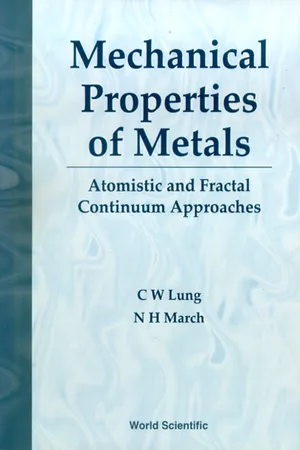
The book is intended to describe the basic and newly developed elements of the physics of solids and materials science on mechanical properties of metals with as much continuity as is possible. Particular emphasis has been placed in atomistic and fractal approaches and continuum theory of dislocations is also introduced. Since the book is meant for the two main topics of progress in recent years, some interesting and important topics which have not been discussed or introduced are given in detail.For a long time, pair potentials were used very expensively in simulation studies. They can reproduce usefully total energies for many systems. But when one turns to elastic properties, fracture of surfaces, and the vacancy formation energy, deficiencies and limitations begin to emerge. These limitations of the simple pair potential approximation have been addressed by the development of empirical many-body potentials which is the major theme of our book.Over a decade or more, diverse scientists have recognized that many of the structures common in their experiments have a special kind of geometrical complexity. The key to this progress is the recognition that many random structures obey a symmetry that objects look the same on many different scales of observation. The concept of fractals was introduced by Mandelbrot and applied to fractures by himself and collaborators. Their work pointed to a correlation between toughness and the fractal dimension. Our interest is the fractal aspects of fractured surfaces. We will discuss more in our book.The strain field of a dislocation has a long range part and this part can be discussed rigorously from elasticity theory. Recent progress in elastic strain fields and dislocation mobility were made by Indenbom and Lothe. The elementary essentials will be introduced in our book.
eBook - PDF
Mechanical Properties Of Metals
Atomistic and Fractal Continuum Approaches
- 415 pages
- English
- PDF
- Available on iOS & Android
eBook - PDF
About this book
Information
Table of contents
- Preface
- CONTENTS
- Chapter 1 Background and Some Concepts
- Chapter 2 Phenomenology and Experiments
- Chapter 3 Introduction to Extended Defects and Mechanical Strength
- Chapter 4 Some Characteristic Features of Fractals
- Chapter 5 Elastic Moduli and More General Phonon Properties
- Chapter 6 Elements of Electronic Structure Theory
- Chapter 7 Theory of Pair Potentials in Simple s-p Metals
- Chapter 8 Transcending Pair Potentials: Glue Models of Interatomic Forces
- Chapter 9 Positron Annihilation: Experiment and Theory
- Chapter 10 Stretched Chemical Bonds, Electron Correlation and Extended Defect Propagation
- Appendix
- References
Trusted by 375,005 students
Access to over 1.5 million titles for a fair monthly price.
Study more efficiently using our study tools.
Frequently asked questions
Yes, you can cancel anytime from the Subscription tab in your account settings on the Perlego website. Your subscription will stay active until the end of your current billing period. Learn how to cancel your subscription
No, books cannot be downloaded as external files, such as PDFs, for use outside of Perlego. However, you can download books within the Perlego app for offline reading on mobile or tablet. Learn how to download books offline
Perlego offers two plans: Essential and Complete
- Essential is ideal for learners and professionals who enjoy exploring a wide range of subjects. Access the Essential Library with 800,000+ trusted titles and best-sellers across business, personal growth, and the humanities. Includes unlimited reading time and Standard Read Aloud voice.
- Complete: Perfect for advanced learners and researchers needing full, unrestricted access. Unlock 1.5M+ books across hundreds of subjects, including academic and specialized titles. The Complete Plan also includes advanced features like Premium Read Aloud and Research Assistant.
We are an online textbook subscription service, where you can get access to an entire online library for less than the price of a single book per month. With over 1.5 million books across 990+ topics, we’ve got you covered! Learn about our mission
Look out for the read-aloud symbol on your next book to see if you can listen to it. The read-aloud tool reads text aloud for you, highlighting the text as it is being read. You can pause it, speed it up and slow it down. Learn more about Read Aloud
Yes! You can use the Perlego app on both iOS and Android devices to read anytime, anywhere — even offline. Perfect for commutes or when you’re on the go.
Please note we cannot support devices running on iOS 13 and Android 7 or earlier. Learn more about using the app
Please note we cannot support devices running on iOS 13 and Android 7 or earlier. Learn more about using the app
Yes, you can access Mechanical Properties Of Metals by C W Lung, Norman H March in PDF and/or ePUB format, as well as other popular books in Biological Sciences & Science General. We have over 1.5 million books available in our catalogue for you to explore.