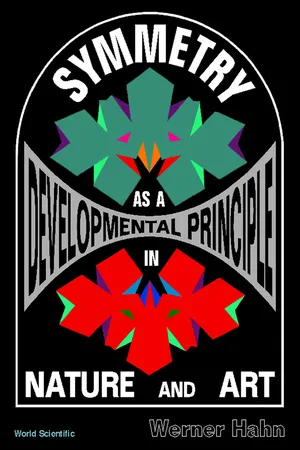
Looking beyond the boundaries of various disciplines, the author demonstrates that symmetry is a fascinating phenomenon which provides endless stimulation and challenges. He explains that it is possible to readapt art to the sciences, and vice versa, by means of an evolutionary concept of symmetry. Many pictorial examples are included to enable the reader to fully understand the issues discussed. Based on the artistic evidence that the author has collected, he proposes that the new ars evolutoria can function as an example for the sciences.The book is divided into three distinct parts, each one focusing on a special issue. In Part I, the phenomenon of symmetry, including its discovery and meaning is reviewed. The author looks closely at how Vitruvius, Polyclitus, Democritus, Plato, Aristotle, Plotinus, Augustine, Alberti, Leonardo da Vinci and Durer viewed symmetry. This is followed by an explanation on how the concept of symmetry developed. The author further discusses symmetry as it appears in art and science, as well as in the modern age. Later, he expounds the view of symmetry as an evolutionary concept which can lead to a new unity of science. In Part II, he covers the points of contact between the form-developing process in nature and art. He deals with biological questions, in particular evolution.The collection of new and precise data on perception and knowledge with regard to the postulated reality of symmetry leads to further development of the evolutionary theory of symmetry in Part III. The author traces the enormous treasure of observations made in nature and culture back to a few underlying structural principles. He demonstrates symmetry as a far-reaching, leading, structuring, causal element of evolution, as the idea lying behind nature and culture. Numerous controllable reproducible double-mirror experiments on a new stereoscopic vision verify a symmetrization theory of perception.
- 533 pages
- English
- PDF
- Available on iOS & Android
eBook - PDF
Symmetry As A Developmental Principle In Nature And Art
About this book
Information
Table of contents
- TABLE OF CONTENTS
- ACKNOWLEDGEMENT
- INTRODUCTION
- FOREWORD
- SECTION I ON THE CONCEPT AND SIGNIFICANCE OF SYMMETRY
- SECTION II ON THE PROBLEM OF ORGANIC FORM DEVELOPMENT
- SECTION III EVOLUTIONISM/ARS EVOLUTORIA — THEORY ON LIGHT/COLOUR AND FORM, MORPHOGENESIS, MORPHO-MUTABILITY AND MORPHO-EVOLUTION AS CAUSAL FORM THEORY
- Colour Plates
- LITERATURE AND FIGURE SOURCES
- AUTHOR INDEX
- SUBJECT INDEX
Trusted by 375,005 students
Access to over 1.5 million titles for a fair monthly price.
Study more efficiently using our study tools.
Frequently asked questions
Yes, you can cancel anytime from the Subscription tab in your account settings on the Perlego website. Your subscription will stay active until the end of your current billing period. Learn how to cancel your subscription
No, books cannot be downloaded as external files, such as PDFs, for use outside of Perlego. However, you can download books within the Perlego app for offline reading on mobile or tablet. Learn how to download books offline
Perlego offers two plans: Essential and Complete
- Essential is ideal for learners and professionals who enjoy exploring a wide range of subjects. Access the Essential Library with 800,000+ trusted titles and best-sellers across business, personal growth, and the humanities. Includes unlimited reading time and Standard Read Aloud voice.
- Complete: Perfect for advanced learners and researchers needing full, unrestricted access. Unlock 1.5M+ books across hundreds of subjects, including academic and specialized titles. The Complete Plan also includes advanced features like Premium Read Aloud and Research Assistant.
We are an online textbook subscription service, where you can get access to an entire online library for less than the price of a single book per month. With over 1.5 million books across 990+ topics, we’ve got you covered! Learn about our mission
Look out for the read-aloud symbol on your next book to see if you can listen to it. The read-aloud tool reads text aloud for you, highlighting the text as it is being read. You can pause it, speed it up and slow it down. Learn more about Read Aloud
Yes! You can use the Perlego app on both iOS and Android devices to read anytime, anywhere — even offline. Perfect for commutes or when you’re on the go.
Please note we cannot support devices running on iOS 13 and Android 7 or earlier. Learn more about using the app
Please note we cannot support devices running on iOS 13 and Android 7 or earlier. Learn more about using the app
Yes, you can access Symmetry As A Developmental Principle In Nature And Art by Werner Hahn in PDF and/or ePUB format, as well as other popular books in Biological Sciences & Science General. We have over 1.5 million books available in our catalogue for you to explore.