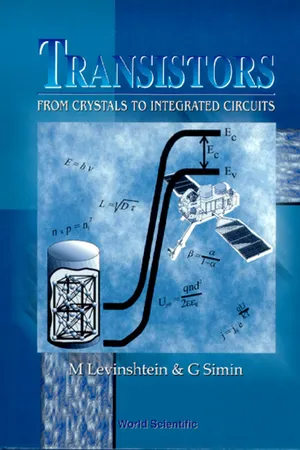
This new book by M Levinshtein and G Simin tells the readers about the design and work of the most important and most interesting semiconductor devices — the transistors.The book is written in a friendly and easy to read manner and is meant primarily for young people, high school students, freshmen and sophomores. However, the original approach to semiconductor physics makes this book attractive to physics teachers and professors as well.The book consists of 3 parts:Part I: The section on semiconductors describes the main properties of semiconductors, explains the difference between the semiconductors, metals and dielectrics. We find here the explanation of the appearance of those wonderful properties of semiconductors which underlie their numerous applications. This part also contains a vivid and detailed description of the main types of motion of the charge carriers in semiconductors: thermal motion, motion in the electric field and diffusion.Part II covers Barriers and Junctions. In order to understand the principles of the work of the most important semiconductor devices, it is not sufficient just to get to know the properties of semiconductors. It is also quite essential to study certain specific and interesting phenomena — the so-called junctions. This part of the book contains a detailed and vivid description of those properties and in that view of the properties of the p-n junctions and diodes: photodiodes, varicaps, light emitting diodes, solar cells and rectifier diodes.Part III covers Transitors. It describes the basis of the work of the Bipolar and Field Effect Transistors. Without making use of rather complicated equations or notions of quantum mechanics the authors give a clear and simple explanation of the cause of ability of those devices to amplify and generate electric signals. They tell the readers how transistors are manufactured and describe the work of the transistor's simplest circuits.The last chapter of the book is devoted to the ideas underlying the transistors: integrated circuits. It is these integrated circuits which are the foundation of modern electronics: from telephone apparatus to supercomputers, from medical instruments to cosmic communication systems.In conclusion, the authors make an attempt to foresee and imagine, together with the reader what other devices may come to substitute the transistor in the future.
eBook - PDF
Transistors: From Crystals To Integrated Circuits
From Crystals to Integrated Circuits
- 255 pages
- English
- PDF
- Available on iOS & Android
eBook - PDF
Transistors: From Crystals To Integrated Circuits
From Crystals to Integrated Circuits
About this book
Information
Table of contents
- Contents
- Preface
- Introduction
- Part I Semiconductors
- Part II Barriers & Junctions
- Part III Transistors
Trusted by 375,005 students
Access to over 1.5 million titles for a fair monthly price.
Study more efficiently using our study tools.
Frequently asked questions
Yes, you can cancel anytime from the Subscription tab in your account settings on the Perlego website. Your subscription will stay active until the end of your current billing period. Learn how to cancel your subscription
No, books cannot be downloaded as external files, such as PDFs, for use outside of Perlego. However, you can download books within the Perlego app for offline reading on mobile or tablet. Learn how to download books offline
Perlego offers two plans: Essential and Complete
- Essential is ideal for learners and professionals who enjoy exploring a wide range of subjects. Access the Essential Library with 800,000+ trusted titles and best-sellers across business, personal growth, and the humanities. Includes unlimited reading time and Standard Read Aloud voice.
- Complete: Perfect for advanced learners and researchers needing full, unrestricted access. Unlock 1.5M+ books across hundreds of subjects, including academic and specialized titles. The Complete Plan also includes advanced features like Premium Read Aloud and Research Assistant.
We are an online textbook subscription service, where you can get access to an entire online library for less than the price of a single book per month. With over 1.5 million books across 990+ topics, we’ve got you covered! Learn about our mission
Look out for the read-aloud symbol on your next book to see if you can listen to it. The read-aloud tool reads text aloud for you, highlighting the text as it is being read. You can pause it, speed it up and slow it down. Learn more about Read Aloud
Yes! You can use the Perlego app on both iOS and Android devices to read anytime, anywhere — even offline. Perfect for commutes or when you’re on the go.
Please note we cannot support devices running on iOS 13 and Android 7 or earlier. Learn more about using the app
Please note we cannot support devices running on iOS 13 and Android 7 or earlier. Learn more about using the app
Yes, you can access Transistors: From Crystals To Integrated Circuits by Michael E Levinshtein, Grigory S Simin, Minna M Perelman in PDF and/or ePUB format, as well as other popular books in Biological Sciences & Science General. We have over 1.5 million books available in our catalogue for you to explore.