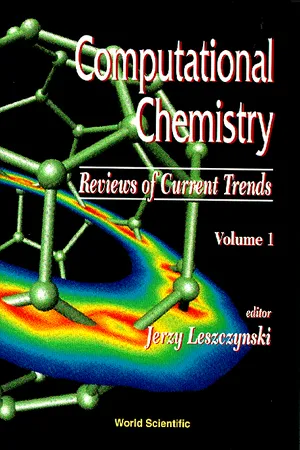
This book presents an overview of recent progress in computational techniques as well as examples of the application of existing computational methods in different areas of chemistry, physics, and biochemistry. Introductory chapters cover a broad range of fundamental topics, including: state-of-the-art basis set expansion methods for computing atomic and molecular electronic structures based on the use of relativistic quantum mechanics; the most recent developments in Hartree-Fock methods, particularly in techniques suited for very large systems; the current analysis of the solute-solvent free energy of interaction and the physical bases used to evaluate the electrostatic, cavitation, and dispersion terms; an introduction to the additive fuzzy electron density fragmentation scheme within various ab initio Hartree-Fock quantum-chemical computational schemes, which has provided the means for generating representative molecular fragment densities characteristic to their local environment within a molecule. This book also features a review of recent ab initio calculations on the structure and interactions of DNA bases, a chapter on computational approaches to the design of safer drugs and their molecular properties, and a systematic conceptual study on a route which allows one to stuff fullerenes.
eBook - PDF
Computational Chemistry: Reviews Of Current Trends, Vol. 1
- 282 pages
- English
- PDF
- Available on iOS & Android
eBook - PDF
Computational Chemistry: Reviews Of Current Trends, Vol. 1
About this book
Information
Table of contents
- CONTENTS
- PREFACE
- Chapter 1: Relativistic Many-Body Calculations on Atoms and Molecules
- Chapter 2: Modern Developments in Hartree-Fock Theory: Fast Methods for Computing the Coulomb Matrix
- Chapter 3: Local-Shape Analysis of Macromolecular Electron Densities
- Chapter 4: Liquid-State Quantum Chemistry: Computational Applications of the Polarizable Continuum Models
- Chapter 5: Elemental Boron Route to Stuffed Fullerenes
- Chapter 6: Interactions of DNA Bases and the Structure of DNA. A Nonempirical Ab Jnitio Study with Inclusion of Electron Correlation
- Chapter 7: Computational Approaches to the Design of Safer Drugs and Their Molecular Properties
- INDEX
Trusted by 375,005 students
Access to over 1.5 million titles for a fair monthly price.
Study more efficiently using our study tools.
Frequently asked questions
Yes, you can cancel anytime from the Subscription tab in your account settings on the Perlego website. Your subscription will stay active until the end of your current billing period. Learn how to cancel your subscription
No, books cannot be downloaded as external files, such as PDFs, for use outside of Perlego. However, you can download books within the Perlego app for offline reading on mobile or tablet. Learn how to download books offline
Perlego offers two plans: Essential and Complete
- Essential is ideal for learners and professionals who enjoy exploring a wide range of subjects. Access the Essential Library with 800,000+ trusted titles and best-sellers across business, personal growth, and the humanities. Includes unlimited reading time and Standard Read Aloud voice.
- Complete: Perfect for advanced learners and researchers needing full, unrestricted access. Unlock 1.5M+ books across hundreds of subjects, including academic and specialized titles. The Complete Plan also includes advanced features like Premium Read Aloud and Research Assistant.
We are an online textbook subscription service, where you can get access to an entire online library for less than the price of a single book per month. With over 1.5 million books across 990+ topics, we’ve got you covered! Learn about our mission
Look out for the read-aloud symbol on your next book to see if you can listen to it. The read-aloud tool reads text aloud for you, highlighting the text as it is being read. You can pause it, speed it up and slow it down. Learn more about Read Aloud
Yes! You can use the Perlego app on both iOS and Android devices to read anytime, anywhere — even offline. Perfect for commutes or when you’re on the go.
Please note we cannot support devices running on iOS 13 and Android 7 or earlier. Learn more about using the app
Please note we cannot support devices running on iOS 13 and Android 7 or earlier. Learn more about using the app
Yes, you can access Computational Chemistry: Reviews Of Current Trends, Vol. 1 by Nicholas Bodor, Matt Challacombe, Pavel Hobza in PDF and/or ePUB format, as well as other popular books in Biological Sciences & Science General. We have over 1.5 million books available in our catalogue for you to explore.