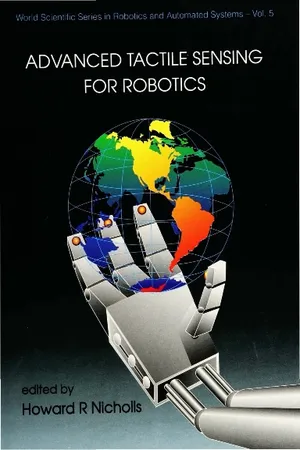
Advanced robot systems require sensory information to enable them to make decisions and to carry out actions in a versatile, autonomous way. Humans make considerable use of information derived through touch, and an emerging domain of robot sensing is tactile sensing. This book considers various aspects of tactile sensing, from hardware design through to the use of tactile data in exploratory situations using a multi-fingered robot hand.In the first part of the book, the current state of progress of tactile sensing is surveyed, and it is found that the field is still in an early stage of development. Next, some fundamental issues in planar elasticity, concerning the interaction between tactile sensors and the environment, are presented. Having established how the basic data can be derived from the sensors, the issues of what form tactile sensors should take, and how they should be used, are considered. This is particularly important given the infancy of this field. The human tactile system is examined, and then biological touch and its implications for robotics is looked at. Some experiments in dextrous manipulation using a robot hand are described, which apply some of these results. The integration of tactile sensors into a complete system is also considered, and another, novel, approach for using touch sensing in a flexible assembly machine is described.Both basic material and new research results are provided in this book, thus catering to different levels of readers. The chapters by world experts in different aspects of the field are integrated well into one volume. The editor and authors have produced a thorough and in-depth survey of all work in robot tactile sensing, making the book essential reading for all researchers in this emergent field.
- 320 pages
- English
- PDF
- Available on iOS & Android
eBook - PDF
Advanced Tactile Sensing For Robotics
About this book
Information
Table of contents
- Summary of Table of Contents
- Contents
- Preface
- List of Contributors
- List of Figures
- List of Tables
- Chapter 1 Introduction to Tactile Sensing
- Chapter 2 Tactile Sensor Designs
- Chapter 3 Processing and Using Tactile Sensor Data
- Chapter 4 Planar Elasticity for Tactile Sensing
- Chapter 5 Integrating Tactile Sensors — ESPRIT 278
- Chapter 6 Distributed Touch Sensing
- Chapter 7 The Human Tactile System
- Chapter 8 Lessons From the Study of Biological Touch for Robotic Tactile Sensing
- Chapter 9 Lessons From The Study Of Biological Touch For Robotic Haptic Sensing
- Chapter 10 Object Recognition Using Active Tactile Sensing
- Chapter 11 Experiments In Active Haptic Perception With The Utah-MIT Dextrous Hand
- Chapter 12 Future Trends in Tactile Sensing
- Appendix A Basic Linear Elasticity
- Index
Trusted by 375,005 students
Access to over 1.5 million titles for a fair monthly price.
Study more efficiently using our study tools.
Frequently asked questions
Yes, you can cancel anytime from the Subscription tab in your account settings on the Perlego website. Your subscription will stay active until the end of your current billing period. Learn how to cancel your subscription
No, books cannot be downloaded as external files, such as PDFs, for use outside of Perlego. However, you can download books within the Perlego app for offline reading on mobile or tablet. Learn how to download books offline
Perlego offers two plans: Essential and Complete
- Essential is ideal for learners and professionals who enjoy exploring a wide range of subjects. Access the Essential Library with 800,000+ trusted titles and best-sellers across business, personal growth, and the humanities. Includes unlimited reading time and Standard Read Aloud voice.
- Complete: Perfect for advanced learners and researchers needing full, unrestricted access. Unlock 1.5M+ books across hundreds of subjects, including academic and specialized titles. The Complete Plan also includes advanced features like Premium Read Aloud and Research Assistant.
We are an online textbook subscription service, where you can get access to an entire online library for less than the price of a single book per month. With over 1.5 million books across 990+ topics, we’ve got you covered! Learn about our mission
Look out for the read-aloud symbol on your next book to see if you can listen to it. The read-aloud tool reads text aloud for you, highlighting the text as it is being read. You can pause it, speed it up and slow it down. Learn more about Read Aloud
Yes! You can use the Perlego app on both iOS and Android devices to read anytime, anywhere — even offline. Perfect for commutes or when you’re on the go.
Please note we cannot support devices running on iOS 13 and Android 7 or earlier. Learn more about using the app
Please note we cannot support devices running on iOS 13 and Android 7 or earlier. Learn more about using the app
Yes, you can access Advanced Tactile Sensing For Robotics by Tom Husband, Howard R Nicholls in PDF and/or ePUB format, as well as other popular books in Computer Science & Computer Science General. We have over 1.5 million books available in our catalogue for you to explore.