![]()
Chapter 1
ASIA'S SPIRIT OF INNOVATION
Asia is home to major ancient civilisations, which include, in today's terminology, China and India. Their early inventions, spanning several hundreds of years, are forerunners of the advancements and lifestyles we are accustomed to today. With the support of advanced analytical tools and techniques, scientists, archeologist and historians continue to uncover the origin of these ancient inventions.2
During his travels to China in the 13th century, Marco Polo (from Europe) encountered Chinese civilisations which were more technologically advanced than Europe. Arab scholars were also more advanced than the Europeans in the same era. This confirms that Asia used to be the centre of innovation in the first millennium. This gradually shifted to Europe and then to North America in the latter half of the second millennium. Now, the beginning of the third millennium is witnessing the return of the center of innovation to Asia.
What is “Asia”? How different or similar is it to European Union (EU) or the USA?
Asia is a geographical region of the world that comprises many countries including:
Afghanistan, Cambodia, China, India, Indonesia, Japan, Laos, Malaysia, Myanmar, North Korea, the Philippines, Pakistan, Singapore, South Korea, Thailand and Vietnam.
Many of these countries came into being after World War II. During this time their current national borders were formed. Even though these nations are collectively referred to as “Asia”, they are not held together by the same degree of common purpose as the European Union and the nations of Iberian-America.
Asia is an artificial phrase that has become vogue over time. It is a highly heterogeneous region with rich and poor nations, resource-endowed and resource-poor nations, highly democratic and less democratic nations, single language and multilingual nations, nations with single and multiple ethnic groups, small nations and big nations in terms of population and land mass, technologically well-advanced and less-advanced nations, and peaceful nations and nations constantly embroiled in internal and external conflicts. Furthermore, the diets, customs, culture and belief systems vary considerably as one traverses Asia.
The heterogeneity of Asia is perplexing and, at the same time, incredibly interesting. People have begun to recognise Asia as a distinct geographical region of the world with shared challenges, whose influence on the future of the rest of the world cannot be ignored.
Let us do a quick survey of key ancient inventions and continual innovations by Asian countries/civilisations that had a great impact on the development of science and technology and progress of humanity.
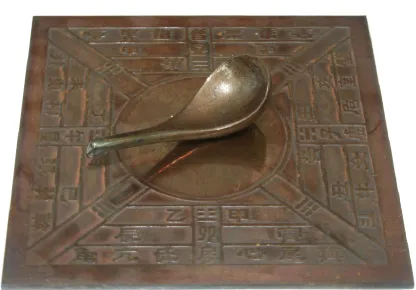
The four great inventions of ancient China were the compass (see Figure 1.1), gunpowder, papermaking and printing.
Figure 1.1: Chinese compass (circa fourth century B.C.).
COMPASS
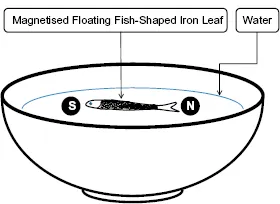
The earliest compasses were reported to exist in China around fourth century B.C. Compasses were made of lodestone, a type of magnetite (magnetic iron ore). The Chinese discovered that an elongated lodestone freely suspended or free to rotate would tend to set its long axis to a north-south direction. The handle of the spoon points to the south. They also discovered that this characteristic could be transferred to an iron/steel needle or object by stroking it with a lodestone, for example in the form of a fish-shaped iron leaf (see Figure 1.2).
The compass enabled mariners to determine the direction of travel even when the weather was foggy and the sky was overcast. This enabled mariners to navigate safely, away from the coast line and head into the open seas. The discovery of the compass laid the foundation for a navigation system for exploration and sea trade leading to the Age of Exploration.3 Chinese Admiral Zheng He was the first person to officially use the compass for navigation during the eight sea voyages between 1405 and 1433.
Figure 1.2: The floating fish-shaped iron leaf compass.4
GUNPOWDER
The Chinese invention of gun powder is mixture of potassium nitrate or saltpeter, charcoal and sulphur. When ignited, this mixture produces a huge volume of gas (about 274 to 360 cubic centimeters of gas per gram of powder) and temperatures that range from 2,100 degree celsius to 2,700 degree celsius. Gunpowder was invented during the ninth century by Chinese alchemists.
The invention of gunpowder revolutionised warfare and transformed the power balances of the world. Modern fireworks that we enjoy watching are made of gunpowder and metal powders.
Today, the innovation of gunpowder in China has gone into the development of modern fireworks that are used in celebration of major events around the world. The literal translation of the Chinese words for fireworks is “fire flower”. The latest spectacular fireworks display held during the opening and closing of the Beijing Olympics in 2008 is a demonstration of how far the innovations of gunpowder with metal oxides has gone to enhance the celebratory impact of major celebrations and events around the world.
PAPER MAKING AND PRINTING
China was the first nation to invent paper. Around 50 A.D., eunuch Tsai Lun from the eastern Han dynasty invented the prototype of modern paper with a mixture of wood fibers from the bark of mulberry trees, bamboo fibres and water, and pressed this mixture onto a textile cloth on a bamboo frame. The pores in the textile cloth allowed the moisture to drain out forming a layer of paper.
Ancient China's long history of hand carving and invention of paper led to the invention of wood block printing. The Chinese text is first written on a thin piece of paper. This paper is glued face down onto a wooden plate. A carver will carve the “reversed” character onto this wooden plate. Ink is then applied onto this wooden plate and pressed onto paper. This was the genesis of wood-block printing in China.
For every new page, a new wood-block had to be carved. This took a great amount of skilled manpower and materials. Bi Sheng (Song Dynasty, 960-1279) invented the carving of individual characters on a small block of moistened clay. These individual blocks were hardened by fire and could be used whenever required. These individual “movable blocks” would be glued to an iron plate to print out a page. These individual clay blocks could then be detached and reconfigured for a new page of text.
The Chinese paper-making invention was easy to mass produce and the Chinese invention of wood-block printing allowed for the easy duplication of information and knowledge.
The invention of paper and printing is an epoch-making event in human history. These inventions enabled the recording, dissemination and distribution of knowledge which in turn stimulated more innovations and discoveries throughout the ages.
SEISMOGRAPH
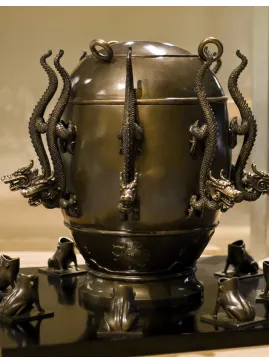
The Indian Tectonic Plate caused frequent earthquakes in China. In 130 A.D., Zhang Heng invented the first earthquake detector using an elaborate bronze vessel inside which a pendulum hung motionless until a tremor moved it. The instrument resembled a wine jar (see Figure 1.3). It has eight Chinese traditional dragon figurines on the body of the jar with the heads aligning to the eight principal directions of the compass. Eight toad figurines, with their mouths opened, are placed below the eight dragons. It was known that when an earthquake occurred as far as four hundred miles away, one of the dragons would release its ball into the mouth of the toad to indicate the direction of the occurrence.
Figure 1.3: Chinese Seismograph — When an earthquake occurs, the dragon will release a ball into the mouth of the toad.
SILK AND CHINESE EMBROIDERY
Silk and Chinese embroidery is a classical intertwining of innovation and art form. China's discovery of silk and development of sericulture5 is a great historical contribution to human society. The discovery of silk production is dated back to 5,000 years ago in China. Silk and Chinese embroidery has made great contributions towards tapestries, textile and fashion in Europe. Chinese silk became much sought after by the aristocrats and nobility of Europe. In 1877, a German geographer, Ferdinand von Richthofen, named the transcontinental trade routes from China to Central Asia and Europe as the famous “Silk Road”.
ENGINEERING — GRAND CANAL OF CHINA
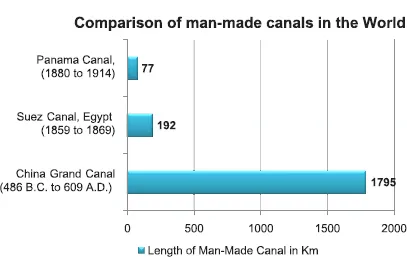
The building of the Grand Canal of China started in 486 B.C. Till today, it remains the longest and oldest man-made canal in the world. It served as a model for transportation, flood control and water management.
Different technologies were used to construct each of the canals. They were built to serve different purposes. The scale and size of any man-made canals over the centuries could not surpass the Chinese Grand Canal (see Figure 1.4).
Figure 1.4: The China Grand Canal is about nine times longer than the Suez Canal and 23 times longer than the Panama Canal.
MATHEMATICS
Science and modern society cannot function without a numeration system for purposes such as the simple tallying of numbers. The global financial meltdown of 2008 showed the importance and great impact of finance, which requires a numeration system. It all started with simple tallies some 17,000 years ago using single strokes (‘I’) on surfaces such as bones. Number language was known to be practiced by several ancient civilisations. A better numeration system based on the derivative of the alphabet arose in India from 200 B.C. to 600 A.D. and replaced all other numeration systems. Arab traders picked up the new numeration system, which subsequently spread to Europe.
Ancient Indians and Babylonians were known to have followed the notion of “zero”. At about 100 B.C. Pingala (India) developed a system of binary enumeration that could be converted to decimal numerals. The concepts of circles, squares, rectangles, and triangles were known to have been developed by ancient Indian scholars. Developments in geometry and algorithms led to innovations in architecture, and developments in astronomy helped to predict the weather, such as monsoonal seasons in India. Indians' deep interest in spirituality and thinking in astronomical time spans have in many ways influenced them to take special interest and focus on precise celestial calculations. In 500 A.D., celestial constants such as the earth's rotation per solar orbit, days per solar orbit, and days per lunar orbit were calculated by Aryabhata from India.
Srinivasa Ramanujan (1887-1920) developed his own theory of divergent series and worked on the Riemann series, elliptic integrals, hypergeometric series, and functional equations of the zeta function. In recognition of all these mathematical contributions, Srinivasa Ramanujan became the first Indian to be elected to the Royal Society, UK, in 1918. Many of his discoveries are applied to physics, particularly crystallography6 and string theory. Crystallography is a tool that is often employed by material scientists. In biology, scientists use X-ray crystallography as the primary method for determining molecular conformations of biological macromolecules such as proteins and nucleic acids including DNA.
PRECIOUS METALS
India is known to have made metallurgical advancements in metal extraction and alloying processes at the same time as the other major ancient civilisations....