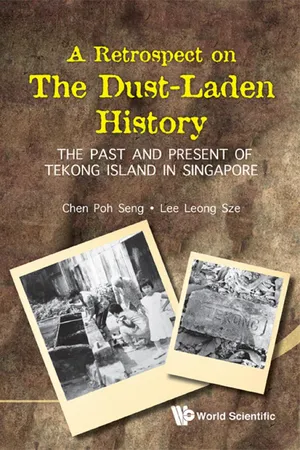
Chen Poh Seng's great grandfather lived in Pulau Tekong, his 50-over cousins were born and educated there. He lived in Changi Point which is 30 minutes away by ferry.
Lee Leong Sze is a Malaysian, graduated from the Department of History, National Chong Hsing University, Taiwan, obtained PhD in Singapore. Two researchers met in August 2005. They shared the same interest in studying the history of Pulau Tekong. During the study, they had full support and encouragement from former residents.
The book describes how Pulau Tekong Island developed during the early 20th century. It describes where the ethnic groups came from, how they settled down, worked and lived together, and the relationship among different ethnic groups, like the Malay and Chinese (including Hakka and Chouchouese) over the years. Finally, the book finds out how and why the villages vanished. The final chapter outlines the outstanding citizens from Pulau Tekong and reviews how they merged with the main stream of Singapore society after leaving the offshore island.
Contents:
Introduction
From Desolation to Prosperity:
Development of Villages
Life in Villages
Conclusion
Composition and Relationship of Ethnic Groups:
Ethnic Structure on Tekong Island
Relationship Between Chinese and Malays
Ethnic Relationship within Chinese
Conclusion
The Impact of World War II:
Influence of World War II on Tekong Island
Tekong Island Under British Government and Self-Governance
The 1960s: A Period of Change
Conclusion
The Development of Tekong Island:
Tekong Island Under Singapore's Development
The Disappearance of Villages on Tekong Island
The Achievements of Former Residents of Tekong Island
Conclusion
Conclusion
Readership: Student, professional, general public.
Trusted by 375,005 students
Access to over 1.5 million titles for a fair monthly price.
As the largest outlying island of Singapore, Tekong Island1 (Pulau Tekong) is located in the northeastern waters of Singapore and functions as an important artery of the Johor River. Legend has it that the island had been inhabited by humans for more than four centuries. Since there is a dearth of historical data, this legend cannot be confirmed. According to the historical data and oral interviews available at present, Malays were dwelling on the island as early as the mid-19th century. Later, people from southern China also migrated to Tekong Island.2 This outlying island had a population of around 5,000. Along with Singapore, Tekong Island had experienced many significant events such as the migration of Malays, Chinese and Indians, the invasion of Japanese during World War II and regaining of self-governance from the British by the People's Action Party. It also witnessed Singapore's union with the Federation of Malaysia and the former's independence on 9 August 1965.
After 1965, Singapore developed rapidly and hence Tekong Island gradually declined, similar to other villages in other highly developed nations. The rapid growth of Singapore attracted the Tekong Island youth, and only the elderly and children were left on the island. Adjusting to the trend of development, parts of the forest area on Tekong Island were commandeered by the government for military purposes in the early 1970s. When Prime Minister Lee Kuan Yew visited Tekong Island, he proclaimed that the island would be developed as a military or industry base within 10 to 12 years and suggested that the residents move to Singapore for a better life.3
Under the arrangement of the government, the residents on Tekong Island began migrating in groups to Singapore in the 1970s. The development of villages on the island ceased as the last group of residents left in 1987. Although a remote and backward region, Tekong Island's history still belongs to a part of that of Singapore. Some residents from the island achieved great success in Singapore. Therefore, it is worthwhile to probe into the history of Tekong Island. However, it is a pity that this small island, with a population of several thousands of people, has been forgotten since all the residents had moved out by 1987. Even former residents had vague memories of the island, which might be an obstacle to research. So far there are only four publications regarding Tekong Island. The first publication is Population and Usage of Land on Tekong Island
, a thesis of bachelor's degree with honors at Nanyang University written by Wu Zhong Bo
in 1971. This research investigates Tekong Island's development, density, distribution, growth, movement, genders and age structure of population, land available for farming, villages and utilization and so on from a geographical perspective. The second publication is History Pulau Tekong & Tian Kong Buddhist Temple
written by Ho Kim Fong
and published in Singapore in 1993. The third one is Loved Tekong
written by Chong Han
and published by Changwu Publishing in Singapore in 1992. Both History Pulau Tekong & Tian Kong Buddhist Temple and Loved Tekong were written by former residents of Tekong Island. It can be seen that the authors had deep affection for the island. Ho Kim Fong recorded Tekong Island's development in the 20th century (including the migration in 1980s) based on his memory. His book also touched upon the distribution of shops on the island, residents' lives and their social interactions. There are also many invaluable photographs of Tekong Island in the book.4 On the other hand, Chong Han wrote about his memories of Tekong in a more literary style. The fourth publication is Tan Kim Keong's
thesis of bachelor's degree of Department of Chinese Studies with Honors in National University of Singapore in 2008, Opera and Society: Chinese Opera in Singapore as an Example
Chapter 3 of the thesis explores the history of Tekong Island, the belief of Tuan, opera culture and Chinese identity from the perspective of opera. Since Tekong Island is one of the four cases discussed in this thesis, the focus would be placed on the belief of Tuan, the culture of opera and relationships in the Chinese society.
To sum up, even though there are few publications about Tekong Island, they give us some clues and inspiration for the research. Since so far few researchers have conducted their study on Tekong Island, many potential research areas such as ethnic relationships, the development of the village and the influence of Singapore's politics on Tekong Island have not been included in any research. Since the history of Tekong Island still remains unexplored in the research of Singapore's history and there are so many topics worthy of discussion, we firmly believe that Tekong Island has potential for research.
The reasons we chose Tekong Island as the subject of the study are the following. One of Chen Poh Seng
(whose friends and relatives are former residents of Tekong Island) suggested that we choose this topic. We gradually became interested in the history of Tekong Island during the process of preparing for our research as Chen provided valuable information. Until now, no research has solely focused on studying Tekong Island's history. It is meaningful for us to investigate this field as we wish to enrich the history of Singapore. Furthermore, there is a great lack of historical data about the development of Tekong Island, and the number of past residents of the island is also dwindling each passing year. In our point of view, it is necessary to preserve the present data in order to document the history by writing. Last but not the least, we have acquired much information from many sources (including former residents) during the process of collecting data. The former residents narrated their experience on Tekong Island, which greatly helped us in our study.
Our research is limited to the period between 1940s and 1980s due to availability of only finite historical data. Documents prior to 1940 or earlier had been lost and Tekong Island officially became a military base in 1987. The locations chosen in the study were 14 villages: Kampong Selabin, Kampong Permatang, Kampong Pasir Merah, Kampong Unum, Kampong Sungei Belang, Kampong Ayer Samak, Kampong Pasir, Kampong Pengkalan Pakau, Kampong San Yong Kong Parit, Kampong San Yong Kong, Kampong Batu Koyok, Kampong Ladang, Kampong Seminei, Kampong Pahang and the Chia Tong Quah Estate on the island.5 The Singapore Government commandeered the entire Tekong Island in 1980s and all the residents moved out of the island. Meanwhile, the development of villages ended. Though Tekong Island has greatly changed and it has become more difficult to conduct studies on this field, it turns more challenging. This research is conducted without real field work, and the history would be reconstructed by historical data and oral interviews. Figure 1 shows the distribution of villages on Tekong Island.
Figure 1. Distribution of villages on Tekong Island.
This study focuses on former residents on Tekong Island. Data were mainly acquired from four sources: (1) publications related to Tekong Island; (2) reports regarding the island's development and residents' activities from newspapers and magazines; (3) official documents, recording the educational development, community events and census of the island; and (4) oral interviews with former residents and their descendants and other oral information obtained from Oral History Department in Singapore.6
The research methods in this study can be divided into three types. Literature review prior to the field research is necessary and constructive because it helps the research to form a basic structure. After historical data, files, old maps and photographs are collected, their authenticity is confirmed and they are arranged for some clues so that the researcher is able to gain an initial understanding of the real scenario and human activities. Since the real field no longer exists in case of Tekong Island, documents and files are more important. This research aims to gather documents, including the distribution of villages, related historical and geographic data, recording of every ethnic group, related theories and studies regarding migration, culture research and ethnography.
The format of an in-depth interview is different from that of a common interview. The purpose of an in-depth interview is to grant the interviewees freedom to say anything related to the question in order to gather their opinion. It is helpful for the researcher to comprehend and analyze the topic through the interviews. Open-response questions are adopted in in-depth interviews to gain more insight into the field of research. In addition to recording the interview, we also observe their facial expressions and body language because the purpose of the interview is to further analyze the interviewee's way of thinking rather than just record the oral data. Thick description cannot be achieved without deep understanding. In studying more complicated cultural topics, it is necessary to obtain views from different people, and cross-interviews are also used to ensure the authenticity of events. In-depth interview provides different aspects for the researcher to construct the truth. Based on the researcher's purpose, questions are formulated to acquire open response and offer the interviewees a chance to talk about their experiences and memories. This research is expected to obtain the former Tekong Island reside...
Table of contents
Cover Page
Title Page
Copyright Page
Contents
Preface by Chen Poh Seng
Preface by Lee Leong Sze
Chapter 1. Introduction
Chapter 2. From Desolation to Prosperity
Chapter 3. Composition and Relationship of Ethnic Groups
Chapter 4. The Impact of World War II
Chapter 5. The Development of Tekong Island
Chapter 6. Conclusion
Appendix
References
Index
Frequently asked questions
Yes, you can cancel anytime from the Subscription tab in your account settings on the Perlego website. Your subscription will stay active until the end of your current billing period. Learn how to cancel your subscription
No, books cannot be downloaded as external files, such as PDFs, for use outside of Perlego. However, you can download books within the Perlego app for offline reading on mobile or tablet. Learn how to download books offline
Perlego offers two plans: Essential and Complete
Essential is ideal for learners and professionals who enjoy exploring a wide range of subjects. Access the Essential Library with 800,000+ trusted titles and best-sellers across business, personal growth, and the humanities. Includes unlimited reading time and Standard Read Aloud voice.
Complete: Perfect for advanced learners and researchers needing full, unrestricted access. Unlock 1.5M+ books across hundreds of subjects, including academic and specialized titles. The Complete Plan also includes advanced features like Premium Read Aloud and Research Assistant.
Both plans are available with monthly, semester, or annual billing cycles.
We are an online textbook subscription service, where you can get access to an entire online library for less than the price of a single book per month. With over 1.5 million books across 990+ topics, we’ve got you covered! Learn about our mission
Look out for the read-aloud symbol on your next book to see if you can listen to it. The read-aloud tool reads text aloud for you, highlighting the text as it is being read. You can pause it, speed it up and slow it down. Learn more about Read Aloud
Yes! You can use the Perlego app on both iOS and Android devices to read anytime, anywhere — even offline. Perfect for commutes or when you’re on the go. Please note we cannot support devices running on iOS 13 and Android 7 or earlier. Learn more about using the app
Yes, you can access Retrospect On The Dust-laden History, A: The Past And Present Of Tekong Island In Singapore by Leong Sze Lee, Poh Seng Chen in PDF and/or ePUB format, as well as other popular books in Biological Sciences & Science General. We have over 1.5 million books available in our catalogue for you to explore.