Handbook On Optical Constants Of Metals, The: In Tables And Figures
eBook - ePub

Handbook On Optical Constants Of Metals, The: In Tables And Figures

In Tables and Figures

  1. 684 pages
  2. English
  3. ePUB (mobile friendly)
  4. Available on iOS & Android
eBook - ePub

Handbook On Optical Constants Of Metals, The: In Tables And Figures

In Tables and Figures

About this book

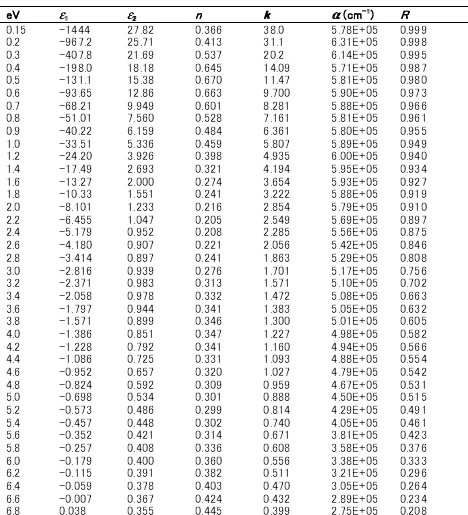
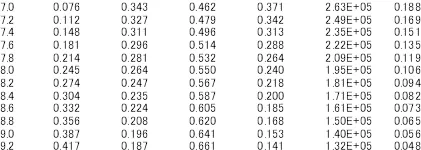
This book presents data on the optical constants of metal elements (Na, Au, Mg, Hg, Sc, Al, Ti, β-Sn, V, Cr, Mn, Fe, La, Th, etc.) semimetal elements (graphite, Sb, etc.), metallic compounds (TiN, VC, TiSi 2, CoSi 2, etc.) and high-temperature superconducting materials (YBa 2 Cu 3 O 7-δ, MgB 2, etc.). A complete set of the optical constants are presented in tabular and graphical forms over the entire photon-energy range. They are: the complex dielectric constant ε( E )=ε 1 ( E )+iε 2 ( E ), the complex refractive index n *( E )= n ( E )+i k ( E ), the absorption coefficient α( E ) and the normal-incidence reflectivity R ( E ). The book will aid many who are interested to know the optical constants of the metals, semimetals, metallic compounds and high-temperature superconducting materials in the course of their work.

Sample Chapter(s)
Chapter 1: Introduction (1,081 KB)
Chapter 2: Metals and Semimetal Elements (268 KB)
Chapter 3: Transition Metal-Carbides and Nitrides (261 KB)
Chapter 5: High-Tc Superconductors (129 KB)


Contents:

  • Introduction
  • Metal and Semimetal Elements
  • Transition-Metal Carbides and Nitrides
  • Metallic Silicides
  • High- T c Superconductors


Readership: Physicists, material scientists, engineers, undergraduate and postgraduate students who work in the field of Optics, especially high energy optics.
Frequently asked questions

Yes, you can cancel anytime from the Subscription tab in your account settings on the Perlego website. Your subscription will stay active until the end of your current billing period. Learn how to cancel your subscription.
No, books cannot be downloaded as external files, such as PDFs, for use outside of Perlego. However, you can download books within the Perlego app for offline reading on mobile or tablet. Learn more here.
Perlego offers two plans: Essential and Complete
  • Essential is ideal for learners and professionals who enjoy exploring a wide range of subjects. Access the Essential Library with 800,000+ trusted titles and best-sellers across business, personal growth, and the humanities. Includes unlimited reading time and Standard Read Aloud voice.
  • Complete: Perfect for advanced learners and researchers needing full, unrestricted access. Unlock 1.4M+ books across hundreds of subjects, including academic and specialized titles. The Complete Plan also includes advanced features like Premium Read Aloud and Research Assistant.
Both plans are available with monthly, semester, or annual billing cycles.
We are an online textbook subscription service, where you can get access to an entire online library for less than the price of a single book per month. With over 1 million books across 1000+ topics, we’ve got you covered! Learn more here.
Look out for the read-aloud symbol on your next book to see if you can listen to it. The read-aloud tool reads text aloud for you, highlighting the text as it is being read. You can pause it, speed it up and slow it down. Learn more here.
Yes! You can use the Perlego app on both iOS or Android devices to read anytime, anywhere — even offline. Perfect for commutes or when you’re on the go.
Please note we cannot support devices running on iOS 13 and Android 7 or earlier. Learn more about using the app.
Yes, you can access Handbook On Optical Constants Of Metals, The: In Tables And Figures by Sadao Adachi in PDF and/or ePUB format, as well as other popular books in Biological Sciences & Science General. We have over one million books available in our catalogue for you to explore.

Information

METAL AND SEMIMETAL
ELEMENTS

2.1 IA METALS

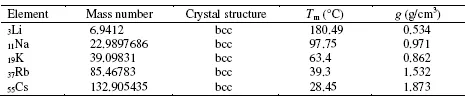
The alkali metals are the simplest of all metals. Lithium (Li) was discovered in 1817. It is the lightest of all metals with a density only about half of that of water. Sodium (Na) was long recognized in compounds (e.g., NaCl). It was first isolated in 1807 by electrolysis of caustic soda. Potassium (K) and rubidium (Rb) were discovered in 1807 and 1861 respectively. Cesium (Cs) was discovered spectroscopically in 1860. The alkali metals are all highly reactive and are never found in elemental forms in nature. Because of this, they are usually stored in mineral oil or kerosene. The alkali metals are mostly silver-colored except for Cs which has a golden tint, and are soft materials of low density. Table 2.1 summarizes some physical properties of group-Ia alkali metals.
Table 2.1 Summary of some physical properties of group-Ia metals. bcc = body-centered cubic; Tm = melting point; g = crystal density.

2.1.1 Lithium (Li)

Table 2.2 Optical constants of Li at 300 K [1,2].
...

Table of contents

  1. Cover
  2. Half Title
  3. Title
  4. Copyright
  5. Preface
  6. contents
  7. Chapter 01
  8. chapter 2
  9. Chapter 03
  10. chapter 4
  11. Chapter 05