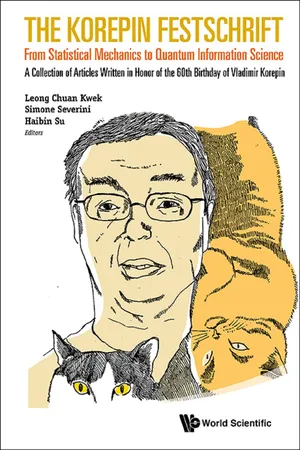
Korepin Festschrift, The: From Statistical Mechanics To Quantum Information Science - A Collection Of Articles Written In Honor Of The 60th Birthday Of Vladimir Korepin
eBook - ePub

Korepin Festschrift, The: From Statistical Mechanics To Quantum Information Science - A Collection Of Articles Written In Honor Of The 60th Birthday Of Vladimir Korepin

A Collection of Articles Written in Honor of the 60th Birthday of Vladimir Korepin

  1. 240 pages
  2. English
  3. ePUB (mobile friendly)
  4. Available on iOS & Android
eBook - ePub

Korepin Festschrift, The: From Statistical Mechanics To Quantum Information Science - A Collection Of Articles Written In Honor Of The 60th Birthday Of Vladimir Korepin

A Collection of Articles Written in Honor of the 60th Birthday of Vladimir Korepin

About this book

This volume mainly summarizes the invited talks presented at the 5th Asia-Pacific Workshop on Quantum Information Science (APWQIS) in conjunction with a Festschrift in honor of Professor Vladimir Korepin's 60th birthday. In this Festschrift, we have assembled a medley of interesting articles from some of his friends, well-wishers and collaborators. Comprising both reviews of the state-of-the-art and the latest results, this book covers various aspects of quantum information science, including topics like quantum discord, quantum computing, quantum entanglement, etc.

Contents:

  • Cancellation of Ultra-Violet Infinities in One Loop Gravity (V E Korepin)
  • Quantum Discord in a Spin System with Symmetry Breaking (B Tomasello, D Rossini, A Hamma and L Amico)
  • Entanglement from the Dynamics of an Ideal Bose Gas in a Lattice (S Bose)
  • Aspects of the Riemannian Geometry of Quantum Computation (H E Brandt)
  • Quantum Mechanics and the Role of Time: Are Quantum Systems Markovian? (T Durt)
  • Explicit Formula of the Separability Criterion for Continuous Variables Systems (K Fujikawa)
  • Yang–Baxter Equations in Quantum Information (M-L Ge and K Xue)
  • Nondistillable Entanglement Guarantees Distillable Entanglement (L Chen and M Hayashi)
  • Reduced Density Matrix and Entanglement Entropy of Permutationally Invariant Quantum Many-Body Systems (V Popkov and M Salerno)
  • Solitons Experience for Black Hole Production in Ultrarelativistic Particle Collisions (I Ya Aref'eva)
  • Sine–Gordon Theory in the Repulsive Regime, Thermodynamic Bethe Ansatz and Minimal Models (H Itoyama)
  • On Some Algebraic and Combinatorial Properties of Dunkl Elements (A N Kirillov)
  • Finite Projective Spaces, Geometric Spreads of Lines and Multi-Qubits (M Saniga)
  • Monogamy of Entanglement, N -Representability Problems and Ground States (T-C Wei)


Readership: Undergraduate, graduate students and researchers interested in quantum information science, statistical mechanics and mathematical physics.

Frequently asked questions

Yes, you can cancel anytime from the Subscription tab in your account settings on the Perlego website. Your subscription will stay active until the end of your current billing period. Learn how to cancel your subscription.
No, books cannot be downloaded as external files, such as PDFs, for use outside of Perlego. However, you can download books within the Perlego app for offline reading on mobile or tablet. Learn more here.
Perlego offers two plans: Essential and Complete
  • Essential is ideal for learners and professionals who enjoy exploring a wide range of subjects. Access the Essential Library with 800,000+ trusted titles and best-sellers across business, personal growth, and the humanities. Includes unlimited reading time and Standard Read Aloud voice.
  • Complete: Perfect for advanced learners and researchers needing full, unrestricted access. Unlock 1.4M+ books across hundreds of subjects, including academic and specialized titles. The Complete Plan also includes advanced features like Premium Read Aloud and Research Assistant.
Both plans are available with monthly, semester, or annual billing cycles.
We are an online textbook subscription service, where you can get access to an entire online library for less than the price of a single book per month. With over 1 million books across 1000+ topics, we’ve got you covered! Learn more here.
Look out for the read-aloud symbol on your next book to see if you can listen to it. The read-aloud tool reads text aloud for you, highlighting the text as it is being read. You can pause it, speed it up and slow it down. Learn more here.
Yes! You can use the Perlego app on both iOS or Android devices to read anytime, anywhere — even offline. Perfect for commutes or when you’re on the go.
Please note we cannot support devices running on iOS 13 and Android 7 or earlier. Learn more about using the app.
Yes, you can access Korepin Festschrift, The: From Statistical Mechanics To Quantum Information Science - A Collection Of Articles Written In Honor Of The 60th Birthday Of Vladimir Korepin by Leong Chuan Kwek, Simone Severini, Haibin Su in PDF and/or ePUB format, as well as other popular books in Physical Sciences & Mathematical & Computational Physics. We have over one million books available in our catalogue for you to explore.

Chapter 1

CANCELLATION OF ULTRA-VIOLET INFINITIES IN ONE LOOP GRAVITY

V. E. KOREPIN
C. N. Yang Institute for Theoretical Physics, State University of New York at Stony Brook,
Stony Brook 11794-3840, New York
Quantization of gravity is a formidable challenge for modern theoretical physics. Ultraviolet divergencies are the problem. In 1974 the author used functional integral formalism for the quantization. The background formulation helped to solve the problem in one loop approximation. The author proved that the divergencies cancel on mass shell, because of Einstein’s equations of motion.
Keywords: Gravity, quantization.

1. Introduction

This is a historical note. In 1974 I was an undergraduate student of L. D. Faddeev. I was working on quantum gravity [without matter] in one loop approximation. I discovered [simultaneously with G. t’Hooft M. Veltman] that on mass shell ultraviolet divergences cancel. The text below is a translation of the Diploma.
The diploma was in Russian, it was never published. Recently Faddeev found a reference to my result by an editor in Feynman’s lectures on gravitation1 (the reference is on page xxxvii of the book). The scan of original diploma can be found in the first line of the webpage.2 The result was obtained simultaneously with G. t’Hooft M. Veltman.3 The translation of the diploma follows.a
The diploma is devoted to quantization of gravity. First appropriate method for quantization of gravity was formulated by Dirac7 in 1958 in a frame of Hamiltonian approach. Other methods [essentially equivalent to Dirac’s] were suggested in Refs. 8–13. Hamiltonian approach is not covariant, this makes perturbation theory complicated.
An approach to covariant quantization of gravity was suggested in Refs. 14 and 15, but this method led to violation of unitarity.16 In the same publication Feynman showed that to restore unitarity of a diagram in a form of a closed ring one has to substract another diagram also in a form of a ring, which describes propagation of fictitious particle. Solution of the problem for any diagram was formulated in 1967 by Fadeev and Popov20 and De-Witt17–19 [using essentially different approaches]. This approach to quantization contains fictitious...

Table of contents

  1. Cover Page
  2. Title Page
  3. Copyright Page
  4. Preface
  5. Contents
  6. Organizing Committee
  7. List of Speakers
  8. Photos
  9. Chapter 1: Cancellation of Ultra-Violet Infinities in One Loop Gravity
  10. Chapter 2: Quantum Discord in a Spin System with Symmetry Breaking
  11. Chapter 3: Entanglement from the Dynamics of an Ideal Bose Gas in a Lattice
  12. Chapter 4: Aspects of the Riemannian Geometry of Quantum Computation
  13. Chapter 5: Quantum Mechanics and the Role of Time: Are Quantum Systems Markovian?
  14. Chapter 6: Explicit Formula of the Separability Criterion for Continuous Variables Systems
  15. Chapter 7: Yang–Baxter Equations in Quantum Information
  16. Chapter 8: Nondistillable Entanglement Guarantees Distillable Entanglement
  17. Chapter 9: Reduced Density Matrix and Entanglement Entropy of Permutationally Invariant Quantum Many-Body Systems
  18. Chapter 10: Solitons Experience for Black Hole Production in Ultrarelativistic Particle Collisions
  19. Chapter 11: Sine–Gordon Theory in the Repulsive Regime, Thermodynamic Bethe Ansatz and Minimal Models
  20. Chapter 12: On Some Algebraic and Combinatorial Properties of Dunkl Elements
  21. Chapter 13: Finite Projective Spaces, Geometric Spreads of Lines and Multi-Qubits
  22. Chapter 14: Monogamy of Entanglement, N-Representability Problems and Ground States
  23. Scientific Programs
  24. List of Participants