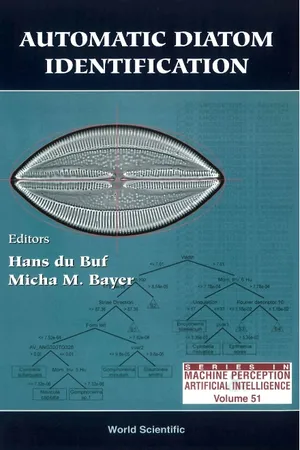
This is the first book to deal with automatic diatom identification. It provides the necessary background information concerning diatom research, useful for both diatomists and non-diatomists. It deals with the development of electronic databases, image preprocessing, automatic contour extraction, the application of existing contour and ornamentation features and the development of new ones, as well as the application of different classifiers (neural networks, decision trees, etc.). These are tested using two image sets: (i) a very difficult set of Sellaphora pupula with 6 demes and 120 images; (ii) a mixed genera set with 37 taxa and approximately 800 images. The results are excellent, and recognition rates well above 90% have been achieved on both sets. The results are compared with identification rates obtained by human experts. One chapter of the book deals with automatic image capture, i.e. microscope slide scanning at different resolutions using a motorized microscope stage, autofocusing, multifocus fusion, and particle screening to select only diatoms and to reject debris. This book is the final scientific report of the European ADIAC project (Automatic Diatom Identification and Classification), and it lists the web-sites with the created public databases and an identification demo.
- 329 pages
- English
- PDF
- Available on iOS & Android
eBook - PDF
Automatic Diatom Identification
About this book
Information
Table of contents
- Contents
- Preface
- Acknowledgments
- Authors' Affiliations
- Chapter 1 Introduction to ADIAC and This Book
- Chapter 2 Diatoms: Organism and Image
- Chapter 3 Diatom Applications
- Chapter 4 ADIAC Imaging Techniques and Databases
- Chapter 5 Human Error and Quality Assurance in Diatom Analysis
- Chapter 6 Contour Extraction
- Chapter 7 Identification Using Classical and New Features in Combination with Decision Tree Ensembles
- Chapter 8 Identification by Curvature of Convex and Concave Segments
- Chapter 9 Identification by Contour Profiling and Legendre Polynomials
- Chapter 10 Identification by Gabor Features
- Chapter 11 Identification by Mathematical Morphology
- Chapter 12 Mixed-Method Identifications
- Chapter 13 Automatic Slide Scanning
- Chapter 14 ADIAC Achievements and Future Work
- Appendix: The Mixed Genera Data Set
Trusted by 375,005 students
Access to over 1.5 million titles for a fair monthly price.
Study more efficiently using our study tools.
Frequently asked questions
Yes, you can cancel anytime from the Subscription tab in your account settings on the Perlego website. Your subscription will stay active until the end of your current billing period. Learn how to cancel your subscription
No, books cannot be downloaded as external files, such as PDFs, for use outside of Perlego. However, you can download books within the Perlego app for offline reading on mobile or tablet. Learn how to download books offline
Perlego offers two plans: Essential and Complete
- Essential is ideal for learners and professionals who enjoy exploring a wide range of subjects. Access the Essential Library with 800,000+ trusted titles and best-sellers across business, personal growth, and the humanities. Includes unlimited reading time and Standard Read Aloud voice.
- Complete: Perfect for advanced learners and researchers needing full, unrestricted access. Unlock 1.5M+ books across hundreds of subjects, including academic and specialized titles. The Complete Plan also includes advanced features like Premium Read Aloud and Research Assistant.
We are an online textbook subscription service, where you can get access to an entire online library for less than the price of a single book per month. With over 1.5 million books across 990+ topics, we’ve got you covered! Learn about our mission
Look out for the read-aloud symbol on your next book to see if you can listen to it. The read-aloud tool reads text aloud for you, highlighting the text as it is being read. You can pause it, speed it up and slow it down. Learn more about Read Aloud
Yes! You can use the Perlego app on both iOS and Android devices to read anytime, anywhere — even offline. Perfect for commutes or when you’re on the go.
Please note we cannot support devices running on iOS 13 and Android 7 or earlier. Learn more about using the app
Please note we cannot support devices running on iOS 13 and Android 7 or earlier. Learn more about using the app
Yes, you can access Automatic Diatom Identification by Micha M Bayer, Hans Du Buf in PDF and/or ePUB format, as well as other popular books in Computer Science & Optical Data Processing. We have over 1.5 million books available in our catalogue for you to explore.