![]() SECTION–1
SECTION–1
PLENARY PRESENTATIONS![]()
TIRAMISU: FP7-PROJECT FOR AN INTEGRATED TOOLBOX IN HUMANITARIAN DEMINING, FOCUS ON UGV, UAV, TECHNICAL SURVEY AND CLOSE-IN-DETECTION
YVAN BAUDOIN and TIRAMISU CONSORTIUM
www.fp7-tiramisu.eu
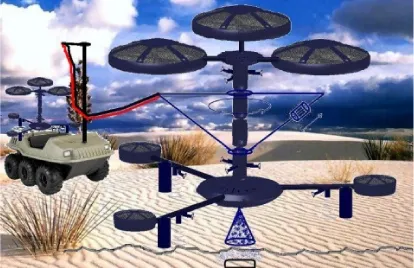
The TIRAMISU project aims at providing the foundation for a global toolbox that will cover the main mine action activities, from the survey of large areas to the actual disposal of explosive hazards, including mine risk education and training tools. After a short description of some tools, particular emphasis will be given to the possible use of UAV (or UGV/UAV) in Technical survey and/or Close-in-Detection
1. UGV
The idea of using robotics for humanitarian demining and/or advanced lightweight modular low-cost robots for technical survey and/or close-in-detection has been proposed by numerous authors [1]. Even though none of the current robotics platform seem to have reached production on a larger scale (except for military EOD/IEDD tasks), many lessons may be learned from several projects and experiences. Robotics solutions properly sized with suitable modularized structure and well adapted to local conditions of dangerous unstructured areas can greatly improve the safety of personnel as well as the work efficiency, productivity and flexibility. In this sense, mobile systems equipped with manipulators for detecting and locating antipersonnel landmines are considered of most importance towards autonomous/semi-autonomous mine location in a proficient, reliable, safer and effective way. Conventional vehicle-mounted mine detector systems employ an array of sensor devices to achieve a detection swath typically 2~4m wide. Some systems employ more than one type of sensor technology. These systems, while being very useful are often expensive, unsafe, complex and inflexible. Nevertheless, several IARP (International Advanced Robotics Programme – http://iarp.isir.upmc.fr ) workshops [2 – 5] have on the contrary shown that the use of Robotics Systems could improve the safety and the clearance efficiency and that they may be considered as promising tools.
One goal of the TIRAMISU project is to develop an advanced lightweight detecting system for humanitarian demining purposes consisting of an integration of three different sensors, a MD, a GPR and an explosives vapor detector (EVD). The final prototype (tool) would consist of a manned or unmanned vehicle-based system capable of detecting explosive devices (ED) with a higher clearance rate than that of the current level of technology.
2. UAV
The Micro-mini UAV (MAV) and Rotary Wings seem to be good candidates for Technical Survey and, possibly, Close-in-detection in Humanitarian Demining while the MALE (Medium Altitude Large Endurance) and SR (Short Range) or MR (Medium Range) could be envisaged for the Non-Technical survey.
The small size of MAVs has several implications on their performance capabilities. First and foremost, they have limited payload capacity (size, weight, and power) and are therefore unable to carry significant computational resources or sensors of the highest accuracy and capability. Second, their small size and relatively low flight speeds make them susceptible to degraded performance caused by high winds and wind gusts. These challenges, imposed by the small size of MAVs, must be overcome for MAVs to be utilized successfully. Future advancements in miniaturization and performance of sensors and computers will enable increased success. However, efforts must also be made to utilize existing sensor and computer capabilities in novel and innovative ways to enhance the utility of MAV systems in the immediate future [6].
The ability to land a MAV accurately on a designated landing point is useful for several applications including the safe recovery of the MAV in risky conditions (a.o. minefields). Several challenges make precision landing/strike difficult for small UAVs. The disturbance imposed by wind is always an issue with MAVs, and for the present, sensor errors such as those common in the measurement of attitude and altitude cause difficulties. For precision landing, the most critical information is to know the location of the MAV relative to the desired landing location. Developing reliable methods for measuring this information is central to the success of a precision landing approach. The value of target (Explosive Device) tracking and localization from a small MAV platform is obvious and significant. This capability is attractive, but presents challenges.
The most significant challenges associated with accurate target localization stem from the lack of precise attitude estimates for the MAV platform. Pitch and roll are difficult to estimate with a high degree of accuracy with the Micro- electromechanical systems (MEMS) sensors typically used for MAV control. Measurements of heading are not available – heading is often approximated by the course of the MAV which is estimated from successive GPS measurements. In high-wind conditions (relative to the desired airspeed), the course is often a poor approximation of the heading.
The ability to operate in constrained environments is of great importance for MAV that must be able to fly amidst natural and man-made obstacle. Air-to- ground detection systems could provide an interesting contribution to the technical survey as well as to the close-in-detection aims for so far technical and operational improvements are precisely defined. Both the aerial platform (a sensor ’ s carrier) and the Remote Pilot Station have to be considered, both in the context of evolving legal (national, European and/or international) regulations.
References
1.E. Colon,Y. Baudoin, Humanitarian demining and robotics: A difficult challenge, CLAWAR 1999, Portsmouth, UK (1999).
2.M. A. Armada, J. Cobano, E. Garcia and P. Gonzalez de Santos Configuration of a legged robot for humanitarian de-mining activities. Proc. of the IARP International Workshop on Robotics and Mechanical Assistance in Humanitarian Demining (HUDEM2005), pp. 131-135 (2005).
3.E. Fukushima, et al. Teleoperated buggy vehicle and weight balanced arm for mechanization of mine detection and clearance tasks, IARP WS HUDEM ’ 2005, Tokyo, pp. 58-63 (2005).
4.T. Fukuda, et al. Environment-adaptive antipersonnel mine detection system – Advanced mine sweeper ’ , IARP WS HUDEM ’ 2005, Tokyo, pp. 33-38 (2005).
5.R. Fernández, C. Salinas, H. Montes, M. Armada. Omnidirectional stereo tracking system for humanitarian demining training. International Symposium Humanitarian Demining, Šibenik, Croatia, pp. 113-116 (2011).
6.Gerard ten Buuren, 2011: Small UAS for Law Enforcement (Netherlands Police Agency KLPD), UAS Global Perspective 2011/2012 – www.uvs-info.com
![]()
ANTHROPOMORPHIC BIOLOGICAL EQUIPMENT
YOSHIHIKO NAKAMURA
University of Tokyo, Japan
Evolution of the human brain emerged by the pressure for communication. It is hard to believe that the pressure of evolution exempted the features of motion patterns from using them for communication. The communication skill is therefore anthropomorphic.
The author would like to call the natural function of the brain to perceive, recognize, understand and respond to the human-like motion patterns, the Anthropomorphic Biological Equipment. The natural and general human- machine interface can be established by developing the similar function on the machine side, which we may call the Anthropomorphic Artificial Equipment. Our research started from the mathematical model of mirror neurons and continues to acquisition of semiology of human behaviors based on technologies such as unsupervised segmentation, iterative clustering, and construction of state transition network. The current research interests target to connect the behavioral semiology to the semiology of a natural language to develop a statistical system that evokes mutual association. This talk introduces the scope of our research and overviews the direction of research.
![]()
MUSCLE COORDINATION OF HUMAN LOCOMOTION
MARCUS PANDY
Department of Mechanical Engineering, University of Melbourne, Australia
Gait-analysis techniques have been used for more than a century to provide information on the kinematics and kinetics of human locomotion, yet the ability of this technique to quantify function is limited because it cannot be used to discern the actions of individual muscles. Computational modelling is the only means available to determine musculoskeletal loading non-invasively. Rapid increases in computing power combined with recent advances in imaging and more efficient algorithms for modelling the musculoskeletal system have enabled more detailed analyses of lower-limb muscle function. This presentation will illustrate how computational modelling has been used to study muscle coordination of human locomotion across a wide spectrum of walking and running speeds. The results have important applications in medicine (orthopaedics), sports (training and injury prevention) and robotics.
![]()
EXOSKELETON SYSTEMS FOR MEDICAL AND CIVILIAN APPLICATIONS
HOMAYOON KAZEROONI
University of California, Berkeley, USA
For widespread use, exoskeletons must be accessible. The medical wearable robotic exoskeletons allow people with paraplegia or other mobility disorders to be upright and mobile, preventing secondary diseases and enhancing their quality of life. These systems will be used for in-home care and everyday use, as well as within hospitals and rehabilitation centers. The industrial wearable robotic systems minimize spinal compression forces of workers who repeat various maneuvers on the job. These devices will be used in auto assembly plants, factories, manufacturing facilities, distribution centers, warehouses, and delivery services. These systems decrease the severity and number of work- related injuries, while enhancing worker safety. The quest to develop accessible exoskeleton orthotic systems suggests less hardware while placing more emphasis on the intelligence and cleverness during both the design stage and the device operation. This talk will describe new engineering developments to realize accessible exoskeleton systems.
![]() SECTION–2
SECTION–2
ASSISTIVE ROBOTICS![]()
OPTIMIZATION-BASED GAIT PLANNING FOR WEARABLE POWER-ASSIST LOCOMOTOR BY SPECIFYING VIA-POINTS*
CHANGHYUN SUNG, TAKAHIRO KAGAWA, YOJI UNO
Department of Mechanical Science and Engineering, Nagoya University,
Furo-cho, Chikusa-ku, Nagoya, Japan
We propose a planning method of gait for a wearable robot. In gait planning of a wearable robot, it is important to reflect desired stride length and foot clearance according to motor function of a user. Furthermore, there are a number of constraints such as fall prevention, collision avoidance and so on. We specify some via-points to deal with these conditions in gait planning. Our method is applied to generate the walking motion of Wearable Power-Assist Locomotor (WPAL). We confirmed that the adequate gait patterns were planned by the proposed method.
1. Introduction
In recent years, rehabilitation systems of paraplegics with spinal cord injuries have been developed for daily life support. Life in a wheelchair often results in secondary complications. Reconstruction of walking is desirable to improve not only their locomotor functions but also the physiological problems. We are developing Wearable Power-Assist Locomotor (WPAL) for paraplegic patients [1]. In control of WPAL, the design of an appropriate gait pattern is important to maintain smooth walking and to reduce the risks ...