Vibration Of Piezoelectric Crystal Plates
eBook - ePub

Vibration Of Piezoelectric Crystal Plates

  1. 432 pages
  2. English
  3. ePUB (mobile friendly)
  4. Available on iOS & Android
eBook - ePub

Vibration Of Piezoelectric Crystal Plates

About this book

The first contemporary text specializing on the dynamic problems of piezoelectric crystal plates for resonant acoustic wave devices (such as resonators, filters, and sensors) since H F Tiersten's publication in 1969. This book provides an up-to-date, systematic and comprehensive presentation of theoretical results on waves and vibrations in quartz crystal plates. It expounds on the application of the theories of elasticity and piezoelectricity in acoustic wave devices made from crystal plates through a coverage spanning from classical results on acoustic wave resonators, up to present-day applications in acoustic wave sensors.

This text begins with the exposition of the simplest thickness modes and various frequency effects in them due to electrodes, mass loading, contact with fluids, air gaps, etc., and continues on to the more complicated shear-horizontal modes, as well as straight-crested modes varying along the digonal axis of rotated Y-cut quartz. Modes varying in both of the in-plane directions of crystal plates are also addressed.

The analysis within are based on the three-dimensional theories of piezoelectricity and anisotropic elasticity with various approximations when needed. Both free vibration modes (stationary waves) and propagating waves are studied in this text. Forced vibration is also treated in a few places.

This book is intended to serve as an informative reference to personnel who employ piezoelectric crystal plates in the course of their profession.

Contents:

  • Theory of Piezoelectricity
  • Thickness Modes in Plates: Elastic Analysis
  • Thickness Modes in Plates: Piezoelectric Analysis
  • Shear-horizontal Waves in Unbounded Plates
  • Shear-horizontal Vibrations of Finite Plates
  • Waves Propagating along Digonal Axis
  • Vibration of Rectangular Plates
  • Scalar Equation for Thickness Modes


Readership: Professional engineers working with Piezoelectric Crystal Plates.

Frequently asked questions

Yes, you can cancel anytime from the Subscription tab in your account settings on the Perlego website. Your subscription will stay active until the end of your current billing period. Learn how to cancel your subscription.
No, books cannot be downloaded as external files, such as PDFs, for use outside of Perlego. However, you can download books within the Perlego app for offline reading on mobile or tablet. Learn more here.
Perlego offers two plans: Essential and Complete
  • Essential is ideal for learners and professionals who enjoy exploring a wide range of subjects. Access the Essential Library with 800,000+ trusted titles and best-sellers across business, personal growth, and the humanities. Includes unlimited reading time and Standard Read Aloud voice.
  • Complete: Perfect for advanced learners and researchers needing full, unrestricted access. Unlock 1.4M+ books across hundreds of subjects, including academic and specialized titles. The Complete Plan also includes advanced features like Premium Read Aloud and Research Assistant.
Both plans are available with monthly, semester, or annual billing cycles.
We are an online textbook subscription service, where you can get access to an entire online library for less than the price of a single book per month. With over 1 million books across 1000+ topics, we’ve got you covered! Learn more here.
Look out for the read-aloud symbol on your next book to see if you can listen to it. The read-aloud tool reads text aloud for you, highlighting the text as it is being read. You can pause it, speed it up and slow it down. Learn more here.
Yes! You can use the Perlego app on both iOS or Android devices to read anytime, anywhere — even offline. Perfect for commutes or when you’re on the go.
Please note we cannot support devices running on iOS 13 and Android 7 or earlier. Learn more about using the app.
Yes, you can access Vibration Of Piezoelectric Crystal Plates by Jiashi Yang in PDF and/or ePUB format, as well as other popular books in Biological Sciences & Science General. We have over one million books available in our catalogue for you to explore.

Information

Chapter 1
Theory of Piezoelectricity
This chapter presents a brief summary of the basic theory of linear piezoelectricity based mainly on the IEEE Standard on Piezoelectricity [1] and the classical book on piezoelectricity [2] by H.F. Tiersten (who also wrote the theoretical part of [1]). The same basic equations and other aspects of the theory can also be found in Chap. 2 of An Introduction to the Theory of Piezoelectricity [3]. Most of the results in this chapter are general theoretical results — only Section 1.4 has an example. Solutions to specific problems are systematically given in later chapters. This chapter uses the Cartesian tensor notation, the summation convention for repeated tensor indices, and the convention that a comma followed by an index denotes partial differentiation with respect to the coordinate associated with the index. A superimposed dot represents a time derivative.
1.1. Basic Equations
The equations of linear piezoelectricity can be obtained by linearizing the nonlinear electroelastic equations [4] under the assumption of infinitesimal deformation and fields. The resulting equations of motion and the charge equation of electrostatics are
image
where T is the stress tensor, ρ is the mass density, f is the body force per unit volume, u is the displacement vector, D is the electric displacement vector, and q is the body free charge density. In this book, f and q are usually zero. Constitutive relations are given by an electric enthalpy function H defined by
image
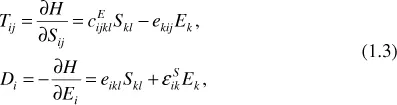
through
image
where the strain tensor, S, and the electric field vector, E, are related to the displacement, u, and the electric potential, ϕ, by
image
image
and
image
are the elastic, piezoelectric, and dielectric constants. The superscript, E, in
image
indicates that the independent electric constitutive variable is the electric field, E. The superscript, S, in
image
indicates that the mechanical constitutive variable is the strain tensor, S. The material constants have the following symmetries:
image
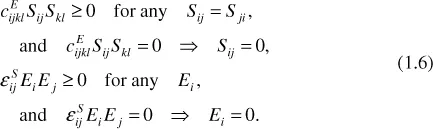
We also assume that the elastic and dielectric tensors are positive definite in the following sense:
image
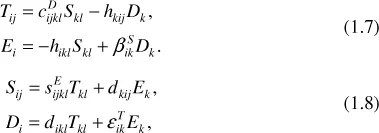
Similar to Eq. (1.3), linear constitutive relations can also be written as
image
image
With successive substitutions from Eqs. (1.3) and (1.4), Eq. (1.1) can be written as four equations for u and ϕ
image
where we have neglected the superscripts of the material constants.
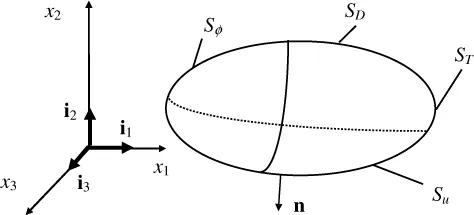
Let the region occupied by a piezoelectric body be V and its boundary surface be S, as shown in Fig. 1.1. Let the unit outward normal of S be n.
image
Fig. 1.1. A piezoelectric body and partitions of its surface.
For boundary conditions, we consider the following partitions of S:
image
where Su is the part of S on which the mechanical displacement is prescribed, and ST is the part of S where the traction vector is prescrib...

Table of contents

  1. Cover
  2. Half Title
  3. Title
  4. Copyright
  5. Preface
  6. Contents
  7. Chapter 1: Theory of Piezoelectricity
  8. Chapter 2: Thickness Modes in Plates: Elastic Analysis
  9. Chapter 3: Thickness Modes in Plates: Piezoelectric Analysis
  10. Chapter 4: Shear-horizontal Waves in Unbounded Plates
  11. Chapter 5: Shear-horizontal Vibrations of Finite Plates
  12. Chapter 6: Waves Propagating along Digonal Axis
  13. Chapter 7: Vibration of Rectangular Plates
  14. Chapter 8: Scalar Equation for Thickness Modes
  15. Appendix 1 Notation
  16. Appendix 2 Material Constants
  17. References
  18. Index