Plastic Reconstructive And Aesthetic Surgery: The Essentials
eBook - ePub

Plastic Reconstructive And Aesthetic Surgery: The Essentials

The Essentials (With DVD-ROM)

  1. 756 pages
  2. English
  3. ePUB (mobile friendly)
  4. Available on iOS & Android
eBook - ePub

Plastic Reconstructive And Aesthetic Surgery: The Essentials

The Essentials (With DVD-ROM)

About this book

This is a concise but comprehensive textbook for plastic surgery residents reviewing for in-service and certifying examinations as well as practicing plastic surgeons preparing for Maintenance of Certification. The book is divided into chapters based on the 24 so-called common plastic surgical procedures. This will allow a discussion of the procedure prior to embarking on surgery and serve as a basis for the development of a basic fund of knowledge in the specialty of Plastic, Reconstructive, and Aesthetic Surgery. Contributors have been selected based on their clinical expertise and academic excellence.

Contents:

  • Core Knowledge and General Principles:
    • Wound Repair (Jason P Ulm and Kevin O Delaney)
    • Grafts and Flaps (Jason P Ulm and Dennis K Schimpf)
    • Anesthetic Implications in Cosmetic Surgery (Gian Paparcuri and Miguel Cobas)
    • Lasers and Aesthetic Devices (Mark S Nestor and Matthew B Zarraga)
  • Plastic Surgery Involving the Integument:
    • Benign and Malignant Skin Lesions (Wrood M Kassira)
    • Infantile Hemangioma (Karim W Sadik and Haaris S Mir)
    • Burn Injury and Treatment (Jessica A Ching and C Wayne Cruse)
    • Cleft Lip and Palate: Anatomy, Embryology, and Repair (Kenneth L Fan, Raja Mohan and Seth R Thaller)
    • Essentials in Plastic Surgery Microtia Chapter (Kenneth L Fan, Raja Mohan and Seth R Thaller)
    • Head and Neck Malignancy (David Nesky and Donald Weed)
    • Principles in Facial Injury Management (Patrick Cole and Larry Hollier, Jr)
    • Aesthetic Surgery of the Face: Face Lift (Erick Martell and Alan Matarasso)
    • Eyelid, Cheek, Lip, Nasal, Scalp, Ear Reconstruction (Anuja K Antony, Victor J Hassid and Mimis N Cohen)
  • Plastic Surgery of the Upper Extremity:
    • Infectious and Inflammatory Disorders of the Upper Extremity (Joshua M Adkinson and Robert X Murphy, Jr)
    • Compression Neuropathies in the Upper Extremity (Askari Morad)
    • Benign and Malignant Tumors of the Upper Extremity (Sara Yegiyants, Yash Avasha and Zubin J Panthaki)
    • Rheumatoid Arthritis of the Hand (Haaris S Mir and Stacy R Henderson)
    • Congenital Hand Anomalies (Sara Yegiyants and Zubin J Panthaki)
    • Upper Extremity Trauma (Deniz Dayicioglu and Derek Ulvila)
    • Dupuytren's Disease (Sara Yegiyants and Zubin J Panthaki)
    • Microsurgery: General Principles (Harvey W-M Chim and Christopher J Salgado)
  • Plastic Surgery of the Lower Extremity:
    • Lower Extremity Reconstruction (John R Barbour and Milton B Armstrong)
    • Reduction Mammaplasty, Augmentation Mammaplasty, and Mastopexy (John C Oeltjen)
    • Breast Reconstruction (John C Oeltjen)
    • Aesthetic Body Contouring: Abdominoplasty (Steven Rueda and Seth R Thaller)
    • Aesthetic Body Contouring: Abdominoplasty Body Contouring after Bariatric Surgery (Benjamin Lemelman, Paul G Cofnas and Seth R Thaller)
    • Body Contouring via Suction Lipectomy (Michelle De Souza and Garry Martin II)
    • Abdominal and Thoracic Reconstruction (Umbareen Mahmood and Deniz Dayicioglu)
    • Pressure Ulcers (Jessica S Suber, Rajiv P Parikh and Deniz Dayicioglu)
    • Vascular Anomalies (Harvey Chim and Arun K Gosain)


Readership: Practicing plastic surgeons preparing for Maintenance of Certification examinations, plastic surgery residents, general surgery and other specialty residents rotating through plastic surgery rotations; medical school students rotating through a plastic surgery rotation.
Frequently asked questions

Yes, you can cancel anytime from the Subscription tab in your account settings on the Perlego website. Your subscription will stay active until the end of your current billing period. Learn how to cancel your subscription.
No, books cannot be downloaded as external files, such as PDFs, for use outside of Perlego. However, you can download books within the Perlego app for offline reading on mobile or tablet. Learn more here.
Perlego offers two plans: Essential and Complete
  • Essential is ideal for learners and professionals who enjoy exploring a wide range of subjects. Access the Essential Library with 800,000+ trusted titles and best-sellers across business, personal growth, and the humanities. Includes unlimited reading time and Standard Read Aloud voice.
  • Complete: Perfect for advanced learners and researchers needing full, unrestricted access. Unlock 1.4M+ books across hundreds of subjects, including academic and specialized titles. The Complete Plan also includes advanced features like Premium Read Aloud and Research Assistant.
Both plans are available with monthly, semester, or annual billing cycles.
We are an online textbook subscription service, where you can get access to an entire online library for less than the price of a single book per month. With over 1 million books across 1000+ topics, we’ve got you covered! Learn more here.
Look out for the read-aloud symbol on your next book to see if you can listen to it. The read-aloud tool reads text aloud for you, highlighting the text as it is being read. You can pause it, speed it up and slow it down. Learn more here.
Yes! You can use the Perlego app on both iOS or Android devices to read anytime, anywhere — even offline. Perfect for commutes or when you’re on the go.
Please note we cannot support devices running on iOS 13 and Android 7 or earlier. Learn more about using the app.
Yes, you can access Plastic Reconstructive And Aesthetic Surgery: The Essentials by Deniz Dayicioglu, John C Oeltjen, Kenneth L Fan, Seth R Thaller in PDF and/or ePUB format, as well as other popular books in Biological Sciences & Science General. We have over one million books available in our catalogue for you to explore.

Information

PLASTIC SURGERY OF THE LOWER EXTREMITY
CHAPTER 22
LOWER EXTREMITY RECONSTRUCTION
John R. Barbour and Milton B. Armstrong
Illustrative Case
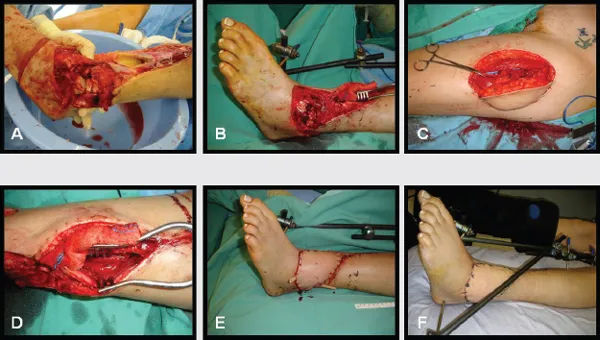
A 25 year-old female school teacher was involved in a single vehicle collision. She sustained an open tibia fracture [Gustilo IIIb] but maintained intact distal sensation and pulses (Fig. 1A). She was treated initially at an outside facility and transferred to a tertiary care center with plastic surgery and reconstructive expertise following medical stabilization, serial operative débridements, and external fixation of the bony fragments (Fig. 1B). Four days following transfer, seven days following the injury, an anterior-lateral thigh fasciocutaneous flap was performed (Fig. 1C), plugged into the anterior tibial artery and vein proximally (Fig. 1D). The bulky excessive tissue was later debulked in the operating room (Figs. 1E and 1F). The patient has now achieved full weight-bearing status on this extremity and is fully ambulatory, having returned to work and full activity.
images
Fig. 1. Operative sequence from initial presentation through final operative debulking.
Principles of Lower Extremity Reconstruction
• The modern dilemma that reconstructive surgeons face is no longer how to salvage an extremity but knowing whether or not attempting salvage is the best treatment for the patient.
• The goal in the reconstruction of lower extremity trauma is to restore the anatomy of the altered segment and to achieve functional recovery.
• Primary factors influencing outcomes of lower extremity injuries include degree of soft tissue damage, absence of plantar sensation, and severity of vascular injury.
• Indications for primary amputation include complete anatomic division of the posterior tibial nerve in adult patients, crush injuries with > 8 hours of warm ischemia, and an unstable patient.
• Preservation of mobility of the knee and ankle joints and restoration of the sensation and proprioception of the plantar surface of the foot allow for a functional extremity.
• Bone stabilization should be achieved expediently, and can be achieved internally with screws, rods, or plates or externally with percutaneous pins.
• Early flap coverage of wounds has demonstrated improved results if accomplished within the first 72 hours following injury.
• Limb reconstruction should be reserved for patients with reasonable expectation of ambulation within one year of the injury.
• Amputation may result in a more functional limb, as it can result in a quicker return to ambulation, activity, and work.
Evaluation
• Evaluation of a patient with a significant extremity injury should focus on the patient as a whole, with assessment and treatment following standard guidelines of the Advanced Trauma Life Support system.
• Severe open fractures treated at dedicated trauma units with both orthopedic and plastic surgery services have lower complication rates and lower need for revision surgery compared with those treated initially at local hospitals without such services.1
History
• The exact mechanisms of injury including any for...

Table of contents

  1. Cover Page
  2. Title Page
  3. Copyright Page
  4. Dedication Page
  5. Contents
  6. Editors
  7. Contributors
  8. Foreword
  9. Preface
  10. Core Knowledge and General Principles
  11. Plastic Surgery Involving the Integument
  12. Plastic Surgery of the Upper Extremity
  13. Plastic Surgery of the Lower Extremity
  14. Index