Kernel Smoothing In Matlab: Theory And Practice Of Kernel Smoothing
eBook - ePub

Kernel Smoothing In Matlab: Theory And Practice Of Kernel Smoothing

Theory and Practice of Kernel Smoothing

  1. 244 pages
  2. English
  3. ePUB (mobile friendly)
  4. Available on iOS & Android
eBook - ePub

Kernel Smoothing In Matlab: Theory And Practice Of Kernel Smoothing

Theory and Practice of Kernel Smoothing

About this book

Methods of kernel estimates represent one of the most effective nonparametric smoothing techniques. These methods are simple to understand and they possess very good statistical properties. This book provides a concise and comprehensive overview of statistical theory and in addition, emphasis is given to the implementation of presented methods in Matlab. All created programs are included in a special toolbox which is an integral part of the book. This toolbox contains many Matlab scripts useful for kernel smoothing of density, cumulative distribution function, regression function, hazard function, indices of quality and bivariate density. Specifically, methods for choosing a choice of the optimal bandwidth and a special procedure for simultaneous choice of the bandwidth, the kernel and its order are implemented. The toolbox is divided into six parts according to the chapters of the book.

All scripts are included in a user interface and it is easy to manipulate with this interface. Each chapter of the book contains a detailed help for the related part of the toolbox too. This book is intended for newcomers to the field of smoothing techniques and would also be appropriate for a wide audience: advanced graduate, PhD students and researchers from both the statistical science and interface disciplines.

Contents:

  • Introduction
  • Univariate Kernel Density Estimation
  • Kernel Estimation of a Distribution Function
  • Kernel Estimation and Reliability Assessment
  • Kernel Estimation of a Hazard Function
  • Kernel Estimation of a Regression Function
  • Multivariate Kernel Density Estimation


Readership: Advanced graduate students, researchers in mathematics or statistics.

Frequently asked questions

Yes, you can cancel anytime from the Subscription tab in your account settings on the Perlego website. Your subscription will stay active until the end of your current billing period. Learn how to cancel your subscription.
At the moment all of our mobile-responsive ePub books are available to download via the app. Most of our PDFs are also available to download and we're working on making the final remaining ones downloadable now. Learn more here.
Perlego offers two plans: Essential and Complete
  • Essential is ideal for learners and professionals who enjoy exploring a wide range of subjects. Access the Essential Library with 800,000+ trusted titles and best-sellers across business, personal growth, and the humanities. Includes unlimited reading time and Standard Read Aloud voice.
  • Complete: Perfect for advanced learners and researchers needing full, unrestricted access. Unlock 1.4M+ books across hundreds of subjects, including academic and specialized titles. The Complete Plan also includes advanced features like Premium Read Aloud and Research Assistant.
Both plans are available with monthly, semester, or annual billing cycles.
We are an online textbook subscription service, where you can get access to an entire online library for less than the price of a single book per month. With over 1 million books across 1000+ topics, we’ve got you covered! Learn more here.
Look out for the read-aloud symbol on your next book to see if you can listen to it. The read-aloud tool reads text aloud for you, highlighting the text as it is being read. You can pause it, speed it up and slow it down. Learn more here.
Yes! You can use the Perlego app on both iOS or Android devices to read anytime, anywhere — even offline. Perfect for commutes or when you’re on the go.
Please note we cannot support devices running on iOS 13 and Android 7 or earlier. Learn more about using the app.
Yes, you can access Kernel Smoothing In Matlab: Theory And Practice Of Kernel Smoothing by Ivanka Horová, Jan Koláček, Jiří Zelinka in PDF and/or ePUB format, as well as other popular books in Biological Sciences & Science General. We have over one million books available in our catalogue for you to explore.

Information

Chapter 1

Introduction

1.1 Kernels and their properties

Kernel smoothing belongs to a general category of techniques for nonparametric curve estimation including nonparametric regression, nonparametric density estimators and nonparametric hazard functions. These estimations depend on a smoothing parameter called a bandwidth which controls the smoothness of the estimate and on a kernel which plays a role of weight function. As far as the kernel function is concerned, a key parameter is its order which is related both to the number of its vanishing moments and to the number of existing derivatives for the underlying curve to be estimated.
In this chapter, we introduce a definition of the kernel and show some of its useful properties. Various aspects of the choice of the kernel function have been discussed, e.g., in Wand and Jones (1995); Müller (1988). As concerns a bandwidth choice – it is a crucial problem in the kernel smoothing and it will be discussed in the next chapters.
Throughout this book the following definition of a kernel is suitable for our considerations.
Definition 1.1. Let v, k be nonnegative integers, 0 ≤ v < k. Let K be a real valued function satisfying K ∈ Sv, k,
where
image
(1.1)
Such a function is called a kernel of order k. The integral conditions are often called moment conditions. We will use the short notation βk instead of βk(K) if there cannot be any misunderstanding.
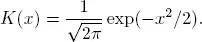
A commonly used kernel function is the Gaussian kernel
image
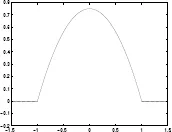
But this kernel has an unbounded support and thus it does not belong to the class Sv,k. For our purpose the kernels with bounded support will be more useful. Figure 1.2shows the most popular polynomial kernel – the Epanechnikov kernel (see Epanechnikov (1969)).
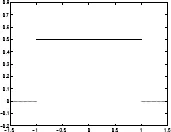
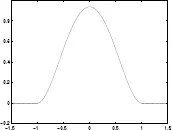
Example 1.1. Figures 1.11.4 present some kernels from the class S0,2. IA denotes the indicator function of the set A.
image
Fig. 1.1 K(x) =
image
(x), uniform kernel.
image
Fig. 1.2 K(x) =
image
(x), Epanechnikov kernel.
image
Fig. 1.3 K(x) = (1 – |x|)I[–1,1](x), triangle kernel.
image
Fig. 1.4 K(x) =
image
(1—x2)2I[–1,1](x), quartic kernel.
Example 1.2. Figures 1.5 and 1.6 present some kernels f...

Table of contents

  1. Cover
  2. Halftitle
  3. Title
  4. Copyright
  5. Dedication
  6. Preface
  7. Contents
  8. Chapter 1: Introduction
  9. Chapter 2: Univariate kernel density estimation
  10. Chapter 3: Kernel estimation of a distribution function
  11. Chapter 4: Kernel estimation and reliability assessment
  12. Chapter 5: Kernel estimation of a hazard function
  13. Chapter 6: Kernel estimation of a regression function
  14. Chapter 7: Multivariate kernel density estimation
  15. Notation
  16. Bibliography
  17. Index