![]()
Part One
Ancient Routes to Health and
Spiritual Fulfillment
Part One Overview
1. Acupuncture
2. Ayurveda
3. Chinese Medicine, Traditional (TCM)
4. Homeopathy
5. Native American Healing
6. Naturopathic Medicine
Part One Overview
The mainly ancient approaches reviewed in this part share many features. Instead of disease-oriented therapies, these are general routes to the maintenance and restoration of health and well-being. They involve much more than prescriptions for ailments. They provide a level of lifestyle guidance that some see as a substitute for religion. Indeed, most of these health-related theories once were, or still are, thoroughly entwined with religion and with the broader culture. And most have endured for hundreds or thousands of years.
In that distant past, medicine, magic, and religion were one and the same. No doubt the great ancient shamans, like those to follow, were both priest and physician, with the extra ability to contact and influence the supernatural forces believed to control all events, including life, death and health. The famous “Venus of Wilendorf” is one of many small fertility icons found around the world. These small carved figures were created 25,000–30,000 years ago when religion, magic and medicine were combined as one. They are still combined in some areas of today’s world.
The healing systems discussed here originated long before the time of scientific understanding of the human body and its biological mechanisms. It is not surprising, therefore, that both physical and cosmic concerns and uncertainties are reflected in these early explanations of health and illness. They are concerned not only with how the body works and how it changes when death occurs, but also with the meaning of celestial events and the relationships among humans, the environment, the spirit world, and the cosmos.
One of the central ideas shared by these approaches, common to most early efforts to understand health, illness, death, and the human relationship with the larger world, is the notion of an invisible vital energy or life force. Called prana in Ayurvedic medicine, qi or chi (both pronounced “chee”) in traditional Chinese medicine, and by many other terms, the circulation of this vital force could explain life and death. The idea also provided a way of understanding links and pathways between the human body, humankind, the spirit world, and the universe.
It is possible that ancient efforts to improve the flow of human vital energy lie behind peculiar archaeological finds in Europe and South America. Many human skulls dating back 8,000 years have been found with a round plug of bone removed. Healed edges around the hole indicate that at least some people survived the procedure. Was this procedure, called trepanation, evidence of prehistoric cults of healing? Illness was thought to be caused by spirits; the holes may have been meant to free these evil spirits to bring about a complete cure. The precise rationale for this primitive surgical effort is unknown. Experts believe it was performed as a religious rite, as a way to create an opening for the escape of magical demons, as a healing ritual. Perhaps it was a means of improving the flow of human vital energy and bridging the connection between spiritual forces and the mind and body, or a means of draining excess energy. These combined purposes express the unity of religion, magic, and medicine that existed since earliest times.
Another feature common to early healing approaches is the effort to explain physiological events in terms of well-known contrasting pairs: hot-cold, wet-dry, light-dark, yin-yang, active-passive. These qualities were ascribed not only to all bodily components and functions, but also to emotional states, climate, and seasons, achieving the necessary integration of people, space, and time. Early humans made similar connections between body and mind, society and landscape. All were interrelated and reflected one another in a complex system of parallel associations.
Numbers, too, were important and used commonly across the various early healing systems. They provided a means of reflecting universal patterns, controlling human fate, and connecting the activities of the human body with nature’s rhythms and cycles. The numbers 4 and 5 predominated as magical in the ancient world. Examples of the latter include the five elements of ancient China, the five elements of the Ayurvedic worldview, the “Five World Regions” drawn in the pre-Columbian Mexico Codex, and the five senses of Tibetan medicine. The broad significance of the number 4 is evident in descriptions of living creatures and plants, time, elements, ceremonial activity, and points of the sacred hoop in Native American artifacts; it also is found in the ancient Greek conception of bodily humors and the basic elements in the universe.
The healing systems discussed here are not the only or even the earliest such systems. They were selected because they are followed by many people today. Each offers guidance in caring for the body, the mind, and the spirit in an integrated fashion that seems to meet not only the need for physical healing, but also seems to fulfill a spiritual hunger that is as present today as it was in centuries and millennia past.
![]()
1
Acupuncture
Although acupuncture is only one component of traditional Chinese medicine, it is a major component and so deserves its own chapter. Acupuncture is a distinct entity because it has its own traditions and conceptual basis, as well as an elaborate system of understanding how the body works and how it relates to the environment. It also has achieved unprecedented wide-spread acceptance.
Probably acupuncture was a formalized outgrowth of the natural human tendency to stroke, massage, or press the body until pain is relieved. One can imagine the process becoming increasingly sophisticated over the centuries, as pressing specific points on the body, perhaps by group consensus, was found to relieve distress in particular areas of the body. Acupressure apparently gave rise to the more technological, albeit still ancient, variation: acupuncture.
Acupressure involves placing very firm finger pressure for a few minutes on specific acupoints to relieve pain and stress. Pressure can be applied by one’s own or another person’s fingers. Acupressure predates acupuncture and gave rise to it. Acupressure is acupuncture without the needles. It is discussed further in Chapter 22.
One of the most studied of complementary therapies, modern acupuncture is accepted by mainstream medicine for the management of various types of pain, for addiction control and for the treatment of several physical and emotional symptoms experienced by cancer patients and others. For this reason, acupuncture is a good example of the few treatments discussed in this book that sits on the cusp of mainstream medicine. It is available today in many mainstream hospitals, clinics and cancer centers.
Acupuncture was popular in ancient China, banned in 1822 by the Chinese Imperial Medical College, which prohibited disrobing as indecent, and rediscovered in the twentieth century. Today, herbal remedies (Chapter 11) and other traditional techniques, such as tai chi and qi gong and acupressure, join acupuncture as central components of Traditional Chinese Medicine.
What It Is
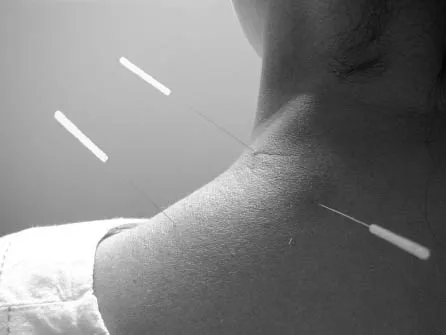
Acupuncture is a medical therapy developed in China more than two thousand years ago. It involves the placement of hair-thin, disposable needles into the skin (Figure 1). Ancient acupuncture needles were made of bone, stone or metal, including silver and gold. Modern needles are made of stainless steel. The needles penetrate just deep enough into the skin to keep from falling out, and skilled practitioners accomplish virtually painless insertion. Unlike needles used to give injections, modern acupuncture needles are not hollow, and are therefore very thin, about the width of a human hair. They are sterile, disposable and safe.
Needles are placed at specific points along meridians, or channels. These channels are like rivers with tributaries that flow into increasingly narrow rivulets, mimicking nature’s flow of water to increasingly smaller streams. The twelve main meridians, like the twelve main rivers of ancient China, represent an internal system of communication and transport, just as actual waterways permit communication and transport in the outer world. The human body is viewed as a miniature model, or microcosm, of the universe.
Each channel is believed to be connected to a specific networked area or organ system of the body. By needling acupoints along a particular meridian, a problem in a distant area of the body can be treated. Acupoints are used in both acupuncture and acupressure. In modern acupuncture, more than 1,000 acupoints (some experts say more than 2,000) are recognized, but most treatments require needles in only ten or twelve points. Typically, needles are kept in place for less than one-half hour. Determining the exact size and placement of the needles is essential. Twirling or setting them or using “electro-acupuncture,” where a small amount of electricity goes through the needle from a source clipped to the top, enhances the result.
Figure 1. Hair-thin acupuncture needles.
In classic Chinese medicine, it was believed that every problem, weakness, illness, and symptom could be corrected by acupuncture. Further, this ancient healing method was but one integral piece of a complex mosaic that explained health, disease, the cosmos, and the relationship of humankind to nature and the universe as a whole. This can be seen in the relationship between the number of months and days in a year, the human body’s twelve main meridians, and, in the original classic Chinese Medicine texts, the 365 acupoints. The individual pulsates to the rhythm of the cosmos.
Originally, acupuncture was thought to be a cure-all. It was used to treat all ailments by restoring balance within the individual, and between the individual and the universe.
Sometimes acupuncture is augmented by moxibustion, the placement of a smoldering plug of the herb mugwort on a meridian acupoint. This practice is as old as acupuncture. Cupping is another ancient Chinese and Indian remedy in which heated cups are placed on the skin, sometimes after small punctures are made at the intended location. This process produces a suction force that is thought to boost circulation and improve health. Insertion of acupuncture needles only in the outer ear is a relatively new variation, in which the ear serves as a miniature map of the entire body and its acupoints.
Modern Acupuncture
Modern versions of acupuncture use electricity, heat, laser beams, sonar rays, and other non- needle acupoint stimulators. In use since the 1930s, electroacupuncture is considered less tiring and time-consuming than the manual version. Needles are connected to a supply of weak electric power. Therapeutic reactions are said to be just as effective.
What Practitioners Say It Does
In China, acupuncture is still applied to treat ailments and cure disease, including serious illnesses such as cancer and diabetes, but careful investigations find no benefit against disease. In modern Chinese hospitals, acupuncture sometimes is used as a secondary surgical anesthetic. In Asia and in the West, acupuncture is used and has been found effective to relieve arthritis, menstrual symptoms and chronic pain caused by other problems. It also assists withdrawal from addictions such as drug and alcohol dependency. Of greatest significance here, acupuncture effectively treats many physical and emotional symptoms associated with cancer and cancer treatment. Research supporting its effectiveness for purposes relevant to cancer patients are detailed below under the subheading, “Research Evidence to Date.”
Beliefs on Which It Is Based
Classic, traditional acupuncture is based on ancient Chinese medicine and its understanding of health. The origins of acupuncture illustrate how the earliest civilizations sought to understand the world and its various components, including seasons, nature, wellness and disease. All were seen as parts of a single whole. Each aspect of life, including health and disease, was conceptualized as a polarity, manipulated by two opposing forces in nature. These forces are the yin, or dark female force, and the yang, or light male force. Illness was said to occur when opposing yin-yang energies were not in harmony. Acupuncture and all other healing interventions, such as herbal tonics and qigong, aimed to rebalance these energies.
This deceptively simple idea is actually an extremely complex, detailed set of interactions and connections among bodily organs, forces, and pathways. A central component of the belief system is the concept of vital energy, or the life force. In classic Chinese medicine, the life force is termed chi or ch’i, or in modern transliteration qi (all pronounced “chee”).
When there is a balance of qi—not too...