![]()
Chapter 1
Cosmology: A Preview
The purpose of this Chapter is to give a preview of the field which we consider in this and the accompanying book. The presentation here is at the qualitative level, and is by no means complete. Our purpose is to show the place of one or another topic within the entire area of cosmology.
Before proceeding, let us introduce units and conventions that we use throughout this book.
1.1 Units
We mostly use the “natural” system of units in which the Planck constant, speed of light and the Boltzmann constant are equal to 1,
Then the mass M, energy E and temperature T have the same dimension (since [E] = [mc2], [E] = [kBT]). A convenient unit of mass and energy is 1 eV or 1 GeV = 109 eV; the proton mass is then equal to mp = 0.938 GeV, and 1 K is approximately 10−13 GeV. Time t and length l in the natural system have dimension M−1 (since [E] = [ħω], [ω] = [t−1] and [l] = [ct]), with 1 GeV−1 ~ 10−14 cm and 1 GeV−1 ~ 10−24 s. We give the coefficients relating various units in Tables 1.1 and 1.2.
Problem 1.1. Check the relations given in Tables 1.1 and 1.2. What are 1 Volt (V), 1 Gauss (G), 1 Hertz (Hz) and 1 Angström (Å) in natural system of units?
In natural system of units, the Newton gravity constant
G has dimension
M−2. This follows from the formula for the gravitational potential energy
since [
V] =
M, [
r−1] =
M. It is convenient to introduce the Planck mass
MPl in the following way,
Numerically
Table 1.1 Conversion of natural units into CGS units.
Energy | 1 GeV = 1.6 · 10−3 erg |
Mass | 1 GeV = 1.8 · 10−24 g |
Temperature | 1 GeV = 1.2 · 1013 K |
Length | 1 GeV−1 = 2.0 · 10−14 cm |
Time | 1 GeV−1 = 6.6 · 10−25 s |
Particle number density | 1 GeV3 = 1.3 · 1041 cm−3 |
Energy density | 1 GeV4 = 2.1 · 1038 erg · cm−3 |
Mass density | 1 GeV4 = 2.3 · 1017 g · cm−3 |
Table 1.2 Conversion of CGS units into natural units.
Energy | 1 erg = 6.2 · 102 GeV |
Mass | 1g = 5.6 · 1023 GeV |
Temperature | 1 K = 8.6 · 10−14 GeV |
Length | 1 cm = 5.1 · 1013 GeV−1 |
Time | 1 s = 1.5 · 1024 GeV−1 |
Particle number density | 1 cm−3 = 7.7 · 10−42 GeV3 |
Energy density | 1 erg · cm−3 = 4.8 · 10−39 GeV4 |
Mass density | 1 g · cm−3 = 4.3 · 10−18 GeV4 |
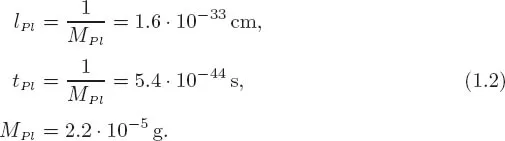
and the Planck length, time and mass are
The gravitational interactions are weak precisely because MPl is large.
Problem 1.2. Check the relations (1.1) and (1.2).
Problem 1.3. What is the ratio of gravitational interaction energy to Coulomb energy for two protons?
The traditional unit of length in cosmology is Megaparsec,
1 Mpc = 3.1 · 1024 cm.
Let us also introduce a convention which we use in this book. The subscript 0 denotes present values of quantities which can depend on time. As an example, ρ(t) denotes the energy density in the Universe as a function of time, while ρ0 ≡ ρ(t0) is always its present value.
There are several units of length that are used in astronomy, depending on sizes of objects and length scales considered. Besides the metric system, in use are
astronomical unit (a.u.), which is the average distance from the Earth to the Sun,
1 a.u. = 1.5 · 1013 cm;
light year, the distance that a photon travels in one year,
parsec (pc) — distance from which an object of size 1 a.u. is seen at angle 1 arc second,
1pc = 2.1 · 105 a.u. = 3.3 light year = 3.1 · 1018 cm.
To illustrate the hierarchy of spatial scales in the Universe, let us give the distances to various objects expressed in the above units.
10 a.u. is the average distance to Saturn, 30 a.u. is the same for Pluto, 100 a.u. is the estimate of maximum distance which can be reached by solar wind (particles emitted by the Sun). 100 a.u. is also the estimate of the maximum distance to cosmic probes (Pioneer 10, Voyager 1, Voyager 2). Further out is the Oort cloud, the source of the most distant comets, which is at the distance of 104 − 105 a.u. ~ 0.1 − 1pc.
The nearest stars — Proxima and Alpha Centauri — are at 1.3 pc from the Sun. The distance to Arcturus and Capella is more than 10 pc, the distances to Canopus and Betelgeuse are about 100 pc and 200 pc, respectively; Crab Nebula — the remnant of supernova seen by naked eye — is 2 kpc away from us.
The next point on the scale of distances is 8 kpc. This is the distance from the Sun to the center of our Galaxy. Our Galaxy is of spiral type, the diameter of its disc is about 30 kpc and the thickness of the disc is about 250 pc. The distance to the nearest dwarf galaxies, satellites of our Galaxy, is about 30 kpc. Fifteen of these satellites are known; the largest of them — Large and Small Magellanic Clouds — are 50 kpc away. Search for new, dimmer satellite dwarfs is underway; we note in this regard that only eight of Milky Way satellites were known by 1994.
The mass density of the usual matter in usual (not dwarf) galaxies is about 105 higher than the average over the Universe.
The nearest usual galaxy — the spiral galaxy M31 in Andromeda constellation — is 800 kpc away from the Milky Way. Despite the large distance, it occupies a sizeable area on the celestial sphere: its angular size is larger than that of the Moon! Another nearby galaxy is in Triangulum constellation. Our Galaxy together with Andromeda and Triangulum galaxies, their satellites and other 35 smaller galaxies constitute the Local Group, the gravitationally bound object consisting of about 50 galaxies.
The next scale in this ladder is the size of clusters of galaxies, which is 1–3 Mpc. Rich clusters contain thousands of galaxies. The mass density in clusters exceeds the average density over the Universe by a factor of a hundred and even sometimes a thousand. The distance to the center of the nearest cluster, which is in the Virgo constellation, is about 15 Mpc. Its angular size is about 5 degrees. Clusters of galaxies are the largest gravitationally bound systems in the Universe.
1.2 The Universe Today
We begin our preview with the brief discussion of the properties of the present Universe (more precisely, of its observable part).
1.2.1 Homogeneity and isotropy
The Universe is homogeneous and isotropic at large spatial scales. The sizes of the largest structures in the Universe — superclusters of galaxies and gigantic voids — reach1 tens of Megaparsec. At larger scales all parts of the Universe look the same (homogeneity). Likewise, there are no special directions in the Universe (isotropy). These facts are well established by deep galaxy surveys which collected data from millions of galaxies.
About 20 superclusters are known by now. The Local Group belongs to a supercluster with the center in the direction of Virgo constellation. The size of this supercluster is about 30 Mpc, and besides the Virgo cluster and Local Group it contains about a hundred groups and clusters of galaxies. Superclusters are rather loose: the density of galaxies in them is only twice higher than the average in the Universe. The nearest to Virgo is the supercluster in Hydra and Centaurus constellations; its distance to Virgo supercluster is about half a hundred Megaparsec.
The largest catalog of galaxies and quasars up to date is the freely available catalog of SDSS [2] (Sloan Digital Sky Survey). This catalog is the result of the analysis of the data collected during almost 8 years of operation of a dedicated telescope, 2.5 meters in diameter, which is cap...