![]()
PART I
![]()
Chapter 1
What is Business Intelligence?
1. Value-Adding, Competitive Intelligence
In recent years, the source of power has shifted from land, finance and capital to intellectual capital; in the 21st century, society will be governed by intelligence, knowledge and wisdom. In the future, the power of a nation will be based not only on its territory, population, military strength, products and finance, but also on intelligence, technology, knowledge, education, intellectual prowess, software and culture, which will form the major factors of progress and development of the nation and society. Faced with this transition, Japan needs to establish new strategies to renovate and rebuild the nation.
In this respect, study of business intelligence and competitive intelligence is highly necessary. Business Intelligence (BI) refers to information that is collected, organized, evaluated and analyzed; thus value-added, it can contribute to decision-making. Competitive Intelligence (CI) is part of BI; CI enhances the value of BI further, giving it a competitive edge.
To have BI, it is necessary to clearly define the purpose at hand when collecting information; to secure reliable information sources; to assess, examine, and analyze the obtained information; to draw up and make use of effective reports; and to audit the intelligence. This process of refining information into intelligence is called the “ intelligence cycle”.
Dr. Benjamin Gilad, former Associate Professor at Rutgers University, divides the processes of BI into five parts — collection, evaluation, storing, analysis, and dissemination — in his book, The Business Intelligence System . That is to say, the information collected from the government and industry should be evaluated, stored, analyzed, and disseminated.
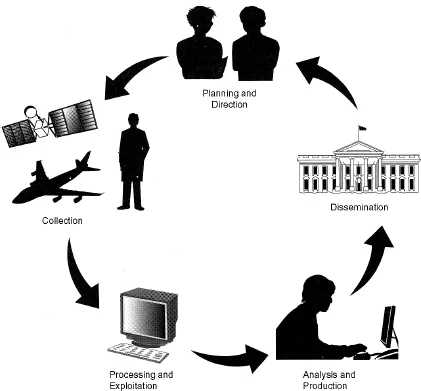
On the other hand, Mr. Mark Lowenthal, a former CIA analyst and a current lecturer of intelligence at Columbia University, introduces five phases of the intelligence cycle — planning/direction, collection, processing/exploitation, analysis/production, and dissemination — in his book, Intelligence from Secrets to Policy (see Figure 1).
Dr. Stevan Dedijer of Lund University, Sweden, divides BI into four processes — retrieval and collection, storing, analysis, and presentation — while Mr. Herbert E. Meyer, ex-Vice Chairman of the
Figure 1: The Intelligence Process: A CIA View
National Intelligence Council, defines BI as information to be collected, selected, analyzed, organized and disseminated to fulfill unique needs of a particular company's policy-making (Herbert E. Meyer, Real-World Intelligence ).
2. The Methodology of Business Intelligence
For BI strategy, it is vital to have information analysis ability to make the best use of information for corporate strategy, recognizing crises and opportunities lying ahead, and preparing the company for them. In the US and Europe, corporations make use of techniques developed by the CIA and the intelligence community as management methods to refine information into intelligence.
Herbert E. Meyer divides the process into the following four stages:
(1) Distinguish relevant information from irrelevant information.
(2) Select necessary information and store it.
(3) Process the collected information.
(4) Report the results, conclusion, assessment, and prediction, so that it can contribute to top management's decision-making.
Through the above four phases, i.e., selection, gathering, processing and dissemination, information becomes value-added intelligence that generates profits.
Companies collect and analyze information for the following purposes:
(1) To collect information about competitors, industries, governments and nations for management strategy;
(2) To collect and analyze background information, such as information about technology, politics, economy, society and culture;
(3) To observe the changing business environment and keep track of trends; and
(4) To monitor the trends of suppliers of materials, exporting nations, competitors and overseas markets.
Utilizing BI thus, corporations strive to achieve their strategic targets.
This calls for a system of BI collection and analysis, and for that system, we need strategies for linking and combining collected information and detecting trends. In this way, BI — highly value-added business information — becomes management tools to provide top management with intelligence and knowledge. Herbert E. Meyer predicts that such BI systems for collecting information will grow larger in scale and more efficient than national intelligence services.
Japanese corporations are said to be inferior to their European and American counterparts in their information analysis ability. They should therefore focus their efforts on enhancing their information analysis ability.
According to an intelligence specialist, almost 97% of necessary information can be obtained from public and open sources and from private sources. Therefore, it is not necessary to resort to unlawful means or spying. What is important here is not obtaining that mere 3% of secret information, which would infringe on corporate ethics and corporate governance, but ascertaining if the necessary information is securely gathered, if there is any redundant information, and whether or not the sources are reliable. In other words, what is important is “ Information Audit.”
In corporate accounting and financial audit, we examine if funds are properly used and whether any unlawful deeds are committed. Likewise, we should consider intelligence as capital and assets of corporations, and audit intelligence activities too. Here, it should be clearly noted that “information audit” is as important as accounting and financial audit for corporate management.
Herbert E. Meyer emphasizes that companies which can understand their own information environment and that of their competitors and establish competitive management strategies will win in this rapidly globalizing information society. He further predicts that BI and BI systems will revolutionize management tools.
The biggest weapon of corporations and organizations in the 21st century is “ Intellectual Capital,” which has not been fully developed yet. Intellectual capital consists of intelligence, knowledge and wisdom.
“ Intellectual Capital” will become the new assets of companies to replace “machines,” “financial capital,” and “land” of the 20th century, and “intelligence” will become the major profit-generating factor in this century. Under such circumstances, it is imperative for companies to obtain value-added intelligence which translates to profits — that is to say, valuable business intelligence — in order to secure competitive advantages.
About 10,000 years ago during the Agricultural Age, the foundation of power was land. The Industrial Revolution transferred power to capital. However, the 21st century is the era of intelligence and knowledge; the source of power has shifted to intelligence, knowledge, education, intellectual ability, software and culture. Hence, education on intelligence and business intelligence in general is crucial in this era.
Information is classified into the following three categories:
(1) Public and open information;
(2) Private information;
(3) Confidential information.
In business, we must not deal with confidential information which would require espionage to obtain it. It is of utmost importance that we gather information ethically. An American organization, Society of Competitive Intelligence Professionals (SCIP), has a Code of Ethics emphasizing the importance of ethics in intelligence activities. The main objective of BI is obtaining competitive advantage by BI methods in areas such as business development, restructuring of corporations, strategic alliances, M&A, overseas investment, and risk management.
3. The Roles of Business Intelligence
The roles of business intelligence are:
(1) Deepening and expanding of existing business;
(2) Risk management;
(3) Information control, and security control and maintenance;
(4) Information manipulation.
That is to say, BI activities encompass all activities in collecting, analyzing and utilizing every kind of information including open, private, confidential, critical, aggressive, and defensive information; furthermore, primary and direct information, secondary and indirect information, human intelligence, documents, images, communications, competitive information, technology and patent information, and accounting and financial information.
To fulfill the above roles, the Chief Information Officer (CIO) and Chief Knowledge Officer (CKO) should conduct a thorough Information Audit, introducing the method of Supply Chain Management (SCM). It is recommended that Information Chain Management (ICM), Knowledge Chain Management (KCM) and Value Chain Management (VCM), which I am a proponent of, are effectively implemented.
The method of ICM is to refine and add value to information by linking target-setting and information, and by repeating the entire sequence of target-setting, information-gathering, selection, checking the sources, analysis, assessment, utilization, intelligence audit and review. The key is to link information of the past, present and future, and to have clear images of targets, so that the future can be predicted accurately. For multifaceted, multilateral and multilayered utilization of information, linking information — “correlation,” “combination,” and “collaboration” — becomes crucial.
Information does not lessen in value when given to others; in fact, information tends to accumulate when we offer it to others. To make use of this nature of information for effective information gathering, we need to first give before taking it. BI activities have to be done in the spirit of “give and take.” This is what distinguishes information from other tangible things and products.
Undoubtedly, intelligence education, especially creative education, will become very important in the 21st century for government, industry and academia, in the rapidly globalized society where intelligence and knowledge rule. Today, 80% of computer databases are in English. It is estimated that at least two billion people in the world can communicate in English. When 1.3 billion Chinese people communicate in English, the total number of English speakers will soar to some three billion; that is, almost half of the entire population of the world will be able to communicate in English.
The keywords of this century are information, English and international relations. To survive the 21st century, competency in English, interests in international relations, and BI abilities will become important assets for acquiring a competitive advantage.
Dr. Benjamin Gilad of Rutgers University notes that there is a flood of information in the world today, and yet, intelligence — truly useful, value-added information — is as scarce as water in the desert.
We must therefore study and learn BI, and become able to collect information, evaluate and analyze it, and add value to it, thus turning information into intelligence. To reiterate: if we are to survive in the fierce global competition of the new century, clearly we need Intelligence Education — education on information, ICT and intelligence.
![]()
Chapter 2
Competition and Intelligence
1. Competition and Business Intelligence
1.1. Business intelligence is still not a familiar concept in Japan
It is said that the term “ business intelligence” was introduced in 1972 by the late Dr. Stevan Dedijer, professor at Lund University, Sweden. Dr. Dedijer had studied nuclear physics and had connec...