![]()
Chapter 1
Introduction
The solving of coastal problems will remain for years rather an art than a knowledge, with the slogan: ‘the art of engineering is to get sufficient conclusions from insufficient data”. However also art needs skill, and a mathematical theory; which clarifies in an exact way the implications of several schematizations of reality, may provide a part of this skill. At the moment only several aspects of the processes, which occur in nature can be schematized and translated into a mathematical theory. In the transition of the real prototype to the mathematical model the danger is hidden, to concentrate on an insignificant feature, which gives pseudo exact results. This can be avoided by active knowledge of the prototype and carrying out measurements in prototype and hydraulic models, from which a “smoothing of data” can result. It is cheaper and faster to consider only one of the three aspects: prototype, theory and laboratory, however, often only a combination of all of these aspects reveals the truth. The theory indicates pertinent contradictions in the measurements, but measurements in prototype are necessary to keep the attention on invalid schematization.
This book deals on “Coastal Dynamics”, which will be defined in a narrow sense as a mathematical theory, which starts from given equations of motion for the sediment, which leads with the continuity equation and given boundary conditions to a calculated (eventually schematized) coastal topography, which is generally a function of time. This is clearly analogous to aero- and hydrodynamics, thermo-dynamics, hydrology and other related fields.
The subject of this book, however, covers only a specific part of the Coastal Dynamics. It is based upon the notion of old masters, that for a manager the back-side of a cigar-box should be large enough to evaluate all the information and anti-information which is poured over him. For instance: statements, based upon high-tech number-crunching can find a sad end when those do not match large-scale continuity. Think for instance of tidal computations, in which time-varying boundary conditions (shoals which emerge above water level during a part of the tide) are not reproduced accurately enough.
The positive role of refined numerical techniques on solving problems in coastal dynamics should be stressed. However, one will not find much about it in this book. Emphasis is on physics, rather than on mathematics. It is meant for coastal managers, to inspire them, to enable them to put sensible questions and, if necessary, to say: “Oh, no sir”.
The theory would be sterile without a consideration about the validity of the equation of motion, so much the more, while these equations of motion are not as evident, straight-forward and single-valued as for instance the Euler-equations in hydrodynamics.
The Newtonian laws are not quite sufficient for the computation of the sediment motion, because the motion of grains is subject to stochastic processes as the shape of the grains, the shape of the granular bed surface, turbulence, irregular wave motion, etc.
In modern sophisticated computermodels, a physical approach going far into details is possible, this includes the consideration of water and sand apart from each other, investigation of turbulent and viscous forces on the grains, and calculation of the sediment motion.
This is a difficult and tiresome way, which has to be followed and will give finally the best results. However, the building of structures cannot wait for that, as it has not done in the past and therefore a short-cut from theory to practice has to be made, which involves the use of experimental data. This includes entirely the loss of the paradise of exactness. As the accuracy of the experimental data is very poor, this is a serious draw-back. Instead of the real equations of motion substitutes have to be chosen and when it is not carefully examined, if and when these assumed equations of motion are valid, the mathematical theory is just an escape from reality.
In the mathematical theory, all constants and variables are indicated by symbols and it is suggested, that the numerical value of many of these constants can be found from prototype data. Without a discussion about at least the order of magnitude of these constants. the theory is merely a start for future research.
Under coastal dynamics in a broader sense also these discussions about the validity of the equations of motion and the order of magnitude of the assumed constants will be included.
In this book the sediment transport formulae, which are used, are not thoroughly discussed.
The coastal dynamics, as presented in this course, provides a far from complete theory.
The aim is threefold:
• It is a start for future research;
• it leads to qualitative conclusions about the effect of coastal structures;
• some of the results are already available for practical computations.
Although based upon universal physics, applications treated are more or less tailor made for Dutch circumstances. The same holds for schematizations used.
However, the book aims at a much broader public than only people of Dutch nationality.
Thus it is important to consider the physical characteristics of the considered examples rather than its location:
a. Nearly all considered (Dutch) beaches are sandy beaches (D50 ≈ 200 µm); rock never emerges at the surface; effect of peat layers (occurring seldomly, apart from in the Wadden area’s and in the estuaries) may be neglected. Beaches like those emerge at many (most) of the places at the East- and Westcoast of the USA and in Japan. Grain size as given above has an ashtonishing university all over the world.
b. A difference between Dutch beaches and beaches elsewhere is the number of breaker bars, counted in cross-shore direction. Nearly nowhere this number exceeds two; however, in the Netherlands the occurrence of three successive breaker bars (Fig. 2.3) is not unusual. Up to now, the physics in detail of breaker bars is not well enough understood to give an explanation.
c. Effect of a rocky sublayer may occur on many places in the USA (for instance: Hawaii). However, the one- and two-coastline theory (displayed in this book) are based upon a solid sublayer; thus the application of the theory, the determination of the “closure depth” will be more straight forward at those kind of beaches than on beaches like the considered ones, where this closure depth depends on the wave height (cf. Chapters 4 and 5)
Thus, it may be concluded, that the theory developed has a much more general application than the choice of examples suggests. Theory is very much in line (qua topic and approach) with international literature, as presented in the bi-annual International Conferences on Coastal Engineering.
Chapter 2 gives an overview of the Dutch coast. The papers, on which it is based upon, are written for a broad public and thus sometimes might give more basics than necessary for most of the present readers.
Chapter 3 gives (at this moment more or less classical) line theory. Chapters 4–6 (determination coastal constants; experimental verification (laboratory and nature) and evaluation) try to expose, whether nature knows coastal dynamics.
Where the former chapters mainly deal with uninterrupted coasts (apart from single discontinuities like harbor moles or groins), in Chapter 7 some ideas are exposed concerning interaction of delta’s and tidal basins. It is an important subject for the Netherlands, as a large part of the coast consists of tidal lagoons and estuaries (Chapter 2.1).
As mentioned in the preface, in this book coastal dynamics is considered from one viewpoint. Thus the attention should be drawn on Chapter 8, in which a number of Dutch coastal specialists give additional information and thus can deliver the three-dimensional view.
![]()
Chapter 2
The Dutch Coast: A Coastal
Engineering View
2.1. Introduction
2.1.1. Contents of this Chapter
Coastal dynamics, as defined in the introduction (Chapter 1), is based on universal physics. However, as explained already in the introduction, the scientific language of this book will have a Dutch accent. General laws will be explained using examples regarding mainly to the Dutch coast. And as not all possible boundary conditions on our global sphere are considered, a loss of generality should be taken for granted.
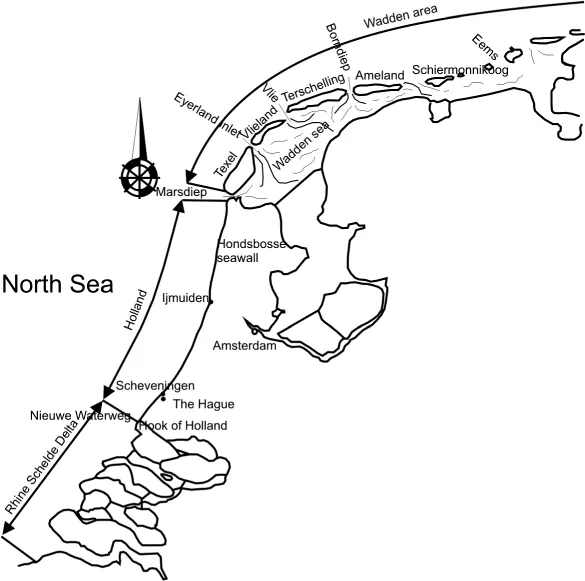
Thus, this chapter (specifically Section 2.1) will start with an overview of the Dutch coast. An impression is given by the map of Fig. 2.1 and the aerial views are displayed in the photographs, Figs. 2.2–2.7. Those are derived from the site of the National Institute for Coastal and Marine Management (RIKZ).a
The country is unique in this way, that systematic measurements concerning its beach were already started (at least were saved) in 1850. A display and a phenomenological analysis of those antique measurements (up to 1968) are given in Section 2.2. Phenomenologically based conclusions about, for instance, the effect of groins can be drawn from those measurements. As could be expected, measurements were intensified in the course of time. Especially, the start of systematically profile measurements around 1960 (the so-called JARKUS-measurementsb gave a more three-dimensional view. Description and analysis are given in Section 2.3. Behavior of breaker bars, effect of harbor moles and the overall coastal behavior, after depthaveraging over the breaker bar area (i.e. the coastal behavior on a larger scale) can be described.
Fig. 2.1 The Dutch coast.
Section 2.4 focuses on the sand transport along the Dutch coast,c as derived from the (external) effects of waves and tides. Starting from a simple (i.e.: simplified) transport relation, the CERC-formula, on a yearly basis probability distributions are derived for the longshore transport; this as function of the site along the coast.
However, as will be c...