![]()
Part I
The Reading Toolkit
This title probably conjures up the image of a schoolboy's pencilcase containing a few chosen articles designed to help reading: a pair of glasses, a bookmark, instant coffee, etc. However, this toolkit is quite special. It contains resources invisible to the naked eye, like time, memory, energy, attention, and motivation. A skillful writer minimises the time, memory, and energy needed for reading, while keeping reader attention and motivation high.
![]()
1
Require Less from Memory
The Forgotten Acronym
Let us start with a story.
Acronyms allow writing to be more concise. However, conciseness is unhelpful if it decreases clarity. An acronym is clear within the paragraph in which it is defined. If it continues to be used regularly in the paragraphs that follow, the reader is able to keep its meaning in mind. But, if it appears irregularly or if reading is frequently interrupted, the acronym—away from the warm nest of the reader's short-term memory—loses its meaning. Food gets cold fast when it is out of the oven; you warm it up before eating it. Similarly, keep the acronym warm in the reader's memory; redefine it regularly in your paper.
Reader curiosity or impatience also contributes to reading accidents. The reader has the unfortunate habit (from the author's point of view) of skipping entire parts of your article to go directly to a figure, or to a section in your paper that seems interesting (via the heading or subheading). If the figure caption or the heading/subheading contains acronyms, and if the reader has skipped the sections that contain their definitions, then the accident will happen.
Avoiding problems with acronyms is easy:
- If an acronym is used only two or three times in the entire paper, it is better not to use one at all (unless it is as well known as IBM).
- If an acronym is used more than two or three times, expand its letters the first time it appears on a page so that the reader does not need to flip pages back and forth. Some journals ask authors to regroup all acronyms and their definitions at the beginning of their paper so that the reader can locate them more easily.
- Avoid acronyms in visuals or define them in their caption.
- Avoid acronyms in headings and subheadings because readers often read the structure of a paper before going inside the paper.
- Be conservative. Define all acronyms, except those commonly understood by the readers of the journal where your paper is published.
Notice the just-in-time definition of the acronym in the following example.
The new universal learning algorithm SVM (support vector machine) had a profound impact on the world of classification.
The Detached Pronoun
This, it, them, they, and their a are all pronouns. A pronoun usually replaces a noun, but sometimes it replaces a phrase, a sentence, or even a full paragraph. Like the acronym, it is a shortcut that avoids the repetition of words.
Pronouns and acronyms are both pointers. This characteristic is at the root of all problems:
- If you point in the direction of someone who has already left the room, nobody will understand. Likewise, if the noun the pronoun points to is 20 or 30 words back in the text, it may have left the reader's short-term memory; the noun–pronoun link is broken. Usually, this memory lapse is not enough to discourage readers from reading forward. They tolerate ambiguity and read on because they are hopeful that the text will become clearer later. Interpretation errors and reduced understanding are therefore likely.
- If you point towards a person in a group far away from you, people will find it difficult to guess whom exactly you are pointing to. When the pronoun points back to several likely candidates, the reader—whose incomplete understanding of the text does not allow disambiguation—will pick the most likely candidate and read on, hoping clarity will be forthcoming. If that likely candidate is the wrong one, then interpretation errors will follow and understanding will drop to a lower level.
- Finally, some fingers seem to point nowhere; actually, they point somewhere, but only the person who is pointing knows where. When the pronoun points to something that is only in the mind of the author, the reader is left guessing and more often than not guesses wrongly. Understanding thus drops to a lower level.
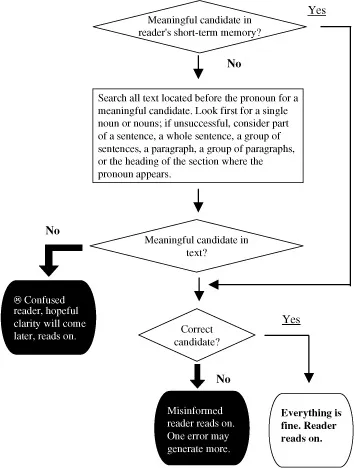
A diagram (
1) helps to visualise the exploratory process followed by readers when encountering a pronoun.
The new notation
1 is simply an invitation to look at visual
1.I do not mention whether visual 1 is a diagram, a table, or a photo because you know the difference.
Why the big black
before the number? It is to help your eyes easily return to the text at the right place after you have looked at the visual. As you return, just let your eyes be guided by the dark beacon.
The diagram highlights that a reader stops searching for another candidate (i.e. antecedent) as soon as a likely one is found in his or her short-term (working) memory. The choice of candidate is influenced by the reader's knowledge: the more superficial the knowledge, the more error-prone the choice will be. Authors who wish nonexperts to read their paper should be aware that pronouns present dangers.
1. Process for finding a suitable candidate (antecedent) for a pronoun. This diagram explores the process followed by readers looking for a candidate (antecedent) for a pronoun. The writer should consider three important facts: (1) Readers decide the meaningfulness of the match between a pronoun and its candidate. Therefore, their knowledge of the topic is part of the process, and little knowledge may mean greater ambiguity. (2) Readers stop looking for a candidate as soon as they think they have found one (preferably in their short-term memory). They do not have the energy, the time, or the will to stop and analyse whether the pronoun candidate they chose is the correct one. As a result, errors occur more frequently if the candidate is so distant from its pronoun that it no longer is in memory. (3) Readers continue reading whether they have identified the correct candidate or not. Being unable to find the candidate may be less “damaging” to the understanding than continuing reading with a “corrupted” understanding because, in the first case, the reader seeks to increase understanding, while in the second case, the reader is lulled into a false sense of understanding.
In the following example, try and determine what the pronoun “their” refers to. The three candidates are in bold. Had the sentence been clear, this task would have been instantaneous. You will probably struggle; but if you do not, ask yourself how much does knowledge of the field assist you in making the correct choice.
The cellular automaton (CA) cell, a natural candidate to model the electrical activity of a cell, is an ideal component to use in the simulation of intercellular communications, such as those occurring between cardiac cells, and to model abnormal asynchronous propagations, such as ectopic beats, initiated and propagated cell-to-cell, regardless of the complexity of THEIR patterns.
It is difficult to determine the plural noun pointed to by “their” because the sentence segment “regardless of the complexity of their patterns” could be moved around in the sentence and still make sense.
…to use in the simulation of intercellular communications, regardless of the complexity of their patterns…
…to model abnormal asynchronous propagations, regardless of the complexity of their patterns…
…such as ectopic beats, regardless of the complexity of their patterns…
Communications, propagations, and beats can all display complex patterns. Let us decide that in this text, “their” represents the “abnormal asynchronous propagations.”
The ambiguity can be removed in different ways. First, one could simply omit the detail if it is not essential, or make that point later in the paragraph. The long sentence would then be seven words shorter.
The cellular automaton (CA) cell, a natural candidate to model the electrical activity of a cell, is an ideal component to use in the simulation of intercellular communications, such as those occurring between cardiac cells, and to model abnormal asynchronous propagations, such as ectopic beats, initiated and propagated cell-to-cell.
One could also rewrite the sentence to make the pronoun disappear.
The cellular automaton (CA) cell—a natural candidate to model the electrical activity of a cell—is an ideal component to use in the simulation of intercellular communications, such as those occurring between cardiac cells, and to model the cell-to-cell initiation and propagation of abnormal asynchronous events (such as ectopic beats) with or without complex patterns.
Finally, one could repeat the noun instead of using a pronoun.
The cellular automaton (CA) cell, a natural candidate to model the electrical activity of a cell, is an ideal component to use in the simulation of intercellular communications, such as those occurring between cardiac cells, and to model abnormal asynchronous events, such...