![]()
“Most people do not accumulate a body of experience. Most people go through life undergoing a series of happenings which pass through their systems undigested. Happenings become experiences when they are digested, when they are reflected on, related to general patterns, and synthesized.”
Saul Alinsky, Rules for Radicals, quoted by Henry Mintzberg in “The Five Minds of a Manager” Harvard Business Review 11/03
“All people dream; but not equally. Those who dream by night in the dusty recesses of their minds wake in the day to find that it was vanity. But the dreamers of the day are dangerous people, for they may act their dream with open eyes to make it possible”.
T. E. Lawrence
The most commonly mentioned challenge that business managers worldwide face is “balancing work and family/personal time.” I can say this after having asked groups of senior level managers all over the world this question, “What is the biggest problem you face in life?”
I wonder what your biggest challenge in life is. Write your biggest challenge in life here:
That might seem like an abrupt introduction, “Hello, how are you? What's your biggest problem in life?”
The basis for the question, though, is this: adult learning theory suggests that adults learn best when they are dealing with issues that are current, immediate, and personal to them. When speakers or educators or consultants begin talking about issues or concerns that are on their minds and not the issues that are on the listeners’ minds, the listeners tend to tune out and glaze over. Unfortunately, that's often a problem in management education sessions.
Many consultants will conduct “needs assessment” prior to making recommendations to clients. The theory behind this is sound, namely, that one should know what the problems are before trying to solve them. Yet many, if not most, educational experiences presume an agenda and jump right in.
So, asking the question, “What is the biggest problem you're facing in life?” turns out to be a great way to begin a program and ground the discussions in current, immediate, personalized issues. We post these on the walls throughout the seminar so we can refer back to them and ensure that our discussions are on track.
Problems Occur at Four Levels
1. Societal
2. Organizational
3. Work Group
4. Individual
Problems can occur, obviously at several levels including societal, organizational, immediate work group, and individual.
Balancing work and family/ personal life is the most commonly mentioned issue in these discussions regardless of where you ask. It's not just a North American issue. The same issue comes up in London, Rio de Janeiro, Bangkok, Sydney, Cairo, Athens, Istanbul, Mexico City, and San Jose, as well as in the United States.
There is ample reason to suggest why this balancing act is a global phenomenon. Friedman's “flat world” suggests that with the advent of the World Wide Web and advances in telecommunication, we can be in touch instantaneously anywhere in the world. Margins are harder to hide. Deals are easier to make. Partners, vendors, and suppliers are more accessible. The competition is working harder. The answer, it seems, is everyone is trying to do more with less and to keep up in the meantime.
Recently, I was standing in the men's room in a well-known four-star hotel chain on a break between program sessions, and the man standing next to me is on his cell phone discussing business matters. Can I cough? Do I flush? What are the business etiquette rules there? I have a friend who sleeps with his Blackberry. If he awakes during the night, he's answering and sending emails, so that associates get up in the morning with several to-do items in their inboxes. How does one balance work and family/personal life when work follows you wherever you go?
Another friend was a CEO who had a conversation with his wife about retirement. Like me, maybe like you, he's been thinking about slowing down and spending more time with his spouse. It turns out that she has been turning her energies to her interests and developed her own professional activities as the children have left home. Slowing down for retirement for him is counter-cyclical to her ramping up at the point of the empty nest. In his words, he's “resigned to more singular activities.”
Many have observed that life seems backwards—when you have enough resources to enjoy it, your body and perhaps your mind are in decline. This is not always the case, though. There's a young 26-year old woman in China reportedly worth $2.5 billion.1 Another young woman, a teenager from Scotland, has already sailed around the world single-handedly. Of course, Michael Phelps, the Olympic swimmer, will have set records that may not be broken for a long time at the ripe old age of 23. What's next for him?
There are at least two sets of issues here, the immediate and the time-based. Let's explore the immediate set of issues first. That is, how are you doing as of today? Are you where you want to be today? How have you used your time on earth so far? Here's a way of making that assessment relatively quickly. Once you've determined where you are, we can move on to how things unfold over time. Then we'll explore the lifestyles of a variety of executives to see how they have dealt with the challenges of modern executive living.
Whether we pay attention to
these various “-al aspects of
life”or not, they are unfolding
day by day. If that simultaneous
unfolding is connected
and balanced, the overall
effect is pleasing, even powerful.
If it's not, the result can
be cacophonous and jarring,
even enervating.
THE BALANCE WHEEL
We could compare human life to a symphony. Like a symphony, life has a beginning and an end, and in between different movements, different paces for the different movements, and a multitude of contributors who are all playing different melodies and riffs at once. In a symphony, there are violins, cellos, cornets, tympani, and woodwinds, dozens and dozens of different instruments all playing or resting simultaneously. If each of the pieces is in tune, on time and played well, the overall effect is pleasing, even powerful and inspiring.
While we don't have musical instruments in life, we do have various “-al” aspects of life: physical, intellectual, emotional, spiritual, social, parental, marital, political, professional, financial, sexual, and so on. Whether we pay attention to these various “-al aspects of life” or not, they are unfolding day by day. If that simultaneous unfolding is connected and balanced, the overall effect is pleasing, even powerful. If it's not, the result can be cacophonous and jarring, even enervating.
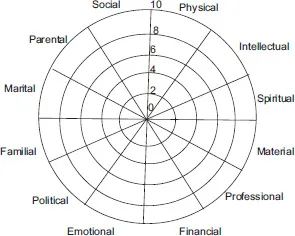
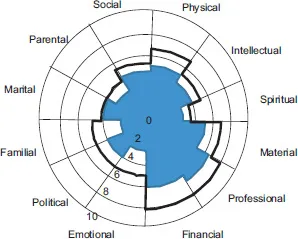
Figure 1.1. A Personal Development Balance Wheel.
Consider the diagram in Figure 1.1. The center or origin of the diagram represents zero development, what we might see in a new-born infant. Each successive, larger circle represents growth or development until we reach the outer circle which represents “world-class development.” Note that this is not the maximum potential of the individual, rather the maximum potential of the human race. Each of the circles is numbered from zero at the center to 10 on the outer ring. A 10 on the physical dimension would be a world record holder or an Olympic gold medalist. A 10 on the financial dimension would be, as of 2008, Carlos Slim of Mexico, Warren Buffett or Bill Gates of the United States and Lakshmi Mittal of India, people worth between US$50 and 65 billion. A 10 on the professional level would be a Nobel Prize or the presidency of a large nation.
The definitions for the other dimensions might be more elusive. What is a world-class parent? What is a world-class daughter? What is a world-class citizen? Nevertheless, in society, we recognize these people in their various pursuits and put them forward as examples of some kind of “ideal homo sapiens.”
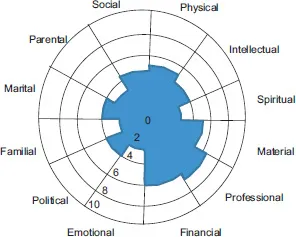
With this simple diagram, we can ask the question, “Given your X years in life, how far have you developed on each of these dimensions?” With an assessment this will give us a picture at a moment in time of the development we've been able to achieve so far. Figure 1.2 shows such an assessment.
In this example, the individual does not believe he (or she) has developed much on the emotional, spiritual and familial (as a son to his parents) dimensions, but observes significant development on the professional side. He also seems to think he is somewhat underpaid for his professional development.
Figure 1.2. An Example of a Development Balance Wheel.
Where would this kind of assessment come from? It could be self-assessment, simple reflection. Ben Franklin famously rated himself on a variety of dimensions over the course of his life and reported his progress in his autobiography.1 But self-assessments have the significant risk of benign self-deception. Are we seeing ourselves clearly?
We might get much better data if we could get others who know us well to assess our development as the years go by. Most would not go to that effort, though, so self-assessment is likely the most common way to get such an evaluation.
One could do this annually, say at the beginning of each new year, as a way of charting or seeing one's growth and development over time. This would be comparable to a corporation developing its year-end accounting records into a balance sheet and income statement. These are snapshots of activity to date as of a certain date.
WHAT DO YOU WANT?
So assume for the moment that we all have such a profile as shown in Figure 1.2 whether we're aware of it or not. Life goes by and we grow in some ways and perhaps not in other ways. We might have tangible evidence of our development status, like weight or bank account, or perhaps not, like emotional or spiritual.
The overarching issue, though, is whether or not you're developing in the way you'd like to develop. Are you building the life you want? Or will you end up one day in a place you don't want to be? I have a shelf of books in my office with titles like Must Success Cost So Much?; Career Success Personal Failure; The Failure of the American Dream; The Future of Success; Working Ourselves to Death; and The Overworked American. These are filled with stories of people who worked hard, did what they thought they should, and didn't end up with what they wanted.
It's not clear that they knew what they wanted early in life. Perhaps they just did what they thought they were supposed to and then one day woke up and said, “How did I get here?”
So, one of the questions becomes, “What do you want?” Could you write that down at the moment?
As of this moment, this is what I want:
Figure 1.3. An Example of a Personal Development Balance Wheel with Goals Shown.
Some will say that what you want will change from chapter to chapter in life. Perhaps. But beware. If it changes, will you be working toward what you wanted in the last chapter or will you be able to foresee what you're likely to want, given the predictable stages of adult life, in the future?
Be clear that a perfect circle on ...