Clinical Cases for Surgery Exams
eBook - ePub

Clinical Cases for Surgery Exams

  1. 284 pages
  2. English
  3. ePUB (mobile friendly)
  4. Available on iOS & Android
eBook - ePub

Clinical Cases for Surgery Exams

About this book

Currently, clinical training for undergraduates is becoming more difficult. To be a good doctor with adequate training, one must be exposed to many different patients with a variety of pathologies and diseases. At present, we are unable to achieve this, mainly due to the increase in the medical student cohort each year and fewer in-patients. In short, the student-to-patient ratio is worsening, thus lessening students' contact with patients and learning experience.

Fortunately, with the objective structured clinical examination (OSCE) format, undergraduate and postgraduate teaching and examination have become more efficient. This book will be very useful for students preparing for surgical OSCEs by covering the different clinical scenarios that a certain condition might present, and allowing self-testing of the questions as well as learning from the provided answers.

Contents:

  • General Surgical Principles
  • Trauma
  • Hepatobiliary
  • Colorectal
  • Vascular
  • Head and Neck
  • Breast
  • Upper GI
  • Urology
  • Plastic and Reconstructive Endocrine Surgery
  • Paediatric Surgery
  • Neurosurgery
  • Orthopaedics


Readership: Undergraduate and postgraduate medical students; trainees in surgery.
Frequently asked questions

Yes, you can cancel anytime from the Subscription tab in your account settings on the Perlego website. Your subscription will stay active until the end of your current billing period. Learn how to cancel your subscription.
No, books cannot be downloaded as external files, such as PDFs, for use outside of Perlego. However, you can download books within the Perlego app for offline reading on mobile or tablet. Learn more here.
Perlego offers two plans: Essential and Complete
  • Essential is ideal for learners and professionals who enjoy exploring a wide range of subjects. Access the Essential Library with 800,000+ trusted titles and best-sellers across business, personal growth, and the humanities. Includes unlimited reading time and Standard Read Aloud voice.
  • Complete: Perfect for advanced learners and researchers needing full, unrestricted access. Unlock 1.4M+ books across hundreds of subjects, including academic and specialized titles. The Complete Plan also includes advanced features like Premium Read Aloud and Research Assistant.
Both plans are available with monthly, semester, or annual billing cycles.
We are an online textbook subscription service, where you can get access to an entire online library for less than the price of a single book per month. With over 1 million books across 1000+ topics, we’ve got you covered! Learn more here.
Look out for the read-aloud symbol on your next book to see if you can listen to it. The read-aloud tool reads text aloud for you, highlighting the text as it is being read. You can pause it, speed it up and slow it down. Learn more here.
Yes! You can use the Perlego app on both iOS or Android devices to read anytime, anywhere — even offline. Perfect for commutes or when you’re on the go.
Please note we cannot support devices running on iOS 13 and Android 7 or earlier. Learn more about using the app.
Yes, you can access Clinical Cases for Surgery Exams by Charles T K Tan, Thiam-Chye Lim, Peter A Robless in PDF and/or ePUB format, as well as other popular books in Medicine & Clinical Medicine. We have over one million books available in our catalogue for you to explore.

Information

Publisher
WSPC
Year
2009
Print ISBN
9789812835529
Chapter 1
GENERAL SURGICAL
PRINCIPLES
Q1.1
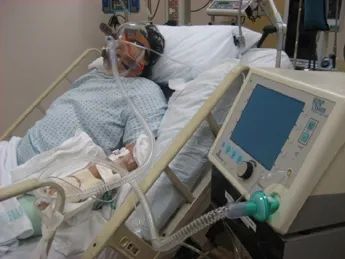
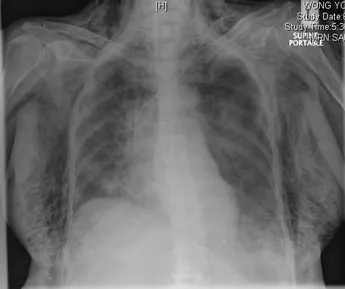
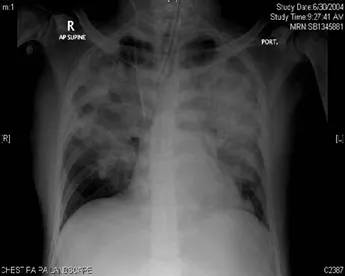
This patient had a liver abscess and was in the Intensive Care Unit.
  1. What can be seen in the chest X-ray (picture A)?
  2. What is the most likely diagnosis and what is its definition?
  3. How can we manage the patient?
  4. What is the equipment used to assist ventilation in picture B?
A.
images
B.
images
Q1.2
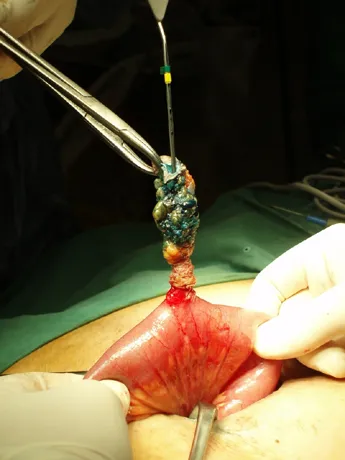
This man had a chronic discharge from his abdominal wall.
  1. What does this intra-operative picture show?
  2. What is the definition and natural history of this pathology?
  3. What are the possible causes of this pathology?
  4. What investigations can be done pre-operatively?
  5. What are some reasons that might prevent patients from recovering from this condition?
images
Answers
A1.1
  1. There is an endo-tacheal tube in position, with a central venous catheter inserted via the right internal jugular vein and bilateral fluffy infiltrates in the lungs.
  2. Acute respiratory distress syndrome (ARDS) secondary to systemic sepsis.
    1. A known precipitating cause.
    2. Acute onset of symptoms.
    3. Hypoxia refractory to oxygen therapy.
    4. New, bilateral infiltrates in the CXR.
    5. No cardiac failure with fluid overload.
  3. Maximal respiratory support with removal of the primary precipitating source of sepsis, which is the liver abscess in this patient.
  4. Bilevel mechanical ventilatory support. It allows the patient to breathe spontaneously at two levels of positive end-expiratory pressure (PEEP).
A1.2
  1. Isolation and excision of an enterocutaneous fistula tract. Methylene blue dye and a metallic probe are used to isolate the fistula tract so that the entire tract may be excised.
  2. A fistula is an abnormal communication between two epithelial-lined surfaces or viscus. In the absence of distal obstruction, most fistulas will close spontaneously.
  3. Trauma/injury to the bowel, Crohn's Disease, abscess, diverticulitis or an inadvertent suture left in the bowel wall after surgery.
  4. Computed Tomographic (CT) scans can be used to rule out an abscess collection or any inflammatory process within the fistula opening. A fistulogram may identify multiple or branched-tracts.
  5. High-output effluent, infection, presence of foreign material, malignancy and poor nutrition.
Q1.3
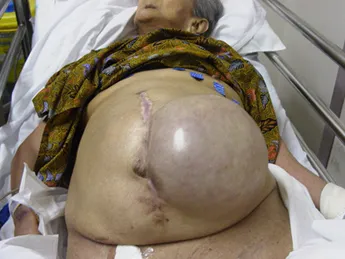
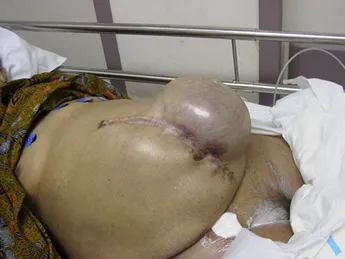
The 72-year-old lady has had abdominal surgery in the past.
  1. What can be seen in these pictures?
  2. What factors may predispose one to develop the condition?
  3. What may be contained in this lump?
  4. What are the indications for emergent surgery?
images
images
Q1.4
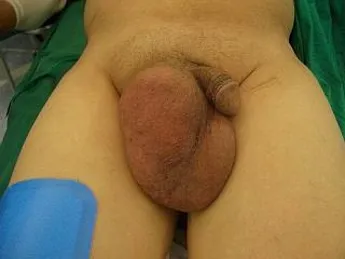
This patient presented with persistent right groin discomfort.
  1. What is the condition shown in picture A?
  2. What would you perform to obtain more information about the patient's condition?
  3. What information would it provide?
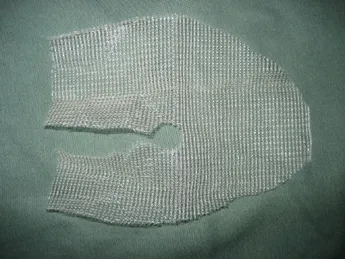
  4. What is shown in picture B?
A.
images
B.
images
Answers
A1.3
  1. Incisional hernia.
  2. Poor wound healing.
    (patient factors) malnutrition, old age, malignancy, immunosuppression, steroids, infection, radiotherapy and obesity.
    (surgeon factors) poor surgical technique and suture breakage.
  3. Any visceral organs (most commonly small or large bowel and omentum).
  4. Pain, irreducibility, intestinal obstruction and peritonism which may suggest ischemia of the contents in the sac.
A1.4
  1. Right inguinal scrotal lump.
  2. Attempt to “get above the lump/mass” or feel the spermatic cord.
  3. In adults, if you can get above the cord or feel it, then it is a scrotal or testicular mass.
    If not, it is an inguinal hernia until proven otherwise.
  4. A prosthetic mesh. There are many types of meshes available for the repair of hernias, with various shapes, sizes and materials.
    After reduction of the viable contents and hernia sac, the weak posterior wall is reinforced with a tension-free deployment of the mesh. The mesh allows for the scarplate formation of the posterior wall, thus providing support to prevent the recurrence of a direct hernia.
Q1.5
A procedure had been performed for these patients.
  1. What has been inserted into these patients?
  2. What are the indications for such use?
  3. What two complications can be seen in pictures A and B?
  4. What are the other complications which may arise from such a procedure?
A.
images
B.
images
Q1.6
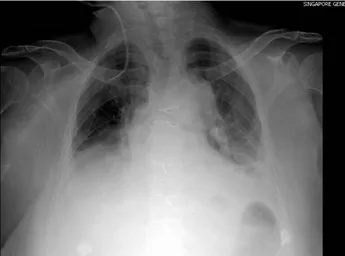
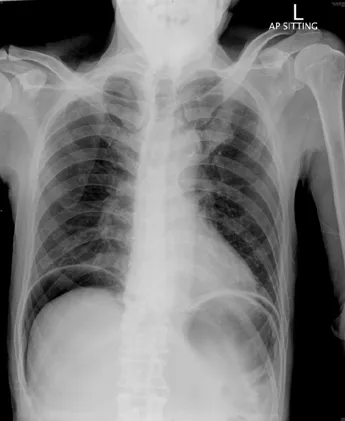
A 40-year-old male presented with sudden onset of severe epigastric pain.
  1. What does this chest X-ray show?
  2. What is your diagnosis?
  3. What do you expect to find on clinical examination?
  4. What other radiological signs may be present?
  5. What are the possible causes of this condition?
  6. Outline your management.
images
Answers
A1.5
  1. Central venous catheters.
    1. Administration of intravenous fluids or blood products.
    2. Monitoring i...

Table of contents

  1. Cover Page
  2. Title Page
  3. Copyright Page
  4. Dedication
  5. Foreword by Abu Rauff
  6. Foreword by Leigh Delbridge
  7. Preface
  8. Acknowledgements
  9. Contents
  10. Editors
  11. List of Chapter Authors
  12. List of Abbreviations
  13. 1. General Surgical Principles
  14. 2. Trauma
  15. 3. Hepatobiliary
  16. 4. Colorectal
  17. 5. Vascular
  18. 6. Head and Neck
  19. 7. Breast
  20. 8. Upper GI
  21. 9. Urology
  22. 10. Plastic and Reconstructive Surgery
  23. 11. Endocrine Surgery
  24. 12. Paediatric Surgery
  25. 13. Neurosurgery
  26. 14. Orthopaedics