![]()
SECTION 1
GOH KENG SWEE AS A POLITICIAN
HON Sui Sen
Othman WOK
Pathmanaban SELVADURAI
Othman Haron EUSOFE
Maurice BAKER
Hedwig Elizabeth ANUAR
Bernard CHEN
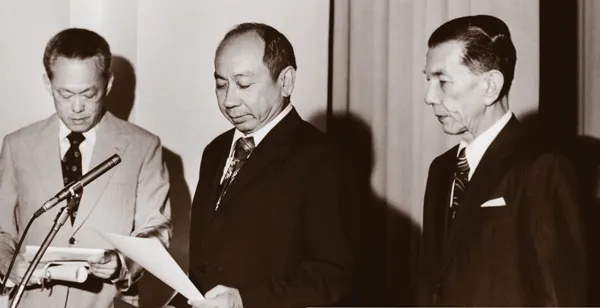
Dr Goh Keng Swee (centre) taking the oath of office as Deputy Prime Minister, with Prime Minister Lee Kuan Yew and President of Singapore Dr Benjamin Henry Sheares witnessing on 1 March 1973.
![]()
by HON Sui Sen
Even individuals like Goh Keng Swee, Lee Kuan Yew and others, at that stage in their lives until the Occupation, did not have any real political consciousness.
Dr Goh Keng Swee, Lim Kim San and I stayed in the Raffles College hostel together. Lim Kim San had a cubicle next to mine. The Arts and Science students were all mixed together. There were the usual activities apart from sports. Third-year students ragged the first-years. We were all victims in the first year to some extent.
Besides sports and other events, there was very little political activity. There was no occasion for such, as in the pre-war days, the Straits Settlements were firmly in the grip of the British. And we were dependent upon them for scholarships so there couldn’t have been very much activity. Besides, we had not been made politically conscious yet. Even individuals like Goh Keng Swee, Lee Kuan Yew and others, at that stage in their lives until the Occupation, did not have any real political consciousness. What they were mostly intent upon was really doing well in their studies and to get a paying job. Getting a paying job in those days was very difficult because the slump had still some after-effects even until 1938 or so, when I graduated.
Dr Goh had always been very good — even in those days — in economics; he was quite a bright student and a good writer. People had respect for Dr Goh even then. He was one of the cleverer but usually lazier students, probably because he found it easy to get through his course which was well within his intellectual capacity. He used to make fun of economics: “If you want to go to sleep, just read Alfred Marshall.” But he had respect for a brilliant lecturer, [Ralph] Arakie, who committed suicide later on. Professor Thomas Henry Silcock who came later on, although competent, didn’t quite have the same kind of brilliance.
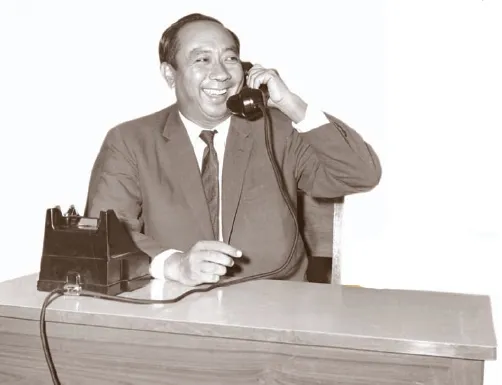
Dr Goh Keng Swee at the Malayan Stock Exchange opening a direct trading line to Kuala Lumpur on 18 January 1961.
In our year, there was no opportunity to apply either for scholarships or fellowships, so that’s why we applied to get into the Straits Settlements Civil Service. That was the only opportunity available to the best students. And I applied like many of the best students, including Dr Goh, I think.
They recruited two persons every year. Besides me, the other one in 1939 was Eu Cheow Chye, not a very outstanding scholar and better known as a sportsman. But he was a steady student. There’s no question that even at that time I thought maybe Dr Goh might have been a better choice.
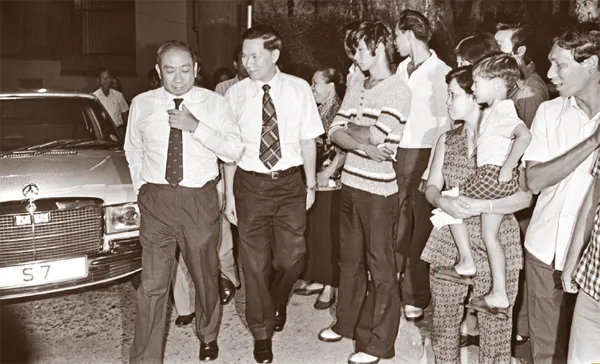
Dr Goh Keng Swee (first from left) arriving at Kreta Ayer People’s Theatre for a charity performance by a Hong Kong cantonese opera troupe on 24 April 1975.
About HON Sui Sen
Dr Goh Keng Swee proposed to then Prime Minister Lee Kuan Yew that Mr Hon Sui Sen succeed him as Finance Minister in 1970, when Dr Goh returned to the Defence Ministry as Minister. Mr Hon had helped Dr Goh to work out the strategy for Singapore’s economic transformation during his years as Permanent Secretary (Economic Development) in the Finance Ministry from 1959 to 1960, as the first Economic Development Board (EDB) Chairman from 1961 to 1968, and as the first Chairman and President of DBS from 1968 to 1970. At the micro level, he was the Chairman of nine companies the government held equity in — National Iron and Steel Mills Ltd, Jurong Shipyard Ltd, Sembawang Shipyard (Pte) Ltd, Keppel Shipyard (Pte) Ltd, Neptune Orient Lines Ltd, Jurong Shipbuilders Ltd, Singapore Electronic & Engineering Ltd, The Insurance Corporation of Singapore Ltd, and Singapore Petroleum Company. He was also Director of Intraco and Commissioner of the Bases Economic Conversion Department. Mr Hon was the top student in the Senior Cambridge Certificate Examination in all of Malaya in 1932. He got a Class 1 diploma from Raffles College in 1938. In 1939 he was appointed to the Straits Settlements Civil Service for which there were only two recruits each year. First appointed as Police Court Magistrate, he became a Deputy Collector of Land Revenue rising to Commissioner of Lands in 1957.
Mr Hon Sui Sen died in 1983. His memory of Dr Goh is drawn from oral history interviews conducted by the Oral History Department of the National Archives of Singapore.
![]()
by Othman WOK
He was not as vocal as Lee Kuan Yew but when he spoke, he was very forthright and spoke his mind. He was straightforward and very serious.
I first met Dr Goh at the Singapore Printing Employees’ Union headquarters during a strike by Straits Times printing staff. He was with Lee Kuan Yew who was legal advisor to the union and KM Byrne who was Head of Civil Service then. At that time Dr Goh was Director of Social Welfare. I found out that he was keen to help us because he had strong anti-colonial feelings. After the strike was settled, there was a discussion within the union premises, during which Lee suggested forming a political party to represent workers in Singapore. Dr Goh then said, “Much better to have a political party to represent the people of Singapore as a whole and fight for independence.” A year later, in November 1954, the PAP was formed.
My impression of Dr Goh was that he was a serious man. He seldom had casual conversations with his colleagues in Parliament. He always stuck to what he said and to his decision. I did not meet him again until 1958 when we were preparing for Singapore’s first General Election in 1959. He was not as vocal as Lee Kuan Yew but when he spoke, he was very forthright and spoke his mind. He was straightforward and very serious. In or outside Parliament he always seemed to be very busy, to have something on his mind, to be thinking all the time.
In 1964 when Singapore was in the Federation of Malaysia, the PAP registered itself as a political party in Malaysia and fielded token candidates for the federal parliamentary elections. Although Dr Goh came from Malacca where I was campaigning for our party’s candidate, he was not involved in any way. I heard later that he was not in favour of the merger. Of all the Malay leaders in Malaysia, Tun Razak was closest to Dr Goh. They used to play golf together. It was through Razak and Dr Goh that Singapore first heard that Malaysian Prime Minister Tunku Abdul Rahman was thinking of separating Singapore from the Federation of Malaysia.
Dr Goh never joined the other MPs in the Members’ Room in Parliament House. Whenever we had dinners or lunches with retired MPs and ministers, Dr Goh never turned up. It seemed to me that he thought socialising was unnecessary or a waste of time. The last time I met him was at an informal dinner he organised in 1986 or 1987. There were seven or eight of us. I remember there were KC Lee (Lee Khoon Choy), Ong Pang Boon, Dr Toh Chin Chye, Phua Bah Lee, myself … I think it was just the people he liked.
About Othman WOK
Mr Othman Wok started his career in journalism with Utusan Melayu Press, Singapore, in 1946 and left as Deputy Editor after 17 years. In 1963, he became the Minister for Social Affairs in Singapore for 14 years till 1977, and then served as the Singapore Ambassador to Indonesia till 1980. He was the Singapore Honorary Consul of the Principality of Monaco from 1996 to 1999.
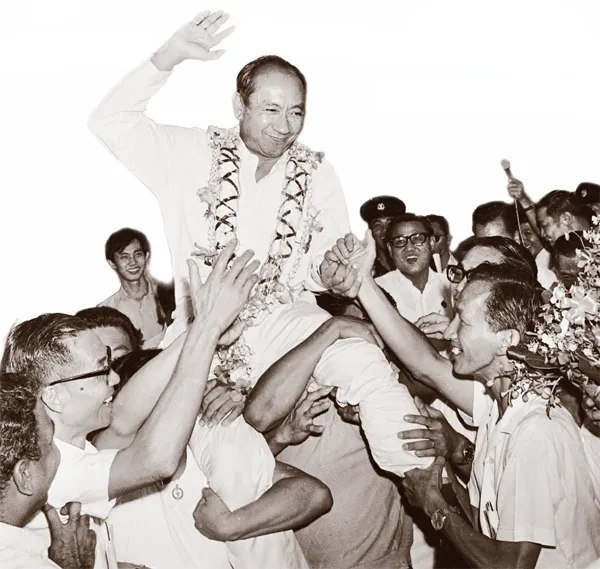
Dr Goh Keng Swee being chaired by his supporters after he was returned uncontested in Kreta Ayer on 2 September 1972.
![]()
by Pathmanaban SELVADURAI
Dr Goh was our mentor and teacher, particularly in political thought, political functioning, understanding the importance of organising para-political parties and mobilising mass support.
I attended University College London studying law during the mid-1950s. For those three to four years I was there, it seemed as if London was one of the major centres of the world, as students were coming together from various parts of the world. Student politics then were on a different level compared to today, and...