- 256 pages
- English
- ePUB (mobile friendly)
- Available on iOS & Android
100 Diagnostic Challenges in Clinical Medicine
About this book
100 Diagnostic Challenges in Clinical Medicine is composed of one hundred well-illustrated clinical scenarios and their appropriate investigations. A wide variety of specialties are covered including cardiology, neurology, dermatology, endocrinology, tropical medicine, haematology, metabolic medicine, radiology, ophthalmology, venereology, and infectious diseases. Presenting the relevant investigations corresponding to each case in an interesting and easy-to-read Q&A format concerning diagnosis and management, this book serves as an ideal, and hopefully enjoyable, study aid for medical students and junior doctors who are preparing for clinical examinations in medicine. By solving the problems posed by these challenging clinical cases, the reader will gain additional practice in diagnosis and treatment strategies.
Readership: Medical students; doctors preparing for higher examinations; practicing clinicians.
Frequently asked questions
- Essential is ideal for learners and professionals who enjoy exploring a wide range of subjects. Access the Essential Library with 800,000+ trusted titles and best-sellers across business, personal growth, and the humanities. Includes unlimited reading time and Standard Read Aloud voice.
- Complete: Perfect for advanced learners and researchers needing full, unrestricted access. Unlock 1.4M+ books across hundreds of subjects, including academic and specialized titles. The Complete Plan also includes advanced features like Premium Read Aloud and Research Assistant.
Please note we cannot support devices running on iOS 13 and Android 7 or earlier. Learn more about using the app.
Information
Case 1


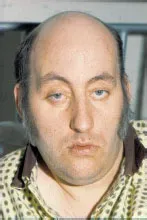
- What three features are shown in the picture?
- What might explain his poor vision?
- What is the clinical diagnosis? How is this condition inherited?
- Which chromosome is abnormally affected?
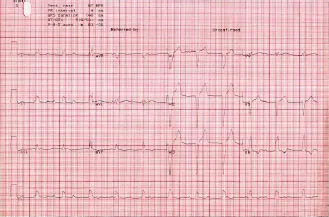
- What is the ECG diagnosis?
- What precise treatment should he receive?
- Frontal balding, bilateral ptosis and long, haggard expressionless features.
- Cataracts and external opthalmoplegia.
- Dystrophia myotonica. Autosomal dominant.
- Chromosome 19.
- Complete heart block.
- Dual chamber permanent pacemaker implantation.
Case 2

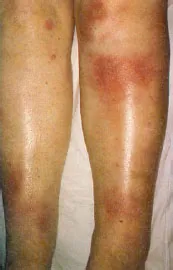
- Describe the lesions.
- What is this condition? What is the pathology?
- With what is it associated?
- What is the usual outcome and what treatment could be given?
- Multiple raised red areas on the shins, which are tender.
- Erythema nodosum. Panniculitis.
- It may be associated with sarcoidosis, tuberculosis, rheumatic heart disease and streptococcal infection. It can also be seen in approximately 5% of patients with an exacerbation of inflammatory bowel disease. Females are affected three times more frequently than males. Drug hypersensitivity (e.g. oral contraceptives, penicillin) may be a cause as well.
- Some severe lesions may ulcerate but are rarely chronic. They usually resolve with steroid therapy or after colectomy.
Case 3

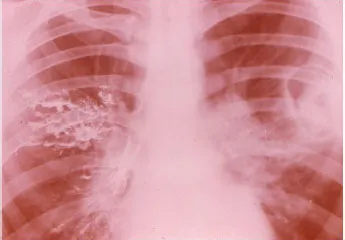
- Name three abnormalities on this chest X-ray.
- What investigation has been performed here?
- What is the diagnosis?
- What simple tests might help confirm the diagnosis?
- What treatment should be recommended?
-
(i) Proximal bronchiectasis in right mid-zone.(ii) Bilateral hilar shadowing.(iii) Large cavitated lesion in left upper zone.
- Bronchography.
- Aspergilloma. The mycetoma is seen inside a large cavity in the left upper zone.
- Fungal culture of sputum or bronchopulmonary lavage; serum IgG precipitins to Aspergillus fumigatus.
- Left upper lobectomy with resection of mycetoma.
Case 4


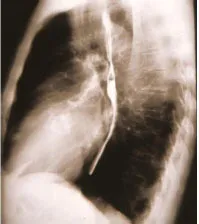
- What does the lateral chest X-ray show?
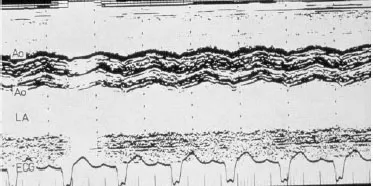
- What does the M-mode echocardiogram show?
- What is the diagnosis?
- What is the next investigation required?
- What treatment is indicated?
- A ring of calcification on the aortic valve.
- Heavy (black) calcification on the aortic valve. (Ao = aorta; LA = left atrium)
- Calcific aortic stenosis.
- Cardiac catheterisation and coronary arteriography for assessment of the aortic valve gradient and the coronary anatomy.
- Aortic valve replacement.
Case 5

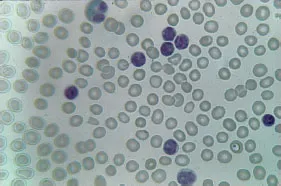
- What is the likely diagnosis?
- Name the cell type.
- What other clinical features should be looked for?
- What two other investigations are indicated?
- What treatment should be given?
- Chronic lymphatic leukaemia.
- B cell.
- Lymphadenopathy, splenomegaly.
- Bone marrow aspiration, lymphocyte cell typing.
- No specific treatment for the leukaemia at present, but n...
Table of contents
- Cover Page
- Title Page
- Copyright Page
- Dedication Page
- Acknowledgements
- Preface
- Case 1
- Case 2
- Case 3
- Case 4
- Case 5
- Case 6
- Case 7
- Case 8
- Case 9
- Case 10
- Case 11
- Case 12
- Case 13
- Case 14
- Case 15
- Case 16
- Case 17
- Case 18
- Case 19
- Case 20
- Case 21
- Case 22
- Case 23
- Case 24
- Case 25
- Case 26
- Case 27
- Case 28
- Case 29
- Case 30
- Case 31
- Case 32
- Case 33
- Case 34
- Case 35
- Case 36
- Case 37
- Case 38
- Case 39
- Case 40
- Case 41
- Case 42
- Case 43
- Case 44
- Case 45
- Case 46
- Case 47
- Case 48
- Case 49
- Case 50
- Case 51
- Case 52
- Case 53
- Case 54
- Case 55
- Case 56
- Case 57
- Case 58
- Case 59
- Case 60
- Case 61
- Case 62
- Case 63
- Case 64
- Case 65
- Case 66
- Case 67
- Case 68
- Case 69
- Case 70
- Case 71
- Case 72
- Case 73
- Case 74
- Case 75
- Case 76
- Case 77
- Case 78
- Case 79
- Case 80
- Case 81
- Case 82
- Case 83
- Case 84
- Case 85
- Case 86
- Case 87
- Case 88
- Case 89
- Case 90
- Case 91
- Case 92
- Case 93
- Case 94
- Case 95
- Case 96
- Case 97
- Case 98
- Case 99
- Case 100