![]()
Chapter 1
Geometrical Optics
When we consider optics, the first thing that comes to our minds is probably light. Light has a dual nature: light is particles (called photons) and light is waves. When a particle moves, it processes momentum, p. And when a wave propagates, it oscillates with a wavelength, λ. Indeed, the momentum and the wavelength is given by the de Broglie relation
where h ≈ 6.62 × 1O–34 Joule-second is Planck's constant. Hence from the relation, we can state that every particle is a wave as well.
Each particle or photon is specified precisely by the frequency ν and has an energy E given by
E = hν.
If the particle is traveling in free space or in vacuum, ν = c/λ, where c is a constant approximately given by 3 × 1O8 m/s. The speed of light in a transparent linear, homogeneous and isotropic material, which we term ν, is again a constant but less than c. This constant is a physical characteristic or signature of the material. The ratio c/ν is called the refractive index, n, of the material.
In geometrical optics, we treat light as particles and the trajectory of these particles follows along paths that we call rays. We can describe an optical system consisting of elements such as mirrors and lenses by tracing the rays through the system.
Geometrical optics is a special case of wave or physical optics, which will be mainly our focus through the rest of this Chapter. Indeed, by taking the limit in which the wavelength of light approaches zero in wave optics, we recover geometrical optics. In this limit, diffraction and the wave nature of light is absent.
1.1 Ferma's Principle
Geometrical optics starts from Ferma's Principle. In fact, Ferma's Principle is a concise statement that contains all the physical laws, such as the law of reflection and the law of refraction, in geometrical optics. Ferma's principle states that the path of a light ray follows is an extremum in comparison with the nearby paths. The extremum may be a minimum, a maximin, or stationary with respect to variations in the ray path. However, it is usually a minimum.
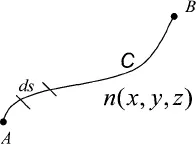
We now give a mathematical description of Ferma's principle. Let n(x, y, z) represent a position-dependent refractive index along a path C between end points A and B, as shown in Fig. 1.1. We define the optical path length (OPL) as
where ds represents an infinitesimal arc length. According to Ferma's principle, out the many paths that connect the two end points A and B, the light ray would follow that path for which the OPL between the two points is an extremum, i.e.,
in which δ represents a small variation. In other words, a ray of light will travel along a medium in such a way that the total OPL assumes an extremum. As an extremum means that the rate of change is zero, Eq. (1.1-2) explicitly means that
Now since the ray propagates with the velocity ν = c/n along the path,
where dt is the differential time needed to travel the distance ds along the path. We substitute Eq. (1.1-4) into Eq. (1.1-2) to get
Fig. 1.1 A ray of light traversing a path C between end points A and B.
As mentioned before, the extremum is usually a minimum, we can, therefore, restate Fermat's principle as a principle of least time. In a homogeneous medium, i.e., in a medium with a constant refractive index, the ray path is a straight line as the shortest OPL between the two end points is along a straight line which assumes the shortest time for the ray to travel.
1.2 Reflection and Refraction
When a ray of light is incident on the interface separating two different optical media characterized by n1 and n2, as shown in Fig. 1.2, it is well known that part of the light is reflected back into the first medium, while the re...