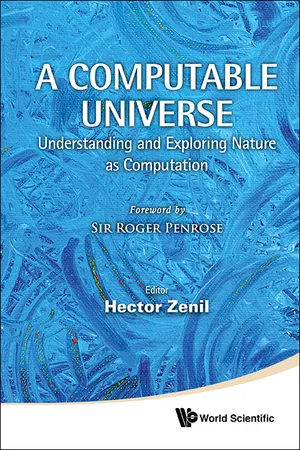
Computable Universe, A: Understanding And Exploring Nature As Computation
eBook - ePub

Computable Universe, A: Understanding And Exploring Nature As Computation

Understanding and Exploring Nature as Computation

  1. 856 pages
  2. English
  3. ePUB (mobile friendly)
  4. Available on iOS & Android
eBook - ePub

Computable Universe, A: Understanding And Exploring Nature As Computation

Understanding and Exploring Nature as Computation

About this book

This volume, with a foreword by Sir Roger Penrose, discusses the foundations of computation in relation to nature.

It focuses on two main questions:

-->

  • What is computation?
  • How does nature compute?

-->

The contributors are world-renowned experts who have helped shape a cutting-edge computational understanding of the universe. They discuss computation in the world from a variety of perspectives, ranging from foundational concepts to pragmatic models to ontological conceptions and philosophical implications.

The volume provides a state-of-the-art collection of technical papers and non-technical essays, representing a field that assumes information and computation to be key in understanding and explaining the basic structure underpinning physical reality. It also includes a new edition of Konrad Zuse's “Calculating Space” (the MIT translation), and a panel discussion transcription on the topic, featuring worldwide experts in quantum mechanics, physics, cognition, computation and algorithmic complexity.

The volume is dedicated to the memory of Alan M Turing — the inventor of universal computation, on the 100th anniversary of his birth, and is part of the Turing Centenary celebrations.

Contents:

    • Foreword (R Penrose)
    • Preface
    • Acknowledgements
    • Introducing the Computable Universe (H Zenil)
  • Historical, Philosophical & Foundational Aspects of Computation:
    • Origins of Digital Computing: Alan Turing, Charles Babbage, & Ada Lovelace (D Swade)
    • Generating, Solving and the Mathematics of Homo Sapiens. E Post's Views on Computation (L De Mol)
    • Machines (R Turner)
    • Effectiveness (N Dershowitz & E Falkovich)
    • Axioms for Computability: Do They Allow a Proof of Church's Thesis? (W Sieg)
    • The Mathematician's Bias — and the Return to Embodied Computation (S B Cooper)
    • Intuitionistic Mathematics and Realizability in the Physical World (A Bauer)
    • What is Computation? Actor Model versus Turing's Model (C Hewitt)
  • Computation in Nature & the Real World:
    • Reaction Systems: A Natural Computing Approach to the Functioning of Living Cells (A Ehrenfeucht, J Kleijn, M Koutny & G Rozenberg)
    • Bacteria, Turing Machines and Hyperbolic Cellular Automata (M Margenstern)
    • Computation and Communication in Unorganized Systems (C Teuscher)
    • The Many Forms of Amorphous Computational Systems (J Wiedermann)
    • Computing on Rings (G J Martínez, A Adamatzky & H V McIntosh)
    • Life as Evolving Software (G J Chaitin)
    • Computability and Algorithmic Complexity in Economics (K V Velupillai & S Zambelli)
    • Blueprint for a Hypercomputer (F A Doria)
  • Computation & Physics & the Physics of Computation:
    • Information-Theoretic Teleodynamics in Natural and Artificial Systems (A F Beavers & C D Harrison)
    • Discrete Theoretical Processes (DTP) (E Fredkin)
    • The Fastest Way of Computing All Universes (J Schmidhuber)
    • The Subjective Computable Universe (M Hutter)
    • What Is Ultimately Possible in Physics? (S Wolfram)
    • Universality, Turing Incompleteness and Observers (K Sutner)
    • Algorithmic Causal Sets for a Computational Spacetime (T Bolognesi)
    • The Computable Universe Hypothesis (M P Szudzik)
    • The Universe is Lawless or “Pantôn chrêmatôn metron anthrôpon einai” (C S Calude, F W Meyerstein & A Salomaa)
    • Is Feasibility in Physics Limited by Fantasy Alone? (C S Calude & K Svozil)
  • The Quantum, Computation & Information:
    • What is Computation? (How) Does Nature Compute? (D Deutsch)
    • The Universe as Quantum Computer (S Lloyd)
    • Quantum Speedup and Temporal Inequalities for Sequential Actions (M Żukowski)
    • The Contextual Computer (A Cabello)
    • A Gödel-Turing Perspective on Quantum States Indistinguishable from Inside (T Breuer)
    • When Humans Do Compute Quantum (P Zizzi)
  • Open Discussion Section:
    • Open Discussion on A Computable Universe (A Bauer, T Bolognesi, A Cabello, C S Calude, L De Mol, F Doria, E Fredkin, C Hewitt, M Hutter, M Margenstern, K Svozil, M Szudzik, C Teuscher, S Wolfram & H Zenil)
  • Live Panel Discussion (transcription):
    • What is Computation? (How) Does Nature Compute? (C S Calude, G J Chaitin, E Fredkin, A J Leggett, R de Ruyter, T Toffoli & S Wolfram)
  • Zuse's Calculating Space:
    • Calculating Space ( Rechnender Raum ) (K Zuse)
    • Afterword to Konrad Zuse's Calculating Space (A German & H Zenil)


Readership: Graduate students who are specialized researchers in computer science, information theory, quantum theory and modern philosophy and the general public who are interested in these subject areas.

Frequently asked questions

Yes, you can cancel anytime from the Subscription tab in your account settings on the Perlego website. Your subscription will stay active until the end of your current billing period. Learn how to cancel your subscription.
At the moment all of our mobile-responsive ePub books are available to download via the app. Most of our PDFs are also available to download and we're working on making the final remaining ones downloadable now. Learn more here.
Perlego offers two plans: Essential and Complete
  • Essential is ideal for learners and professionals who enjoy exploring a wide range of subjects. Access the Essential Library with 800,000+ trusted titles and best-sellers across business, personal growth, and the humanities. Includes unlimited reading time and Standard Read Aloud voice.
  • Complete: Perfect for advanced learners and researchers needing full, unrestricted access. Unlock 1.4M+ books across hundreds of subjects, including academic and specialized titles. The Complete Plan also includes advanced features like Premium Read Aloud and Research Assistant.
Both plans are available with monthly, semester, or annual billing cycles.
We are an online textbook subscription service, where you can get access to an entire online library for less than the price of a single book per month. With over 1 million books across 1000+ topics, we’ve got you covered! Learn more here.
Look out for the read-aloud symbol on your next book to see if you can listen to it. The read-aloud tool reads text aloud for you, highlighting the text as it is being read. You can pause it, speed it up and slow it down. Learn more here.
Yes! You can use the Perlego app on both iOS or Android devices to read anytime, anywhere — even offline. Perfect for commutes or when you’re on the go.
Please note we cannot support devices running on iOS 13 and Android 7 or earlier. Learn more about using the app.
Yes, you can access Computable Universe, A: Understanding And Exploring Nature As Computation by Hector Zenil in PDF and/or ePUB format, as well as other popular books in Biological Sciences & Science General. We have over one million books available in our catalogue for you to explore.

Information

Table of contents

  1. Front Cover
  2. Half Title
  3. Title
  4. Copyright
  5. Dedication
  6. Contents
  7. Foreword
  8. Preface
  9. Acknowledgments
  10. 1. Introducing the Computable Universe
  11. Historical, Philosophical & Foundational Aspects of Computation
  12. 2. Origins of Digital Computing: Alan Turing, Charles Babbage, & Ada Lovelace
  13. 3. Generating, Solving and the Mathematics of Homo Sapiens. E. Post’s Views on Computation
  14. 4. Machines
  15. 5. Effectiveness
  16. 6. Axioms for Computability: Do They Allow a Proof of Church’s Thesis?
  17. 7. The Mathematician’s Bias — and the Return to Embodied Computation
  18. 8. Intuitionistic Mathematics and Realizability in the Physical World
  19. 9. What is Computation? Actor Model versus Turing’s Model C.
  20. Computation in Nature & the Real World
  21. 10. R  eaction Systems: A Natural Computing Approach to the Functioning of Living Cells
  22. 11. Bacteria, Turing Machines and Hyperbolic Cellular Automata
  23. 12. Computation and Communication in Unorganized Systems
  24. 13. The Many Forms of Amorphous Computational Systems
  25. 14. Computing on Rings
  26. 15. Life as Evolving Software
  27. 16. Computability and Algorithmic Complexity in Economics
  28. 17. Blueprint for a Hypercomputer
  29. Computation & Physics & the Physics of Computation
  30. 18. Information-Theoretic Teleodynamics in Natural and Artificial Systems
  31. 19. Discrete Theoretical Processes (DTP)
  32. 20. The Fastest Way of Computing All Universes
  33. 21. The Subjective Computable Universe
  34. 22. What Is Ultimately Possible in Physics?
  35. 23. Universality, Turing Incompleteness and Observers
  36. 24. Algorithmic Causal Sets for a Computational Spacetime
  37. 25. The Computable Universe Hypothesis
  38. 26. The Universe is Lawless or “Pantôn chrêmatôn metron anthrpôn einai”
  39. 27. Is Feasibility in Physics Limited by Fantasy Alone?
  40. The Quantum, Computation & Information
  41. 28. What is Computation? (How) Does Nature Compute?
  42. 29. The Universe as Quantum Computer
  43. 30. Quantum Speedup and Temporal Inequalities for Sequential Actions
  44. 31. The Contextual Computer
  45. 32. A Gödel-Turing Perspective on Quantum States Indistinguishable from Inside
  46. 33. When Humans Do Compute Quantum
  47. Open Discussion Section
  48. 34. Open Discussion on A Computable Universe
  49. Live Panel Discussion (transcription)
  50. 35. What is Computation? (How) Does Nature Compute?
  51. Zuse’s Calculating Space
  52. 36. Calculating Space (Rechnender Raum)
  53. Afterword to Konrad Zuse’s Calculating Space
  54. Index