This is the only book that deals comprehensively with fixed point theorems throughout mathematics. Their importance is due, as the book demonstrates, to their wide applicability. Beyond the first chapter, each of the other seven can be read independently of the others so the reader has much flexibility to follow his/her own interests. The book is written for graduate students and professional mathematicians and could be of interest to physicists, economists and engineers.
Contents:
Early Fixed Point Theorems
Fixed Point Theorems in Analysis
The Lefschetz Fixed Point Theorem
Fixed Point Theorems in Geometry
Fixed Points of Volume Preserving Maps
Borel's Fixed Point Theorem in Algebraic Groups
Miscellaneous Fixed Point Theorems
A Fixed Point Theorem in Set Theory
Readership: Graduate students and professionals in analysis, approximation theory, algebra and geometry. Key Features:
Our book gives a complete treatment of the diverse and manifold use of fixed point theorems and their many applications throughout Mathematics and is another example of the unity within Mathematics
As such it serves as a valuable resource for researchers in diverse fields of Mathematics
It also serves as solid introduction for students to several subjects in modern Mathematics such as Functional Analysis, Topology, Differential Geometry, Dynamical Systems and Algebraic Groups
Frequently asked questions
Yes, you can cancel anytime from the Subscription tab in your account settings on the Perlego website. Your subscription will stay active until the end of your current billing period. Learn how to cancel your subscription.
No, books cannot be downloaded as external files, such as PDFs, for use outside of Perlego. However, you can download books within the Perlego app for offline reading on mobile or tablet. Learn more here.
Perlego offers two plans: Essential and Complete
Essential is ideal for learners and professionals who enjoy exploring a wide range of subjects. Access the Essential Library with 800,000+ trusted titles and best-sellers across business, personal growth, and the humanities. Includes unlimited reading time and Standard Read Aloud voice.
Complete: Perfect for advanced learners and researchers needing full, unrestricted access. Unlock 1.4M+ books across hundreds of subjects, including academic and specialized titles. The Complete Plan also includes advanced features like Premium Read Aloud and Research Assistant.
Both plans are available with monthly, semester, or annual billing cycles.
We are an online textbook subscription service, where you can get access to an entire online library for less than the price of a single book per month. With over 1 million books across 1000+ topics, weβve got you covered! Learn more here.
Look out for the read-aloud symbol on your next book to see if you can listen to it. The read-aloud tool reads text aloud for you, highlighting the text as it is being read. You can pause it, speed it up and slow it down. Learn more here.
Yes! You can use the Perlego app on both iOS or Android devices to read anytime, anywhere β even offline. Perfect for commutes or when youβre on the go. Please note we cannot support devices running on iOS 13 and Android 7 or earlier. Learn more about using the app.
Yes, you can access Fixed Point Theorems And Their Applications by Ioannis Farmakis, Martin Moskowitz in PDF and/or ePUB format, as well as other popular books in Biological Sciences & Science General. We have over one million books available in our catalogue for you to explore.
One of the earliest and best known fixed point theorems is that of Picard-Banach 1.1.1. Either explicitly or implicitly this theorem is the usual way one proves local existence and uniqueness theorems for systems of ordinary differential equations (see for example [79], sections 7.3 and 7.5). This theorem also can be used to prove the inverse function theorem (see [79], pp. 179-181).
Theorem 1.1.1.Let (X, d) be a complete metric space and f : X β X be a contraction mapping, that is, one in which there is a 1 > b > 0 so that for all x, y β X, d(f(x), f(y)) β€ bd(x, y). Then f has a unique fixed point.
Proof. Choose a point x1 β X (in an arbitrary manner) and construct the sequence xn β X by xn+1 = fn(x1), n β₯ 2. Then xn is a Cauchy sequence. For n β₯ m,
But
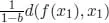
The latter term is β€ (bnβmβ1 + ... + b + 1)d(f(x1), x1) which is itself
. Since 0 < b < 1 this geometric series converges to
. Since bm β 0 we see for n and m sufficiently large, given Ρ > 0,
Hence xn is Cauchy. Because X is complete xn β x for some x β X. As f is a contraction map it is (uniformly) continuous. Hence f(xn) β f(x). But as a subsequence f(xn) β x so the uniqueness of limits tells us x = f(x).
Now suppose there was another fixed point y β X. Then d(f(x), f(y)) = d(x, y) β€ bd(x, y) so that if d(x, y) β 0 we conclude b β₯ 1, a contradiction. Therefore d(x, y) = 0 and x = y.
We remark that the reader may wish to consult Bessaga ([11]), or Jachymski, ([60]) where the following converse to the Picard-Banach theorem has been proved.
Theorem 1.1.2.Let f: X β X be a self map of a set X and 0 < b < 1. If fn has at most 1 fixed point for every integer n, then there exists a metric d on X for which d(f(x), f(y)) β€ bd(x, y), for all x and y β X. If, in addition, some fn has a fixed point, then d can be chosen to be complete.
As a corollary to the Picard-Banach theorem we have the following precursor to the Brouwer theorem.
Corollary 1.1.3.Let X be the closed unit ball in
and f: X β X be a nonexpanding map; that is one that satisfies d(f(x), f(y)) β€ d(x, y) for all x, y β X . Then f has a fixed point.
Proof. For positive integers, n, define
. Then each fn is a contraction mapping of X. Since X is compact, it is complete. By the contraction mapping principle each fn has a fixed point, xn β X and since X is compact xn has a subsequence converging to say x. Taking limits as n β β shows x is fixed by f.
We now state the Brouwer fixed point theorem.
Theorem 1.1.4.Any continuous map f of the closed unit ball Bn in
to itself has a fixed point.
In other words, if one stirs a mug of coffee then at any given time there is at least one particle of coffee that is in exactly the position it started in.
Of course, since the Brouwer theorem is stated in ...

Table of contents
Cover
Halftitle
Title
Copyright
Contents
Preface and Acknowledgments
Introduction
1 Early Fixed Point Theorems
2 Fixed Point Theorems in Analysis
3 The Lefschetz Fixed Point Theorem
4 Fixed Point Theorems in Geometry
5 Fixed Points of Volume Preserving Maps
6 Borelβs Fixed Point Theorem in Algebraic Groups