![]()
Chapter 1
Chinese Medicine has a Lot to Offer
Ping-Chung Leung
Abstract
Aging is a normal physiological process. The factors affecting aging are extremely complex, involving innate genetic, pathological, social-psychological and environmental factors.
Chinese Medicine takes a philosophical view on health that is considered a harmonious balanced state of physiological functions. Maintaining this balance is an effective way of preventing diseases. The balance is favorably maintained through a careful choice of dietary components and a smart practice of exercises which go beyond the usual concept of training muscles and physical abilities. Now that life expectancy is ever increasing, the awareness of wellness and disease prevention has gained universal interests. Apparently, the popular concerns of health promotion viz. cardiovascular, anti-aging, bone health, etc. can be satisfied through a Chinese way of non-aerobic exercises and practical selection of health supplements.
Keywords: Chinese Medicine; Herbs; Prevention; Exercises; Health Supplements.
Knowledge about Chinese Medicine has been misleading. In Europe and America, Chinese Medicine might mean acupuncture and a collection of proprietary botanical drugs manufactured from medicinal herbs. For the Koreans, Chinese Medicine has been adopted in ancient Korea and developed with refinement into “Oriental Medicine”. For the Japanese, Chinese Medicine was the mainline clinical tool before and during the Edo period. Since then Kampo Medicine based on Chinese Medicine has replaced it. Of course a traditional practice could take different forms of development but its cultural roots would ever remain. Given its very long history of record keeping, extending from 3000 years ago, and with numerous occasions of integration with clinical streams outside China during the many imperial efforts of trade expansion along the “Silk route” in the different dynasties, Chinese Medicine very much represents an amalgamation of clinical wisdom in Central China, as well as those collected from India, Persia and around the Mediterranean. Among the different systems of Traditional Medicine, therefore, Chinese Medicine is the broadest and most integrative. The rich historical background and the tremendous collection of clinical wisdom and facts must have perpetuated the popularity and everlasting value of Chinese Medicine (Bensky and Gamble, 1993).
Yet, surprisingly, today, when one takes a careful check at the practice within the most respectable establishment of Chinese Medicine, viz. any “Chinese Medicine Hospital” in China, one’s impression would be that of confusion.
Since the establishment of these “Chinese Medicine Hospitals” in China around the 1950s, they have been providing Chinese Medicine services. Historically traditional Chinese Medicine services were not given in hospital settings. In reality the so-called “Chinese Medicine Hospitals” of today are all mixed hospitals giving both Western and Chinese Medicine services. The very busy outpatient clinics offer mostly Chinese Medicine services like acupuncture and herbal treatment. Once admitted into the wards, the treatment would be mainly modern medicine because of the need for acute management and life-saving procedures. Chinese Medicine practitioners are making their greatest contributions in pain control, cancer adjuvant therapy, allergic conditions, aging and other odd disease pathologies. Their services can be focused mostly in those areas, however they do not want to limit their services. The result is that they need to make use of modern medicine to maintain a comprehensive claim.
The reason behind the bending of traditional practice towards the modern, technology-based approach is also related to financial balance. To sustain a modern hospital, a lot of resources are required. Now that China requires every hospital to be financially independent, relying only on manual therapy, acupuncture and/or herbal remedy would not be sufficient to make ends meet, much less profit. The only means for the Chinese Medicine Hospitals to survive, therefore, is to offer profitable services like modern investigations, surgical interventions, expensive pharmaceuticals, etc.
Chinese Medicine is a pride to all Chinese people because of its obvious link to Chinese culture and philosophy. The pride expands as people outside China are looking up to unique practices like acupuncture, and more and more people are using self-prescribed herbal supplements although some of which might not have originated from Chinese Medicine at all.
Chinese Medicine would stay as a national pride in China, with or without government protection. On the service side, it is already clear that it has a lot to offer in aging and chronic problems, pain control, neurological deficits and other situations when modern treatment fails. Degeneration is an inevitable physiological process associated with aging. Degeneration has the general aspect where tissues and organs run a gradual degradation (Stewart et al., 1989; Kaptchuk and Eisenberry, 1988). Degeneration commonly affects a special functional component of normal physiological activity like the cardiovascular function, musculoskeletal integrity, and mental ability. Chinese Medicine has the traditional claim of maintaining an internal harmony, which refers to a general maintenance of physiological balance. It is also well-known that special choices of herbal combinations have been used traditionally for cardiovascular health, muscle and joint strength, and mental well-being. In the current context, therefore, Chinese Medicine has a lot to offer in those areas.
Oriental societies have a long history of promoting health through the prevention of diseases, which are not short of special terms and connotations. Thus for Traditional Chinese Medicine (TCM), “treating diseases before their onset” does not refer to what we understand by the Public Health Standards of disease prevention, but points to a more personalized pursuit of good health before an individual is disease-struck. Under this category of health practice, living and eating habits, lifestyles and special supplements, are all considered. In fact TCM practitioners consider food to be a form of medicine, and the Indian Ayurvedic practitioners are equally conscious about lifestyle and diet (Su, 1992; Dahanuakr and Thatte, 1996).
“Treating diseases before their onset” requires the individual to be aware of his/her current state of health: whether there is objective or subjective feeling of deficiencies or symptoms, which could then be specifically watched and contained using non-therapeutic means. Such feeling of health risk might refer to frailty, cardiovascular deficiency, joint and bone deterioration, over-weight or loss of mental acuity, etc. (Jiang, 2002).
1.1Food as Medicine
Traditional Chinese Medicine has long history of categorizing varieties of food as medicine-like items which offer specific benefits to different health demands. Classically such food categories are used for the supplement of various deficiencies within “qi”, “yin” and “yang”, which represent heartfelt philosophical expressions rather than specific symptoms. With modern knowledge, the philosophical expressions could be translated into modern language describing different symptomatologies related to physiological systems and structural pathologies.
To give some common examples, see Table 1.1, which lists the herbal items advocated for general and unique health needs. The listed herbal items include commonplace vegetables used in day-to-day meals, as well as rarer herbal items better known in the traditional medicine circle (Liang and Liang, 2006).
Table 1.1. List of Chinese medicinal herbs used as food and health supplements.
Function | Herbal items |
General support | Radix Ginseng
Radix Codonopsis
Rhizoma Dioscoreae
Semen Nelumbinis
Rhizoma Polygonati Odorati
Bulbus Lilii
Semen Coicis
Semen Sesami Nigrum
Fructus Crataegi
Adenophora Stricta |
Supplementing hemopoiesis | Angelica sinensis
Radix Polygoni Multiflori
Fructus Lycii |
Supplementing yin | Fructus Ligustri Lucidi
Rhizoma Polygonati Odorati
Radix Astragalus
Cordyceps |
Supplementing yang | Cortex Eucommiae
Cornu Cervi Pantotrichum
Herba Epimedii |
These herbs are known to have general supportive effects. Some are popular among the male or female. The most accepted utilizations include the supplement of physiological imbalance, described as yin and yang excess or deficiency (Guan et al., 2008).
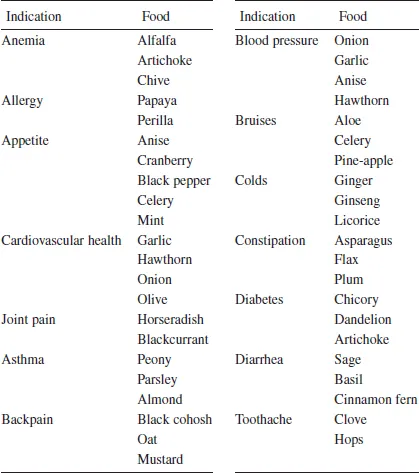
Outside Asia, medicinal herbs might be better known as ingredients for cooking rather than being considered as food. Some herbs are well known to have special therapeutic effects (John, 1974). Table 1.2 contains a list of some common examples.
Table 1.2. Therapeutic effects of some common foods.
1.2Health Claims and Efforts to Regulate Claims
The quest for better health and longevity is well appreciated by the commercial world. The popular traditional practice of cooking and the use of medicinal herbs are modified today as user-friendly health supplements in the convenient forms of tablets, capsules and drinks. Supermarkets are displaying shelf after shelf of health supplements with special health claims, which vary from sheer advertising to traditional beliefs with or without modern justifications. Claims rely on a number of channels: from literature search on health use, laboratory results, animal observations and simple user experiences, all of which possess only low levels of evidence (Bellisle et al., 1998).
The flourishing business of health supplements has naturally invited the attention of regulators who need to control misleading advertising and to protect the users. We should look at the recommendations established in Europe, the US and China.
1.2.1European Union
Since 2001, Health Authority in the European Union started to work on the recommendations to be given for the justification of health claims for health supplements. Large powerful working committees were established to be responsible, and after five years, a proper document was created (COM, 2003).
Seven specific areas were identified, viz. cardiovascular, bone health, physical fitness, body weight regulation, cancer prevention, mental performance and gastrointestinal health, for special scrutiny. With regard to the procedures required for the assessment of health claims (PASSCLAIM), three major foci are chosen: (1) the essential components of the food or health supplement itself, (2) the biological effects of the food or health supplements as observed in the laboratory, and (3) the eventual reduction of disease risks.
It is clear that foci (1) and (2) involve literature search and laboratory work which are easy to achieve, but to prove reduction of disease risk might need proper clinical trials of long durations and high costs. The European Authority acknowledged the difficulty and suggested compromising considerations of small, low level human trials with accumulative data (Aggett et al., 2005).
1.2.2United States
In the United States, there is yet no generally accepted recommendation for the registration of health food and health supplements. In 2003, the American Association of Clinical Endocrinologists (AACE) worked out a set of medical guidelines for the clinical use of dietary supplements and neutraceuticals (AACE, 2003). The guidelines were compiled according to expert opinions which actually followed closely practices of clinical investigations and new drug discovery. The evaluation of the trustworthiness of health supplements was based on three levels of observations. Level 3 refers to all available information related to the clinical benefits including simple case reports. Level 2 refers to simple clinical trials, whether properly or not properly organized. The highest level of Level 1 refers to randomized control trials and meta-analysis. With such understanding, one wonders whether the guidelines are in fact full strict regulations as are required in drug evaluations (Goodman, 2002).
AACE gave a number of examples which are popular non-descriptive supplements claiming specific effects like cholesterol control, glucose control, menopausal well-being, anti-depression, etc. With such specific indications, it is no wonder why the AACE is taking views not different from drug discovery (Engel, 1977).
1.2.3China
The State Food and Drug Administration of China (SFDA) has a well defined set of regulations for the registration of health food and supplements (SFDA, 2002). Since China has a large number of food and medicinal herbs consumed as food, SFDA grouped the herbs into three categories, viz. those used as food, those used either as food or drug, and those that should not be used as food.
With this specific grouping the regulating authority would have less difficulty doing the assessment, however, the procedures required for an official registration are still cumbersome and restrictive. A lot of official reports need to be submitted, including: a detailed description of the item to be registered; additives; special requirements with special plants and animals; toxicology reports, etc. There is however, no requirement on the efficacy explanation or justification of health claims.
The strong tradition of “food therapy” in China must have influenced both users and reg...