![]()
Chapter 1
Regional Economic Development in China:
Agglomeration and Relocation
Wei Houkai
Regional economic development in China has been undergoing a strategic transition from disequilibrium to coordination since 1978, the year the nation adopted the reform and opening-up policy. In light of the major changes that have taken place in the nation’s guidelines for regional development in the intervening years, we can roughly divide the metamorphosis of relevant strategies and policies into three periods: 1979–1990, in which the economy developed in favor of east region; 1991–1998, when strategies were initiated to coordinate the economic development of central and western region; and the post-1999 period, when strategies have come into full swing to coordinate the regional economic development. In the Eighth Five-Year Plan, published in March 1991, the Chinese government put a premium on coordinated regional development from the height of national strategy. Then the government adopted a strategy in September 1999 to develop the western region, initiated another strategy in October 2003 to revitalize old industrial bases in northeastern region and other regions, and issued a call in January 2004 to hasten the rise of the central region, which indicates that the decision to achieve equilibrium in regional economic development entered a period of all-round implementation.
From the perspectives of industrial agglomeration and corporate relocation, this chapter follows the changes in China’s regional economic development since the reform and opening-up. Section 1.1 succinctly discusses the regional division in the Chinese economy and the salient features of economic growth in each region. Section 1.2 analyses the trend and characteristics of the pattern for regional economic growth. Section 1.3 examines the course of changes in regional economic disparity in this country. Section 1.4 elaborates on the trend of concentration of economic activities and its impact on regional growth and disparity. Section 1.5 examines the new tendency of the Chinese industrial relocation from concentration to diffusion. Some conclusions are given in the end.
1.1Division of Economic Regions and Characteristics of Regional Economic Development in China
China is a large developing nation with a comparatively large economic disparity among its regions. In the Sixth Five-Year Plan (1981–1985), which came underway shortly after the adoption of the reform and opening-up, the government followed the old tradition and dichotomized the country into coastal and inland regions to reflect the difference (see Table 1-1).1 On the basis of the traditional dichotomous method, and in light of different geographic locations and regional economic development levels, the Seventh Five-Year Plan (1986–1990) divided the nation into three economic regions — eastern, central, and western regions — to provide the government with something to go by when determining economic development priorities and setting up a pecking order for allocating industrial activity. This division of three economic regions, though somewhat simplistic and rough, has had a major impact on regional statistical work and policy making. The central and western regions used to be mentioned as the “inland region”, and this is why they are usually collectively called the “central and western region”. Under the Eighth Five-Year Plan (1991–1995), the old dichotomous method was inherited, so that the division of the nation into coastal and inland regions continued. The Ninth Five-Year Plan (1996–2000) renamed the two regions as the “eastern region” and “central and western region”. What is noteworthy is that, in the Ninth Five-Year Plan, the government planned to set up seven economic regions by bypassing provincial, municipal, and autonomous regional boundaries, but the plan fell through because of its questionable wisdom and, more importantly, because of its ill-defined purposes. Moreover, the seven-region plan was patterned after the former Soviet Union’s blueprint for synthesized economic regions under central planning, whereas China was already in transition from central planning to a market economic system, with the central government having practically lost its ability to construct the synthesized economic regions.
Table 1-1 Division of Chinese Economic Regions Since the Reform and Opening-Up.
State plan | Period | Regional division |
Sixth Five-Year Plan | 1981–1985 | Coastal region and inland region |
Seventh Five-Year Plan | 1986–1990 | Eastern coastal region, central region, and western region |
Eighth Five-Year Plan | 1991–1995 | Coastal region and inland region |
Ninth Five-Year Plan | 1996–2000 | (1) TheYRD and the areas along the river, Bohai Sea Rim (BSR) region, southeast coastal region, southwest region, and some provinces and autonomous regions in south China, northeastern region, five provinces and autonomous regions in central region, and northwest region; (2) eastern region and central and western region. |
Tenth Five-Year Plan | 2001–2005 | Eastern region, central region, and western region |
Eleventh Five-Year Plan | 2006–2010 | (1)Western region, northeastern region, central region, and eastern region; (2) four categories of main functional areas including optimized, key, restricted, and prohibited development areas. |
Source: The Five-Year Plans for National Economic and Social Development of the People’s Republic of China.
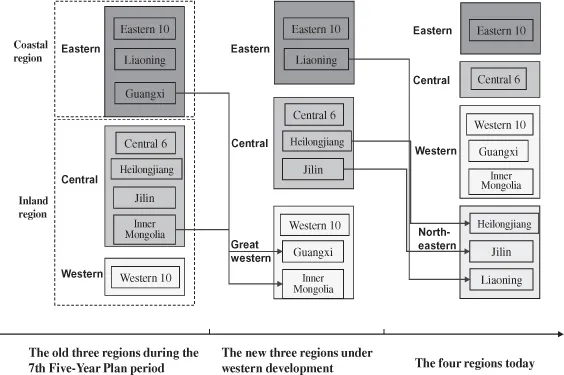
To coordinate regional economic development, the government adopted a strategy to develop the western region in 1999. Apart from the 10 western provinces (municipalities and autonomous regions included, thereafter shortened as “provinces”) listed in the Seventh Five-Year Plan, the policy covered Guangxi (originally part of eastern region), Inner Mongolia (originally part of central region), the Yanbian Korean autonomous prefecture of Jilin province, the Enshi Tujia and Miao autonomous prefecture of Hubei province, and the Xiangxi Tujia and Miao autonomous prefecture of Hunan province. In the administrative unit of provincial level, this arrangement gave rise to the concept of “10 + 2” great western region and formed the division of the nation into new three major regions in the aforementioned strategy. The government thereafter adopted a strategy to revitalize the northeastern region and another strategy to facilitate the rise of the central region. By the time of the Eleventh Five-Year Plan (2006–2010), the nation has been divided into four regions: eastern region, central region, western region, and northeastern region, with 10 provinces in eastern region, and 6 provinces in central region (see Figure 1-1).
Judging from the economic relations and the degree of economic integration, the central region, as it stands today, cannot be counted as an integral region, still less an economic region. Economic disparity is an outstanding problem in both the eastern and western regions. In the western region, there is a yawning gap between its southwest and northwest regions, while in the eastern region, development is lopsided among the Yangtze River Delta (YRD), the Pearl River Delta (PRD), the Shandong Peninsula, and the Beijing–Tianjin–Hebei region.2 Only the northeastern region appears to be a relatively integral economic region.3
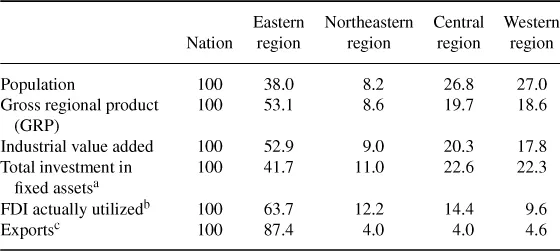
In this chapter, I adopt the Eleventh Five-Year Plan’s division of China into four regions. The eastern region includes Hebei, Beijing, Tianjin, Shandong, Shanghai, Jiangsu, Zhejiang, Fujian, Guangdong, and Hainan; the northeastern region spans Liaoning, Jilin, and Heilongjiang; the central region covers six provinces: Shanxi, Henan, Anhui, Hubei, Hunan, and Jiangxi; and the western region consists of 12 provinces: Inner Mongolia, Guangxi, Shaanxi, Gansu, Ningxia, Qinghai, Xinjiang, Chongqing, Sichuan, Guizhou, Yunnan, and Tibet. According to Table 1-2, the eastern regionhas 38.0% ofthe country’s total population but makes up 53.1% ofthe nation’s total gross regional product (GRP) and 52.9% of the total industrial value added, 41.7% of the total investment in fixed assets, 63.7% of the total value of Foreign Direct Investment (FDI) actually utilized, and 87.4% of the nation’s total exports. In contrast, the percentages of economic aggregates of both central and western regions in the national total are much smaller than their respective portions in the nation’s total population. This disequilibrium in the distribution of economic activity and population is a major cause behind the serious lopsidedness in regional economic development and the glaring regional disparity in China. In 2010, the eastern region registered a per capita GRP of RMB 46,354, as against RMB 34,303 for the northeastern region, RMB 24,242 for the central region, and RMB 22,476 for the western region. A comparison between the provinces reveals that the per capita GRP of Shanghai was the highest in the nation; it is 5.6 times that of Guizhou province. The gap can be even more pronounced when comparisons are drawn among cities and counties and among townships and towns.
Figure 1-1Three Times Main Changes in the Economic Division of China in Recent Years. This comprises the 10 eastern provinces (Eastern 10): Beijing, Tianjin, Hebei, Shandong, Jiangsu, Shanghai, Zhejiang, Fujian, Guangdong, and Hainan; the six central provinces (Central 6): Shanxi, Henan, Anhui, Hubei, Hunan, and Jiangxi; the 10 western provinces (Western 10): Sichuan, Chongqing, Guizhou, Yunnan, Tibet, Shaanxi, Gansu, Ningxia, Qinghai, and Xinjiang.
Source: Wei Houkai et al. (2005). A Study On the Readjustments of Industrial Location in China, Institute of Industrial Economics, CASS.
Table 1-2 Percentages of Major Economic Indicators for China’s Four Regions in National Total in 2010 (%).
a Investment not classified by regions account for 2.4%.
b Data in 2009.
c Computed by the origin of commodity supplies.
Source: China Statistical Yearbook (2011) and Support System for China Statistics Application. FDI actually utilized in 2009 for Beijing is missing and that of Shaanxi and Xinjiang from statistical bulletin.
1.2Disequilibrium in Regional Economic Development: A Growing Tendency
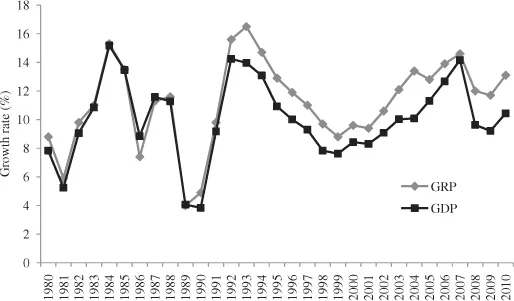
A prevalent misconception in the academic world and among government departments is to compare the GRP growth rates of different regions directly with the nation’s GDP growth rate announced by the National Bureau of Statistics of China (NBSC). This unavoidably leads to mistaken judgments because of the incomparability between GRP and GDP statistics. In fact, the total GRP for the 31 provinces, autonomous regions, and municipalities is a lot higher than the GDP released by the NBSC. Before the statistics were adjusted according to economic survey figures, GRP outstripped GDP by 9.7%, 11.7%, 15.5%, and 19.3%, respectively, in 2001, 2002, 2003, and 2004. Even after the statistics were adjusted in the second economic census, GRP still exceeded GDP by 7.7%, 7.6%, 5.2%, 6.1%, 7.2%, and 8.9% from 2005 to 2010. Of the 31 provinces, autonomous regions, and municipalities, the growth rates of most provincial GRPs are higher than the national GDP growth rate from 2005 to 2010, and only Beijing and Shanghai registered a GRP growth rate slightly lower than that of GDP in 2010. Figure 1-2 indicates that the differentials of growth rate between GDP and GRP have kept growing since 1992.4 According to the NBSC, the nation’s 2010 GDP growth rate stood at 10.4%, while the GRP growth rate averaged 13.1%, with a difference of 2.7 percentage points.5 For this reason, the summarized figures concerning all the 31 provinces, municipalities, and autonomous regions must be used when comparing the GRP growth rate or the per capita GRP of a given region. Failing to do so can only lead to illogical conclusions.
Figure 1-2 Comparisons between GDP and GRP Growth Rates in China during the 1980–2010 Period.
Source: China’s Regional Economies in 17 Reform and Opening-up Years, A Compendium of Statistics for New China’s 50 Years, and the China Statistical Yearbook concerning various years, compiled by the NBSC.
Table 1-3 gives an overview of the GRP growth rates of the four regions duringthe 1980–2010 period. Over the years, the situation of China’s unbalanced regional economic growth until 2006 was that growth was rapid in the eastern region but slow in the central, western, and northeastern regions. The year 2007 was an important turning point, when the western region’s GDP growth rate reached 14.9%, higher than that of the eastern region and the regional average of 14.6%. After 2008, the economic growth rate in the northeastern, central, and western regions were all higher than that in the eastern region, showing a relatively balanced growth situation. During the 1980–1990 period, the annual GRP rate averaged 10.2% in the eastern region, 8.8% in the central and western region, and a meager 8.1% in the northeastern region. In the post-1991 years, the growth rate disparity between the eastern region and the other regions began to expand drastically as the nation speeded up its transition toward the market economy. During the 1991–1998 period, the eastern region registered an average annual GRP growth rate of 14.7%, whereas the figures were 12.0% for central region, 10.4% for western region, and 9.5% for northeastern region. The disparity between eastern region and the rest of the country has somewhat narrowed since 1999 as a result of the implementation of the aforementioned gove...