![]()
Progress of Township Governance Studies
Since the township institution rehabilitated more than 20 years ago, it has undergone a set of reformations, such as “merger and abolishment of township”, “simplification of working load and decentralization”, “composite reform of county–township institutions”, “reformation of tax and fee at village level”. The initiation of every reform has reached a certain degree of achievement; however, every reform has also repeatedly caused new problems. Consequently, these problems which interweave and influence each other have led to the complicated plights of township currently. The research of this chapter begins at the change of policy and progress of study. On the one hand, I would like to review the related policies, especially development of policies and processes of evolution regarding the designation of the township institution. On the other hand, the literature review concentrates on the developmental process of questionnaires, research methods, research findings, and policy opinions. The following part will introduce the questions and strategies of this research.
1.1.Policy Description and Comment
Observing the developmental process of China’s grassroots regime after the reformation, we find that the actual development of township government is about the original good intention of policy designation, which unfortunately has fallen into a new dilemma. This dilemma is over the systematic cycle of “relaxation will cause the disorder, the disorder will cause the close, and the close will cause the demise”. More important, the complicated transformation of rural politics, economy and social lives placed unlimited problems at grassroots society reformation level. That is, the formation of current hardship on the grassroots government is a product of the interaction of dual relationship between institutional designation and actual operation.
1.1.1.Policy tracking
The background of current township regime can be traced to the end of 70s and the beginning of 80s. The responsibility system opened the prelude of reformation and released the huge potential energy of peasants, which brought about the rapid development of rural economy. Simultaneously, the commune system, which “had merged the political and economic power” as the agent of nation, employed the way of class struggle to control and assume the task of developing the rural economy and managing the rural society. How to reintegrate the rural society and structure of the new political regime became the key problems in the forefront of reformation.
Some grassroots governments had actively supported the separation of government and commune management when they faced the sever demand of reorganizing the villages’ order and rebuilding the grassroots regime. The first one was the Goanghua county government in April 1979, and this reformation produced certain positive effects. Nevertheless, the macro institution remained unchanged. As a result, the reorganization of county level was incompatible with the provincial and prefecture levels, which in turn led to the end of reformation at the county level. Hence, this reformation was transferred to the level of grassroots communes, and set up several pilots. These pilots in turn transformed to the more grassroots levels of government; that is, the commune had transformed to township government. This transformation did not change the employment of personnel, but divided the functions of the government, party and enterprise among different departments. This concrete and specific reformation was very extensive, such as dealing with the enterprise owned by the commune, redistributing work of communal cadres, contacts with the production team, distributing the profits and so on. Meanwhile, some people spontaneously conducted the self-rule of villagers. According to the current information, the earliest areas that implemented the self-rule of villagers are the counties of Yizhou and Luochen at the Hochi prefecture in Guangxi province. Because nobody wanted to manage the public affairs after the fulfillment of household responsibility system, people in these areas decided to institute the code of conduct and set up an organization to manage the public affairs administered by the previous brigade. This is the formation of village committee. This autonomous organization brought positive solution to problems such as forcibly occupied arable land, fighting, illegally slashing of the forest in mountain areas, stealing and gambling. This is the earliest reformation of township and village.
In November 1982, the “Drafting Report of Revisionary Constitution” formally submitted its report to the National People’s Congress for deliberation. “Regarding the Chapter of National Institution” proposed to “strengthen the establishment of local regime under the central leadership”, “changed the system of commune characterized with merger of political and economic power and instituted the political regime. The commune was the only one of the organizational formations in the rural collective economy. This change has facilitated to fasten the establishment of rural regime, and was positive to the development of collective economy”. The draft requested that the specifically implemented separation of political and economic works is an exquisite work, and all parts of the country must undertake this work step-by-step in accordance with the local conditions rather than doing it in a perfunctory manner. In December 1982, the National People’s Congress passed the new revised “Constitution of the People’s Republic of China”, where Article 95 regulates that “People’s congresses and people’s governments are established in townships, nationality townships and towns”. On the 31 December 1982, the Politburo discussed and passed the resolution of “Current Problems of Rural Economic Policy”, and indicated the two-way reformation of commune system that is the fulfillment of household responsibility system and separated the political and management functions of commune system”. “The commune system, which merged both political and management functions, must be changed for separating the political and management powers, and this work of change must be well prepared and organized step-by-step. Before the separation of political and management functions, the commune and brigade had seriously assumed the original administrative works, and guaranteed the process of usual work normally. After the separation of government and management functions, the establishment of regime at grassroots level must follow the constitution”. In October 1983, the “Notification of Establishment of Township Government Regarding the Fulfillment of Separating the Political and Management Works” issued by the Central Committee of Chinese Communist Party (CCP) and the State Council requested that the “current system of merging governmental and economic functions is not suitable for the reformation of rural economic system. The constitution clearly stipulated to set up the township government in rural area, and governmental power of township must separate from the management power. Currently, the most urgent work is to establish the township government with separate powers over governmental and economic apparatus. Concurrently, the party branch must be established at township level, and then gradually set up the economic organization in accordance with the demand of production and intention of mass”.
During that time, the central government did not clearly propose a level regarding the scale of township, and regulated the “province, municipality, and autonomous region to decide the establishment and division of townships, nationality townships and towns. The scale of township was based on the administrative district of previous commune to appropriately divide the previously large administrative areas into smaller ones. During the process, the important task is the establishment of towns. A town with certain conditions may set up the town government to promote the development of rural economy and cultural affairs. The village committee, the autonomous organization of grassroots mass, may set up the residential condition of villagers”. From the official document (Policy Research Center, Ministry of Civil Affairs, 1999, p. 868), the designation of institution in that time was to separate the political power from the commune and transfer it to the newly formed people’s government. The commune only retained the function of economic organization. All parts of the country gradually fulfilled the separation of political and economic power. That is, the agricultural responsibility system and separation between the political and economic power comprised the major thinking of central government regarding the reformation of grassroots regime.
Following the restoration of the township government, the reformation too followed. In September 1986, the Central CCP and State Council issued the No. 22 document (“Notification Regarding the Strengthened the Constructive Works of Grassroots Regime at Rural Area”), which clearly reflected the reformative thinking of the 80s. This notification pointed out that “the reformation of grassroots regime at rural area was the important component of the reformation of political institution. Because the time regarding the reformation of grassroots regime was not quite long, the supplementary policies related with this reformation had not been set up yet, and construction of grassroots regime at rural area had led to a host of problems. For example, the relationship between party government and business had not clearly divided the roles of each other, some parts had not separated the political, governmental and economic power, and a few local governments had not fully functioned”. “Despite the establishment of township government and economic organization at township level in some parts of the county, the responsibility between political and economic works has not completely separated. A certain number of township governments have not staffed the personnel for economic affairs, and those local governments were only interested in turning the economic power into the economic organization at township level. As a result, there was no separation between political and economic division”. For solving the above problems, the notification proposed seven requests, such as “clear division between political and governmental works and appropriate arrangement of relationship between political and governmental departments”, “solve the problem of party secretary of township charged with the administrative works”, “fulfillment of the task of separation between political and business works for promoting the development of villages”, “streamline administration and decentralization to strengthen the function of township government”, “practical solutions for the selfestablishment of township regime”, “improvement of cadres’ quality and their working attitudes”, “working for the establishment of village committee”, “strengthening the leadership regarding the establishment work of grassroots regime at rural area”. This document viewed the increasing and complementary establishment of grassroots regime in the countryside as an “important composition of political institution reformation”. From the political and economic sphere and three levels of village, township and county systematically proposed the ideas to complete establishment of township regime. The document explained and described the major problems, such as “self-rule of villagers”, “the relationship between different vertical and horizontal bodies (tiao and kuai)”, “the relationship between party and government”, and “fiscal establishment”. Afterward, the initial statement of important polices regarding the reformation of township regime could be found in this document.
This official document issued by the central level also emphasized the reformation of county level. First, it focused on solving the problem of lack of clear division between party and government and between upper and lower levels. This document required the party and governmental bodies of county and above county level “to reasonably solve the division of work between party and government, and follow the rule of division of work between party and government to lead the task of basic level. Those tasks which belong to government were not assigned to the party secretary of township”. Moreover, “it required to promote the comprehensive reformation of county level, and both reformation of economic system and political institution would need to act in concert with each other, and the institutional reformation of above the county level also coordinates with the reformation of basic level for strengthening the system of regime at basic level”. This document also specifically defined the economic function managed by the township government, and demanded that “the township government must be staffed with full-time cadres to accord with the practical condition for implementing the management work of economic affairs”. Secondly, this document emphasized to solve the conflict of tiao and kuai. “So far, many departments of county government had set up their branches in the township level to extend their power of management to the subordinate level. As a result, the township government found it hard to coordinate and manage every task with its administrative district. The fragmentary tiao and kuai must be reformed gradually, and the basic principle of reformation was to streamline the administration and decentralization. The third one was to promote the fiscal establishment. This official document asked “all parts of the country to set up the fiscal department in township levels as soon as possible”, left some fiscal profit to township level through overcharge, and “promoted the active enrichment at grassroots for fastening the rural construction”. From the perspective of these policies, the main thinking of reformation was to set up the township government for a more comprehensive regime at the basic level. However, when we observe and retrospect the practical process of reformation after 20 years, the expected result has not appeared when compared with the original thinking.
1.1.2.Process of reform
Since the promulgation of the official document of “Notification Regarding the Strengthened the Constructive Works of Grassroots Regime at Rural Area” in 1986, the reformation of township government has made a great effort on merging township, division of powerful structure, and governing structure, and these efforts have won certain positive effects. Nevertheless, the basic objective of reformation has not yet reached in 21st century.
1.1.2.1.First, merger of township and town
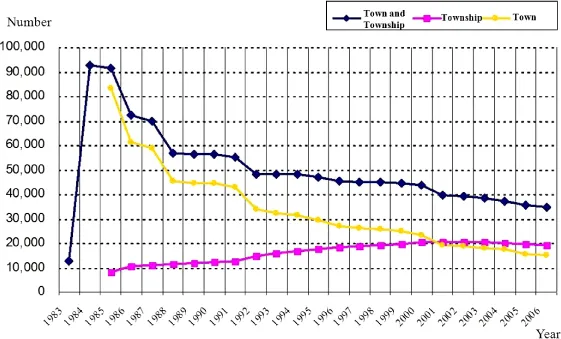
So far, the most progressive part of reformation at the basic level is the merger of township and town. This is the only policy that has reached the expected objective (see Figure 1).
Figure 1 :Changes in Total Number of Towns and Townships (1983–2006).
In October 1983, the Central Committee of CCP and State Council issued the “Notification of Establishment of Township Government Regarding the Fulfillment of Separating the Political and Management Works” and requested to abolish the commune and to set up the township government. This notification regulated the “scale of township, which was based on the administrative area of previous commune. If the administrative area of previous commune is too large, the area of township could appropriately divide into smaller parts”. “The staff number of township was not over the number of current commune, and the specific rule arranged by the province, municipality, and people’s autonomous region”. In fact, the level of provincial government was the practical decision-maker regarding the establishment of township, therefore, the local level had more “space of operation” and flexibility. Afterward, it initiated the process of establishing township, and the administrative areas of such new townships were smaller than previous commune especially the largely increasing number of administrative towns. In late October 1983, 9,028 communes had fulfilled the separation of political and management powers among 902 counties (city, district) in China, and these counties totally set up 12,786 township governments. About 176 out of 902 counties had completely established the township government within their administrative areas.1 Up to the end of 1984, the task of “abolishment of commune and establishment of township” had completed, and nationwide, 92,476 township governments and 8,119 district offices were established.2
After the establishment of township government, a new problem emerged, that the scale of most township government was quite small. Because the partial budget of township government was through the allocation of county government, and part of budget collected from the grassroots, the excessive number of townships increased the administrative cost and led the heavy financial burden among peasants. Therefore, it was necessary to reduce the number of townships for decreasing the number of grassroots governments and burden of peasants. Since 1986, the policy integrated the “Notification Regarding the Strengthened the Constructive Works of Grassroots”, and the first round regarding the merger of townships was implemented nationwide. Up to the end of 1986, the nationwide number of townships immediately dropped from 91,385 in 1985 to 72,135,3 thus reducing the number to less than 19, 250 from the previous year.4 Under the dominance of government, merger of townships continued to progress on a large scale, and the consequence of this policy was the clearly decreased number of townships during 1986 to 1996. According to the statistical numbers from the Ministry of Civil Affairs, the total number of townships nationwide was 45, 277, and less by 26,905 than 10 years ago. The number of townships decreased 34,359, the number of towns increased 7,457, and the number of administrative villages approximately decreased 100,000.5
The number of townships in China was approximately 45,000 during 1996 to 1999. In the 21st century, the government has paid more attention on the policy of merger of townships. The reformation of rural tax and fee started in Anhui province as the pilot, and later this policy was implemented in other provinces. The reformation of rural tax and fee, which aims on the reduction of peasants’ burden, has provided a new opportunity to reformation of township bodies. On 24 July 2000, the Central Committee of CCP and State Council issued the “Notification of Pilot Work Regarding the Reformation of Rural Tax and Fee” to ask the “county and township government to solve the problem of decreasing income through several ways, such as transformation of governmental function, reduction of organizations, compression of the payroll staff, and adjustment of expenditure structure”.6 On 26 December, the Central Committee CCP and State Council issued their report on “Regarding the Opinion of Downsizing Personnel at the Level of City, County and Township”, and pointed out that “the qualified areas where there is no negative effect on the social stability and has positive effect on the economic production and development, and is conducive to the establishment of small-scale township should be chosen to merge with the township. In January 2001, the Central Committee of CCP and State Council issued the “Opinion Regarding Doing the Works of Agriculture and Village in 2001”. In March 2001, the Fourth Session of the Ninth National People’s Congress passed the “The Tenth Five-Year Plan for National Economic and Social Development of the People’s Republic of China”. Both the documents proposed the merger of township government to reach the goals of streaml...