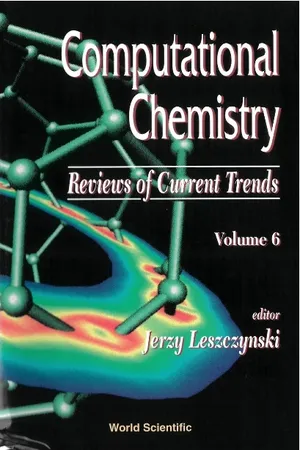
There are strong indications that, in the 21st century, computational chemistry will be a prime research tool not only for the basic sciences but also for the life and materials sciences. Recent developments in nanotechnology allow us to detect a layer of single atoms. Researchers are able not only to image but also to manipulate molecules and atoms. It does not take much imagination to realize that before performing such a task on a real system it is much easier and faster to study models on computers. That is the aim of this volume — it provides up-to-date reviews which cover representative areas of computational chemistry.In Chapter 1, Y Ishikawa and M J Vilkas provide a review of multireference Moller-Plesset (MR-MP) perturbation theory. Fifteen years ago Roberto Car of Princeton University and Michele Parrinello of Max Planck Institute introduced a method that revolutionized electronic structure calculations for molecules, liquids and solids. Ursula Rothlisberger, a former member of Parrinello's group, reviews the formation of the method in its most common implementations in Chapter 2. In the third chapter, Isaac B Bersuker describes the general theory of the combined quantum mechanics-molecular mechanics (QM/MM) approach. In Chapter 4, Marcel Allavena and David White present a review of applications of computational chemistry to proton transfer, the primary process for acid-base chemistry on zeolites. Chapter 5 is a review by S Roszak and J Leszczynski of recent data on the clusters formed from the charged ion and weakly interacting ligands. The last chapter, contributed by Carlos R Handy, is devoted to recent developments in the incorporation of continuous wavelet transform analysis into quantum operator theory.
eBook - PDF
Computational Chemistry: Reviews Of Current Trends, Vol. 6
- 277 pages
- English
- PDF
- Available on iOS & Android
eBook - PDF
Computational Chemistry: Reviews Of Current Trends, Vol. 6
About this book
Information
Topic
Physical SciencesSubtopic
Physical & Theoretical ChemistryTable of contents
- CONTENTS
- Preface
- Chapter 1: Relativistic Multireference Moller-Plesset Perturbation Theory
- Chapter 2: 15 Years of Car-Parrinello Simulations in Physics Chemistry and Biology
- Chapter 3: Methods of Combined Quantum/Classical (QM/MM) Modeling for Large Organometallic and Metallobiochemical Systems
- Chapter 4: A Review of Ab Initio Calculations on Proton Transfer in Zeolites
- Chapter 5: Ionic Clusters with Weakly Interacting Components-Magic Numbers Rationalized by the Shell Structure
- Chapter 6: Turning Point Quantization and Scalet-Wavelet Analysis
- Bibliography
- Index
Trusted by 375,005 students
Access to over 1.5 million titles for a fair monthly price.
Study more efficiently using our study tools.
Frequently asked questions
Yes, you can cancel anytime from the Subscription tab in your account settings on the Perlego website. Your subscription will stay active until the end of your current billing period. Learn how to cancel your subscription
No, books cannot be downloaded as external files, such as PDFs, for use outside of Perlego. However, you can download books within the Perlego app for offline reading on mobile or tablet. Learn how to download books offline
Perlego offers two plans: Essential and Complete
- Essential is ideal for learners and professionals who enjoy exploring a wide range of subjects. Access the Essential Library with 800,000+ trusted titles and best-sellers across business, personal growth, and the humanities. Includes unlimited reading time and Standard Read Aloud voice.
- Complete: Perfect for advanced learners and researchers needing full, unrestricted access. Unlock 1.5M+ books across hundreds of subjects, including academic and specialized titles. The Complete Plan also includes advanced features like Premium Read Aloud and Research Assistant.
We are an online textbook subscription service, where you can get access to an entire online library for less than the price of a single book per month. With over 1.5 million books across 990+ topics, we’ve got you covered! Learn about our mission
Look out for the read-aloud symbol on your next book to see if you can listen to it. The read-aloud tool reads text aloud for you, highlighting the text as it is being read. You can pause it, speed it up and slow it down. Learn more about Read Aloud
Yes! You can use the Perlego app on both iOS and Android devices to read anytime, anywhere — even offline. Perfect for commutes or when you’re on the go.
Please note we cannot support devices running on iOS 13 and Android 7 or earlier. Learn more about using the app
Please note we cannot support devices running on iOS 13 and Android 7 or earlier. Learn more about using the app
Yes, you can access Computational Chemistry: Reviews Of Current Trends, Vol. 6 by Marcel Allavena, Isaac B Bersuker, Carlos R Handy in PDF and/or ePUB format, as well as other popular books in Physical Sciences & Physical & Theoretical Chemistry. We have over 1.5 million books available in our catalogue for you to explore.